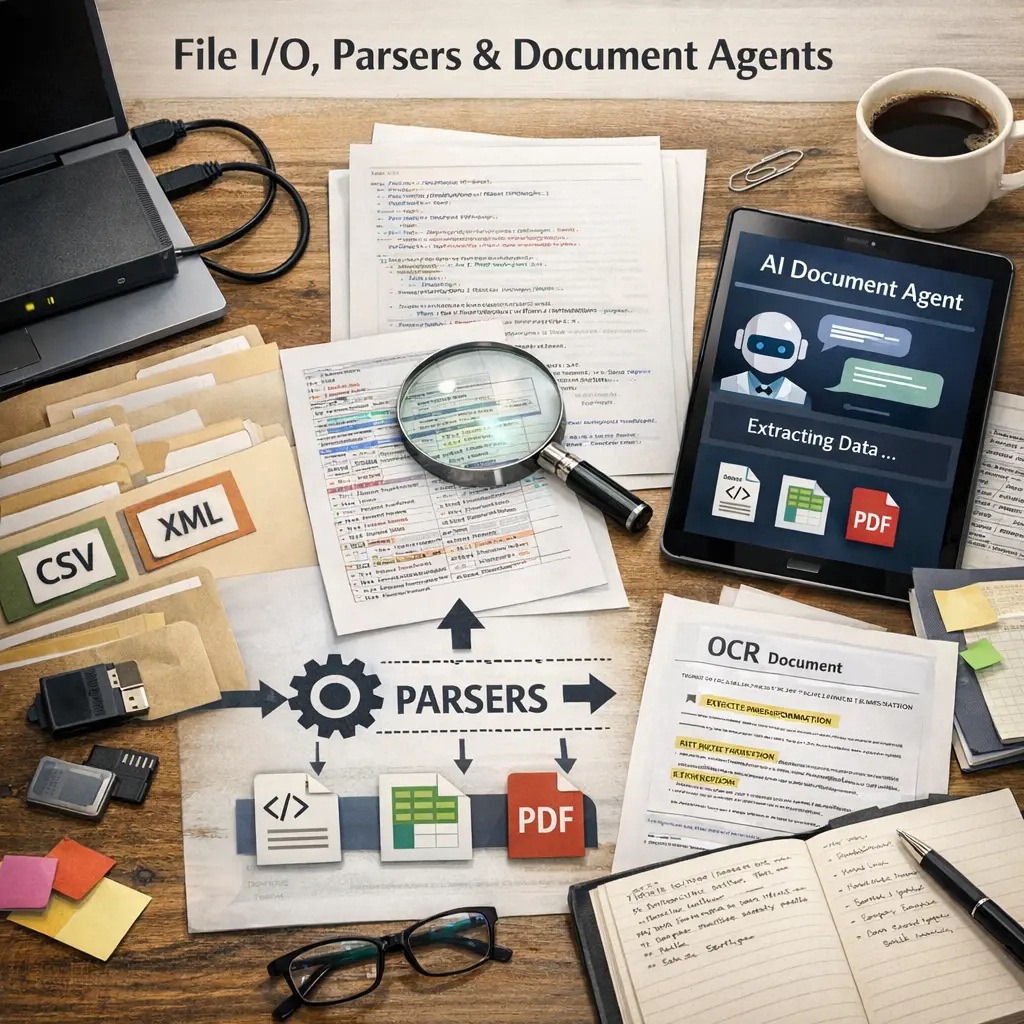
File I/O, Parsers & Document Agents (Agent Architecture) refers to a system design where specialized software agents handle the input and output of files, parse different document formats, and process their content. File I/O manages reading and writing data, parsers interpret and extract meaningful information from documents, and document agents coordinate these tasks within an agent-based architecture, enabling modular, scalable, and automated document processing workflows.
File I/O, Parsers & Document Agents
File I/O, Parsers & Document Agents (Agent Architecture) refers to a system design where specialized software agents handle the input and output of files, parse different document formats, and process their content. File I/O manages reading and writing data, parsers interpret and extract meaningful information from documents, and document agents coordinate these tasks within an agent-based architecture, enabling modular, scalable, and automated document processing workflows.
💡 Key Takeaways
- Grasp the core File I/O concepts: reading, writing, and handling files from disk or streams.
- Understand parsers: how they interpret and transform text data (JSON, XML, CSV) into usable data structures.
- Learn what document agents do: automate document workflows, extraction, routing, and integration across systems.
- Consider practical aspects: encoding, error handling, and basic validation in file processing and parsing.
❓ Frequently Asked Questions
What is file I/O?
File I/O is the process of reading from and writing to files using software interfaces, enabling persistent data storage and retrieval.
What is a parser?
A parser reads raw data in a specific format (like JSON, XML, or CSV) and converts it into a structured in-memory representation, often validating syntax as it goes.
What are document agents?
Document agents are software components that automatically process documents—for example classifying, extracting data, transforming content, and routing results—often using parsers and natural language processing.
How do file I/O, parsers, and document agents work together?
Files supply the raw data; parsers decode and validate this data into structured objects; document agents then use those objects to extract information, make decisions, and trigger downstream actions.