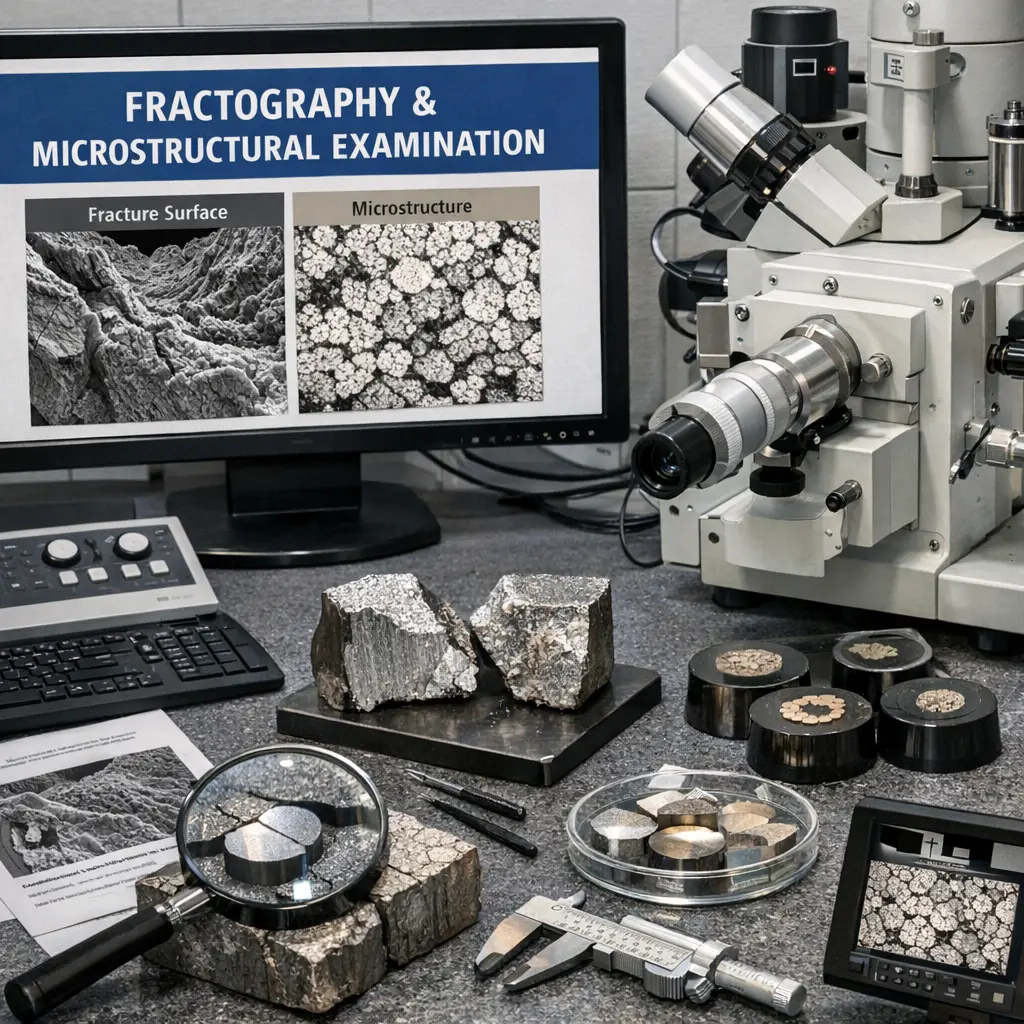
Fractography and microstructural examination are analytical techniques in materials science used to study the features and causes of material failure. Fractography involves examining fracture surfaces, typically with microscopes, to identify fracture modes and origins. Microstructural examination assesses the internal structure of materials, such as grain size, phases, and defects, using optical or electron microscopy. Together, these methods help determine failure mechanisms and improve material performance and reliability.
Fractography and Microstructural Examination
Fractography and microstructural examination are analytical techniques in materials science used to study the features and causes of material failure. Fractography involves examining fracture surfaces, typically with microscopes, to identify fracture modes and origins. Microstructural examination assesses the internal structure of materials, such as grain size, phases, and defects, using optical or electron microscopy. Together, these methods help determine failure mechanisms and improve material performance and reliability.
💡 Key Takeaways
- Recognize and classify fracture surfaces (ductile, brittle, fatigue) from fractography images.
- Understand how microstructure features (grain size, phases, inclusions) influence fracture behavior and toughness.
- Learn preparation and imaging techniques for fractography and microstructure examination (polishing, etching, optical and SEM microscopy).
- Interpret fracture and microstructural features to diagnose failure causes and guide improvements in materials or processing.
- Relate observed features to processing history and service conditions (heat treatment, alloy composition, loading, environment).
❓ Frequently Asked Questions
What is fractography and why is it used in failure analysis?
Fractography is the study of fracture surfaces to identify how a component failed—its origin, crack growth, and fracture mode (ductile, brittle, fatigue, etc.). It uses surface features to determine the cause and guide improvements.
How can you tell if a fracture is ductile or brittle from the fracture surface?
Ductile fracture shows a rough surface with dimples from micro-void coalescence; brittle fracture has flat, faceted surfaces with cleavage patterns and little plastic deformation.
What techniques are commonly used for microstructural examination?
Optical metallography (polishing/etching), scanning electron microscopy (SEM), and diffraction/analysis methods such as EBSD or EDS to map grains, phases, and composition.
How does microstructure influence fracture behavior?
Grain size, phase distribution, and inclusions control crack initiation and propagation. Finer grains and well-distributed phases generally improve toughness, while coarse grains or large inclusions can promote crack formation and brittle fracture.