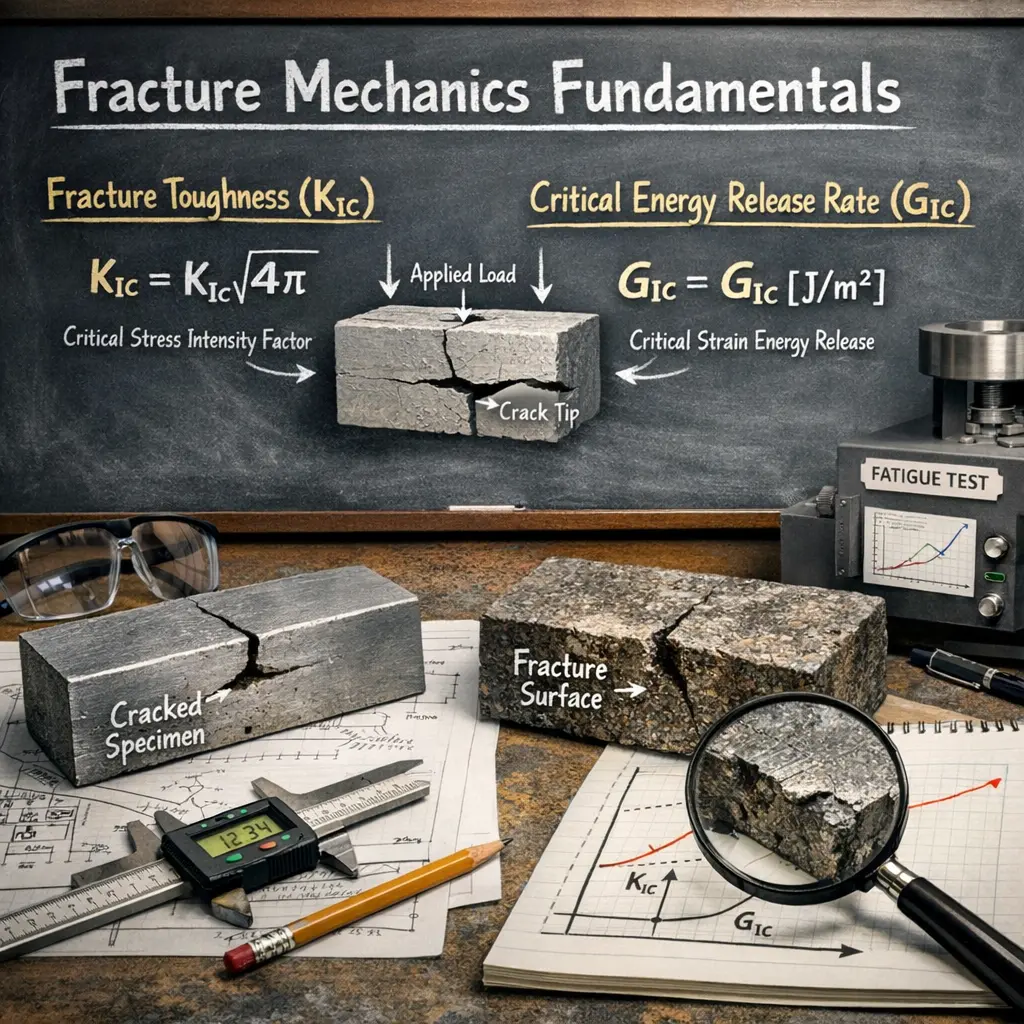
Fracture Mechanics Fundamentals involve studying how and why materials crack or fail under stress. Key parameters include KIC (fracture toughness in mode I, or opening mode) and GIC (critical energy release rate in mode I). These properties help engineers predict a material’s resistance to crack growth, ensuring safe and reliable design in structures. Understanding KIC and GIC is essential in materials science for preventing catastrophic failures in engineering components.
Fracture Mechanics Fundamentals (KIC, GIC)
Fracture Mechanics Fundamentals involve studying how and why materials crack or fail under stress. Key parameters include KIC (fracture toughness in mode I, or opening mode) and GIC (critical energy release rate in mode I). These properties help engineers predict a material’s resistance to crack growth, ensuring safe and reliable design in structures. Understanding KIC and GIC is essential in materials science for preventing catastrophic failures in engineering components.
💡 Key Takeaways
- Understand what fracture toughness is and why it matters for preventing crack growth under stress.
- Know what K_IC (critical stress intensity factor) indicates about crack initiation under Mode I loading.
- Know what G_IC (critical energy release rate) indicates about resistance to crack propagation.
- Learn how K_IC and G_IC relate under linear elastic fracture mechanics and how to use them in material selection and safe design.
❓ Frequently Asked Questions
What are K_IC and G_IC, and what do they measure?
K_IC is the critical stress intensity factor for Mode I crack opening; it quantifies resistance to crack growth under tensile opening. G_IC is the critical energy release rate for Mode I crack growth; it represents the energy required to propagate a crack per unit area (units: MPa√m and J/m^2, respectively).
How are K_IC and G_IC related?
In linear elastic fracture mechanics, G = K^2 / E', so G_IC = K_IC^2 / E'. E' is the effective modulus (E for plane stress, E/(1-ν^2) for plane strain).
How are K_IC and G_IC determined experimentally?
K_IC is usually determined from fracture-toughness tests like compact tension (CT) or single-edge notch bending (SENB) per standards such as ASTM E399. G_IC can be obtained from energy-based tests like double cantilever beam (DCB) tests or by converting K_IC to G_IC using the material's modulus.
What is Mode I fracture, and why are these constants important?
Mode I is crack opening due to tensile loading perpendicular to the crack plane. K_IC and G_IC quantify a material’s resistance to crack initiation and propagation in this mode, guiding safe design and failure prediction.