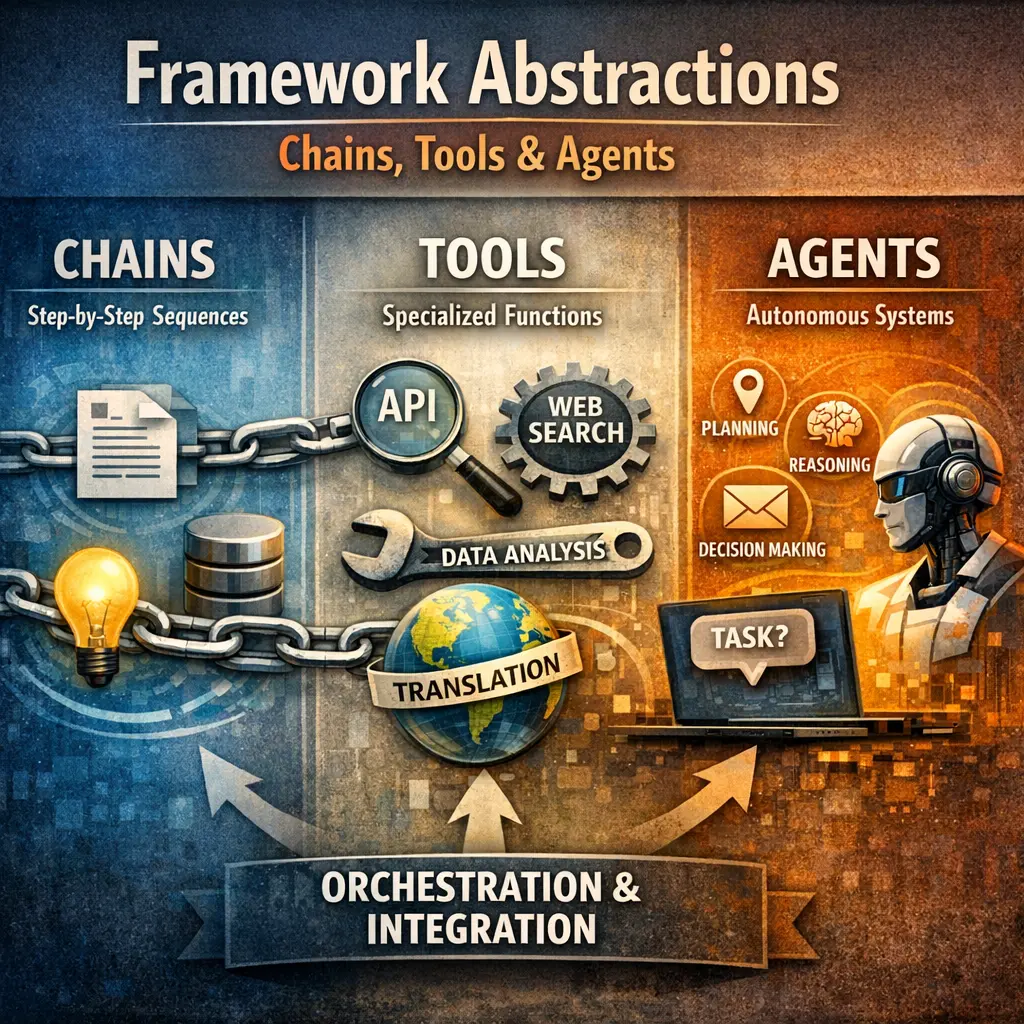
Framework abstractions like Chains, Tools, and Agents (Agent Architecture) refer to structured layers in AI systems. Chains organize sequences of tasks or operations, Tools provide specialized functionalities or capabilities, and Agents act as autonomous entities that leverage chains and tools to achieve goals. This architecture enables modularity, flexibility, and scalability, allowing complex problem-solving by combining simple, reusable components within intelligent systems.
Framework Abstractions: Chains, Tools & Agents
Framework abstractions like Chains, Tools, and Agents (Agent Architecture) refer to structured layers in AI systems. Chains organize sequences of tasks or operations, Tools provide specialized functionalities or capabilities, and Agents act as autonomous entities that leverage chains and tools to achieve goals. This architecture enables modularity, flexibility, and scalability, allowing complex problem-solving by combining simple, reusable components within intelligent systems.
💡 Key Takeaways
- Understand framework abstractions and the roles of Chains, Tools, and Agents.
- Learn how Chains model sequential steps and data flow in processing tasks.
- Discover how Tools extend a framework's capabilities by providing reusable actions.
- See how Agents orchestrate Chains and Tools to complete tasks autonomously.
❓ Frequently Asked Questions
What are framework abstractions and how do Chains, Tools, and Agents relate?
They are modular concepts for structuring AI workflows: Chains define step-by-step processing, Tools provide external capabilities, and Agents coordinate Chains and Tools to achieve goals.
What is a Chain?
A Chain is a sequence of steps where the output of one step becomes input to the next, used to perform a deterministic task or reasoning process.
What is a Tool?
A Tool is an external capability (e.g., API, calculator, search, database) that an Agent can call to perform a task or fetch information.
What is an Agent?
An Agent is an autonomous component that decides which Tools or Chains to use to achieve a user goal, often using a planning or reasoning loop.
How do Chains, Tools, and Agents work together in a task?
An Agent orchestrates Tools and Chains; Chains run defined sequences, while Tools provide capabilities the Agent can invoke to obtain data or perform actions.