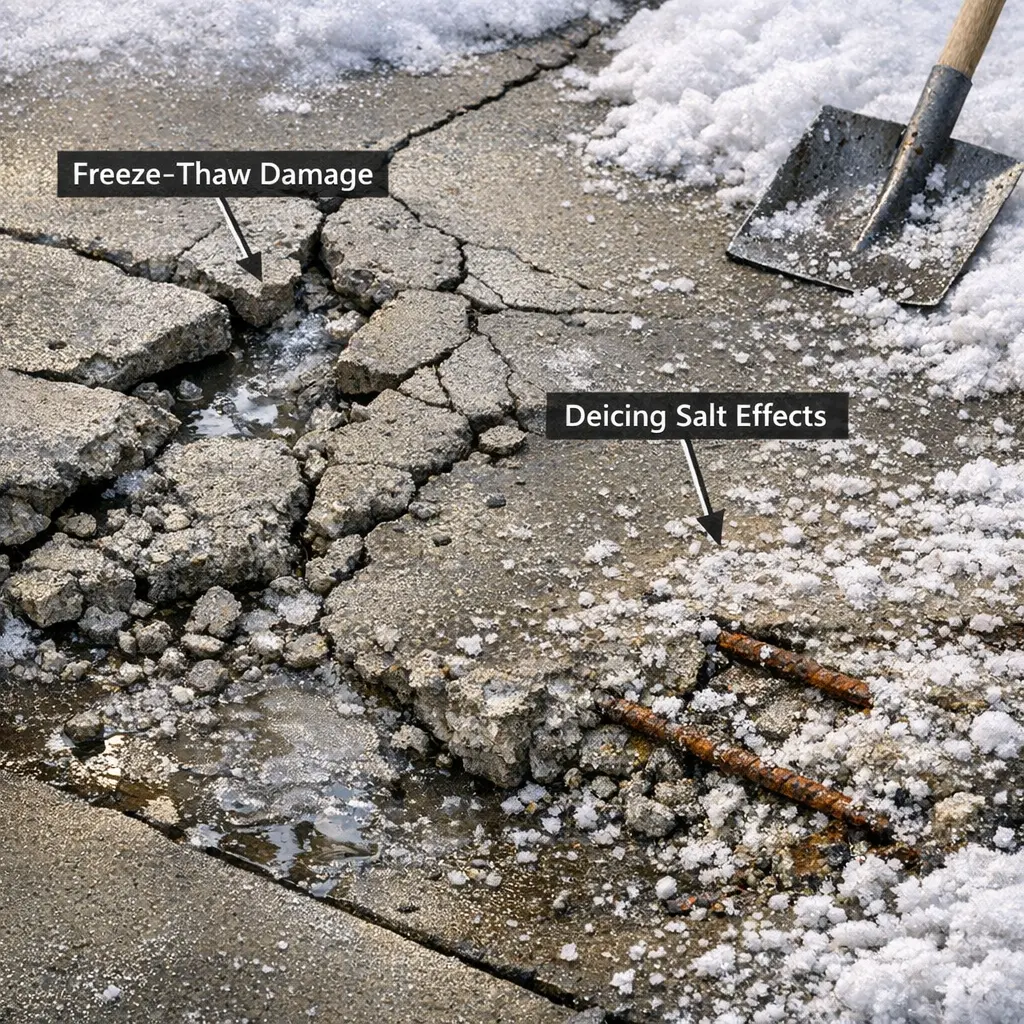
Freeze–thaw damage refers to the deterioration of materials, especially concrete and pavement, caused by repeated cycles of freezing and thawing. Water enters pores or cracks, freezes, expands, and leads to internal stresses and cracking. Deicing salts, commonly used to melt ice, can worsen this damage by increasing moisture penetration and causing chemical reactions that further degrade the material, resulting in spalling, scaling, and reduced structural integrity over time.
Freeze–Thaw Damage and Deicing Salt Effects
Freeze–thaw damage refers to the deterioration of materials, especially concrete and pavement, caused by repeated cycles of freezing and thawing. Water enters pores or cracks, freezes, expands, and leads to internal stresses and cracking. Deicing salts, commonly used to melt ice, can worsen this damage by increasing moisture penetration and causing chemical reactions that further degrade the material, resulting in spalling, scaling, and reduced structural integrity over time.
💡 Key Takeaways
- Understand how freeze–thaw cycles damage concrete and asphalt by water expanding into cracks when it freezes.
- Learn how deicing salts affect freeze–thaw damage, including salt penetration, increased moisture movement, and potential corrosion of embedded metals.
- Identify factors that influence vulnerability, such as porosity, moisture content, temperature range, and traffic loading.
- Explore mitigation strategies like air-entraining admixtures, proper curing, good drainage, and using less aggressive deicers or sealants.
❓ Frequently Asked Questions
What is freeze–thaw damage and how does it happen?
Freeze–thaw damage occurs when water in material pores freezes and expands, creating internal pressure that cracks and spalls the material. Repeated freezing and thawing cycles, especially when pores are saturated or drainage is poor, worsen the damage.
How do deicing salts influence the freeze–thaw process?
Deicing salts lower the freezing point, forming brines that stay liquid over a wider temperature range and can penetrate pores. This increases moisture exposure and refreezing cycles, promoting more cracking. Chloride ions can also promote corrosion of steel reinforcement in concrete.
Which materials are most at risk from freeze–thaw and salt damage?
Porous, saturated materials such as concrete and masonry with high water absorption, as well as asphalt bases with trapped moisture, are most at risk. Unsealed stone or brick and poorly protected surfaces are also vulnerable.
What are effective ways to reduce freeze–thaw and salt-related damage?
Improve drainage and reduce saturation; use materials with good air voids and low permeability; apply non-chloride or less aggressive deicers when possible; seal and maintain surfaces; repair cracks promptly and ensure proper curing to minimize moisture ingress.