Function calling protocols define structured ways for AI agents to interact with external tools or APIs. OpenAI’s function calling uses JSON Schema to specify expected input and output formats, ensuring reliable communication. Pydantic, a Python library, validates and enforces data types according to defined schemas. Together, these protocols enable robust agent architectures, allowing seamless, safe, and automated execution of external functions or tasks by AI systems.
Function Calling Protocols (OpenAI, JSON Schema, Pydantic)
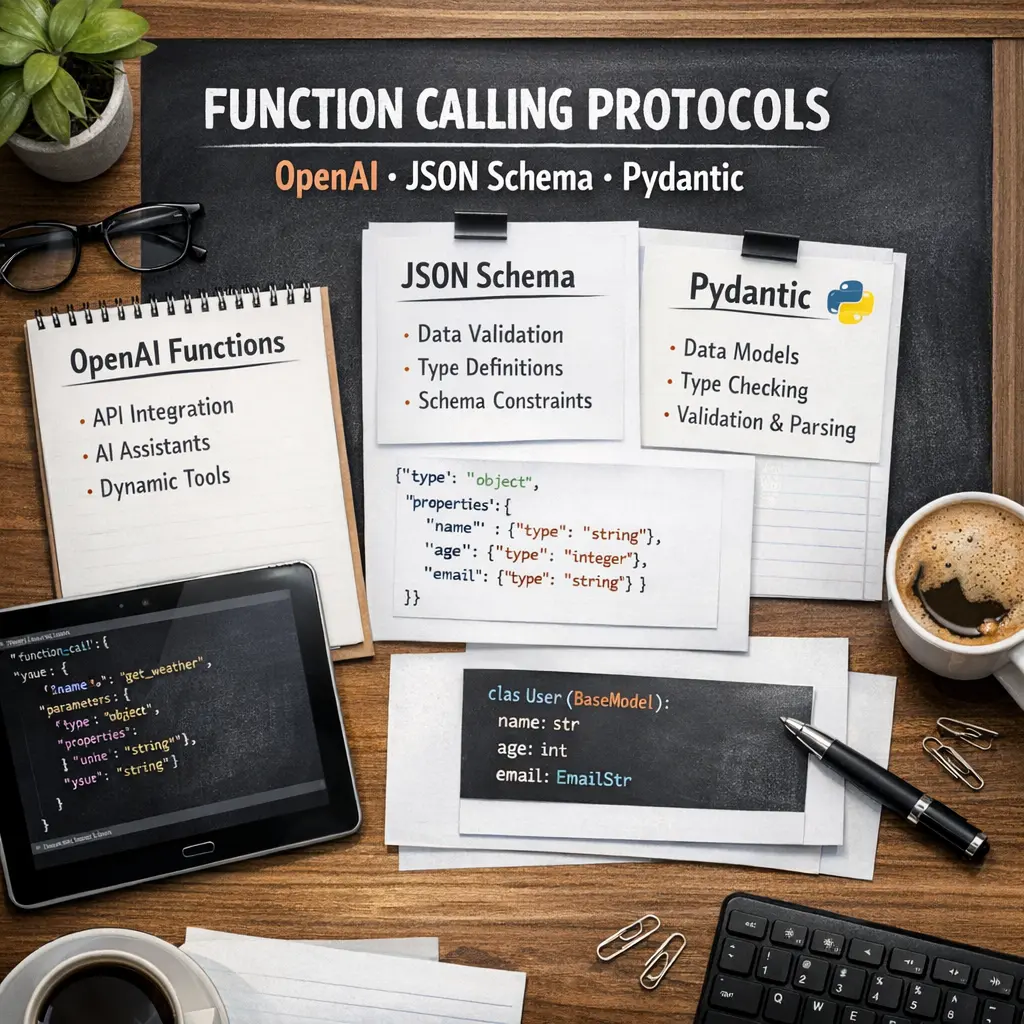
Function calling protocols define structured ways for AI agents to interact with external tools or APIs. OpenAI’s function calling uses JSON Schema to specify expected input and output formats, ensuring reliable communication. Pydantic, a Python library, validates and enforces data types according to defined schemas. Together, these protocols enable robust agent architectures, allowing seamless, safe, and automated execution of external functions or tasks by AI systems.
💡 Key Takeaways
- Understand how OpenAI’s function calling lets the model request and pass structured arguments to external functions.
- Learn to define function schemas with JSON Schema to describe parameter types, required fields, and constraints.
- Explore using Pydantic models to validate, parse, and serialize function call arguments in Python.
- Evaluate the strengths, limitations, and best use cases for OpenAI function calling, JSON Schema, and Pydantic when integrating with apps.
❓ Frequently Asked Questions
What is function calling in OpenAI?
A feature that lets the model request the execution of predefined functions by name and pass arguments, enabling your app to perform actions or fetch data during a chat.
What role do JSON Schema and Pydantic play in function calling?
They validate function arguments. JSON Schema defines the allowed shape of JSON data; Pydantic (in Python) uses typed models to validate and parse inputs before a function is called.
How do you define a function for OpenAI's function calling system?
Register a function with a name, a description, and a parameters schema that specifies each argument’s type and constraints; the model will call it with a JSON-encoded argument set.
What is a function signature in this context?
The declared name and parameter list of a callable, including expected types and validation rules, guiding the model on valid calls.