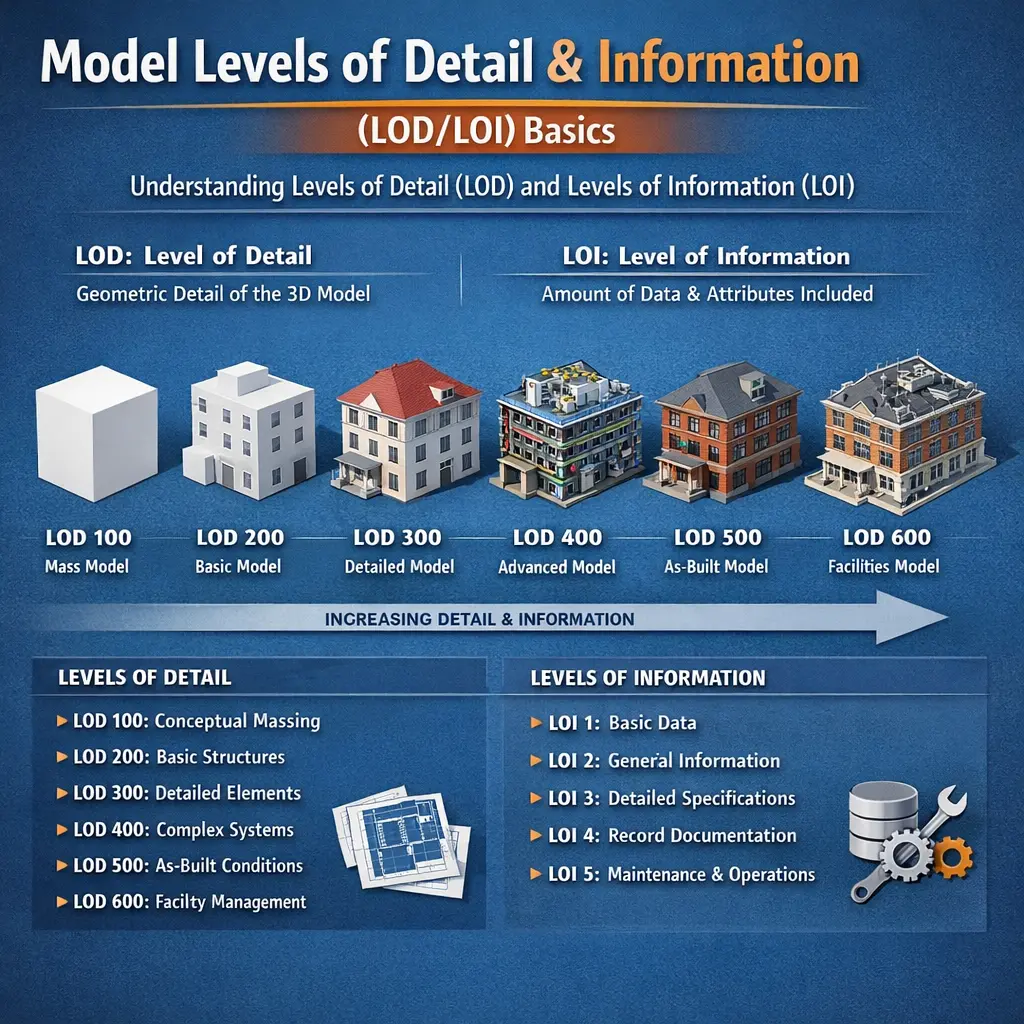
GIS-BIM Data Federation and Georeferencing refers to the integration of Geographic Information Systems (GIS) with Building Information Modeling (BIM) to create a unified digital environment for construction projects. This process enables spatial alignment and accurate location referencing of BIM data within real-world geographic contexts. By federating and georeferencing data, stakeholders gain enhanced visualization, coordination, and decision-making capabilities throughout the construction lifecycle, improving efficiency and reducing errors.
GIS-BIM Data Federation and Georeferencing
GIS-BIM Data Federation and Georeferencing refers to the integration of Geographic Information Systems (GIS) with Building Information Modeling (BIM) to create a unified digital environment for construction projects. This process enables spatial alignment and accurate location referencing of BIM data within real-world geographic contexts. By federating and georeferencing data, stakeholders gain enhanced visualization, coordination, and decision-making capabilities throughout the construction lifecycle, improving efficiency and reducing errors.

💡 Key Takeaways
- Define GIS-BIM data federation and why it matters for built environments.
- Explain how georeferencing aligns BIM models with GIS coordinate systems.
- Identify common challenges and practical solutions in GIS-BIM integration.
- Recognize standard workflows and formats used for GIS-BIM interoperability.
❓ Frequently Asked Questions
What is GIS-BIM data federation?
GIS-BIM data federation combines geographic information system (GIS) data with building information modeling (BIM) data to enable integrated analysis of location context and building details.
Why is georeferencing important for integrating GIS and BIM?
Georeferencing assigns real-world coordinates to both GIS and BIM data so they align on the same map, ensuring accurate spatial placement and consistent analysis.
What are common approaches to federating GIS and BIM data?
Common approaches include using interoperable formats (e.g., IFC for BIM, GeoPackage/GeoJSON for GIS), transforming data into a shared coordinate reference system, and linking semantic information across platforms.
What are typical challenges when federating GIS and BIM data?
Challenges include mismatched data models and schemas, differing coordinate systems, varying levels of detail, inconsistent attributes, and keeping data synchronized across systems.