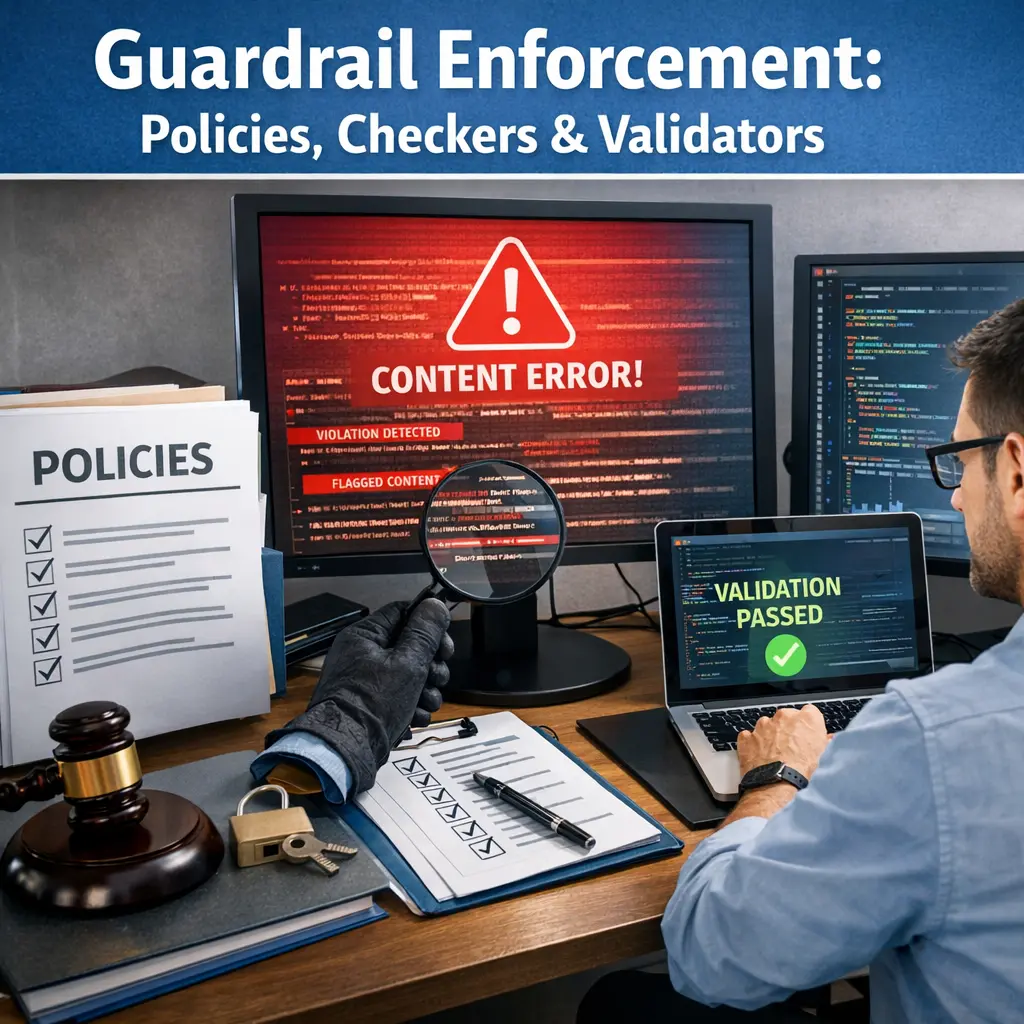
Guardrail Enforcement: Policies, Checkers & Validators (Agent Architecture) refers to a system design approach where specific guidelines (policies) are established to ensure proper agent behavior. Automated checkers and validators continuously monitor and assess agent actions against these policies, preventing errors, enforcing compliance, and maintaining safety. This layered architecture enhances reliability by integrating real-time oversight mechanisms that detect and correct deviations, ensuring agents act within defined boundaries.
Guardrail Enforcement: Policies, Checkers & Validators
Guardrail Enforcement: Policies, Checkers & Validators (Agent Architecture) refers to a system design approach where specific guidelines (policies) are established to ensure proper agent behavior. Automated checkers and validators continuously monitor and assess agent actions against these policies, preventing errors, enforcing compliance, and maintaining safety. This layered architecture enhances reliability by integrating real-time oversight mechanisms that detect and correct deviations, ensuring agents act within defined boundaries.
💡 Key Takeaways
- Define guardrails and why they matter for policy compliance and safe operations.
- Describe the roles of policies, checkers, and validators in enforcing guardrails.
- Distinguish between checkers (detect violations) and validators (prevent issues before they occur) and when to use each.
- Outline best practices for designing, implementing, and measuring effective guardrails.
❓ Frequently Asked Questions
What is guardrail enforcement?
Guardrail enforcement uses predefined policies to automatically block or flag actions that violate rules, preventing unsafe or non-compliant outcomes.
What are policies, checkers, and validators in this context?
Policies define allowable behavior or constraints; checkers scan for violations and report them; validators verify that inputs or configurations meet required criteria before proceeding.
How does guardrail enforcement work in practice?
Policies are encoded as rules; checkers run at appropriate stages (e.g., pre-commit, CI/CD, runtime); validators verify data or configurations; actions are allowed, blocked, or revised with feedback.
Where should guardrails be applied?
In software development, data pipelines, cloud deployments, and governance workflows to prevent misconfigurations, security issues, and quality problems.
How can I implement effective guardrails?
Document policies, implement automated checkers and validators, integrate them into development and deployment pipelines, monitor outcomes, and iterate based on feedback.