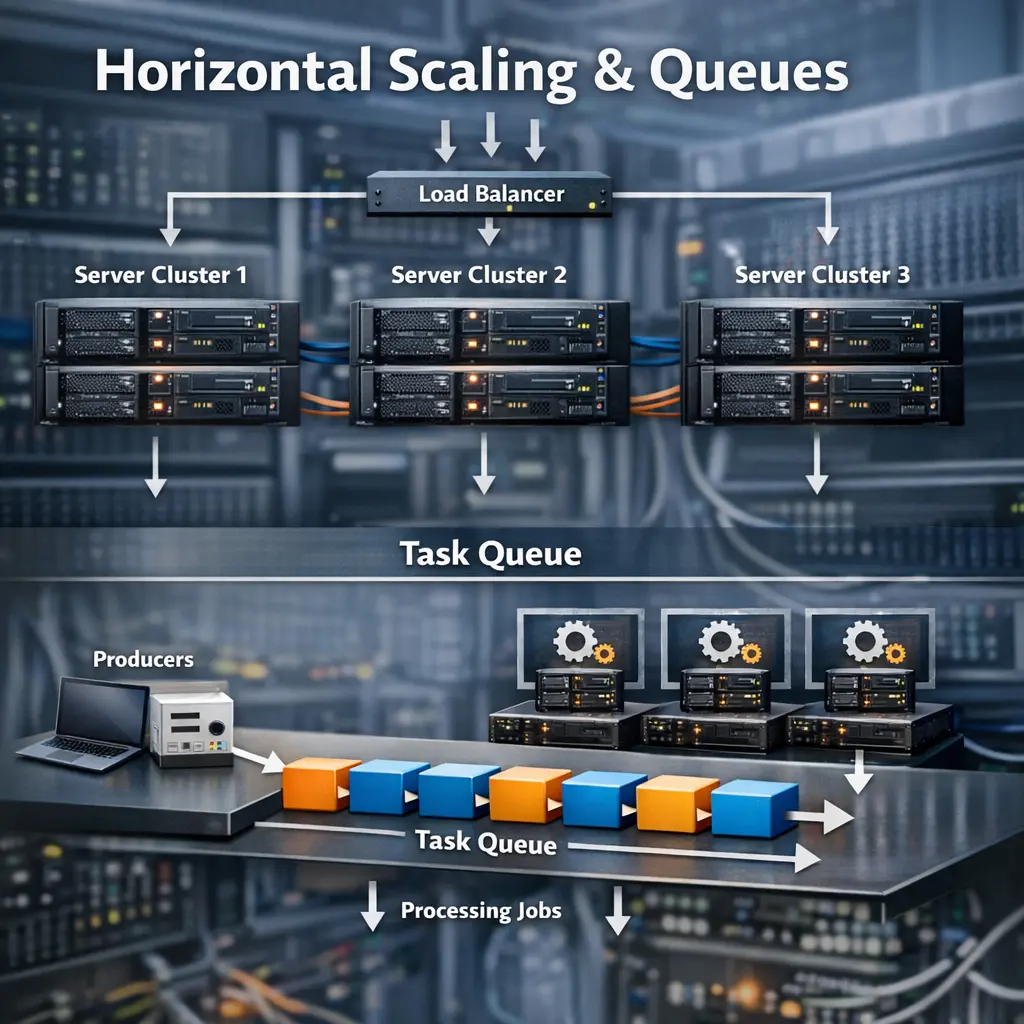
Horizontal scaling in agent architecture involves adding more instances of agents to handle increased workloads, enhancing system capacity and reliability. Queues are used to manage tasks or messages between agents, ensuring efficient load distribution and smooth processing. This approach allows the system to dynamically adapt to varying demands, prevent bottlenecks, and maintain high availability by distributing tasks across multiple agents working in parallel.
Horizontal Scaling & Queues
Horizontal scaling in agent architecture involves adding more instances of agents to handle increased workloads, enhancing system capacity and reliability. Queues are used to manage tasks or messages between agents, ensuring efficient load distribution and smooth processing. This approach allows the system to dynamically adapt to varying demands, prevent bottlenecks, and maintain high availability by distributing tasks across multiple agents working in parallel.
💡 Key Takeaways
- Understand the difference between horizontal and vertical scaling and why horizontal scaling is used to handle increasing load with multiple stateless instances.
- Learn how message queues decouple producers and consumers to absorb bursty traffic and enable parallel processing.
- Recognize common queue patterns (work queues and publish/subscribe) and how they influence scaling, ordering, and fault tolerance.
- Grasp autoscaling basics and how queues help maintain performance in distributed systems, with considerations like idempotency and data consistency.
❓ Frequently Asked Questions
What is horizontal scaling?
Adding more machines or instances to handle increased load, distributing work across multiple nodes rather than upgrading a single machine.
How do queues support horizontal scaling?
Queues decouple producers from workers, allowing many workers to pull tasks in parallel, buffering spikes and balancing work across a pool of processors.
What is a common pattern that uses horizontal scaling and queues?
The producer–consumer (work queue) pattern: producers enqueue tasks; multiple workers dequeue and process them.
What should you consider when scaling horizontally with queues?
Ensure idempotent processing, decide between at-least-once vs exactly-once delivery, manage visibility timeouts, monitor queues, and plan for stateless workers and scalable partitions.