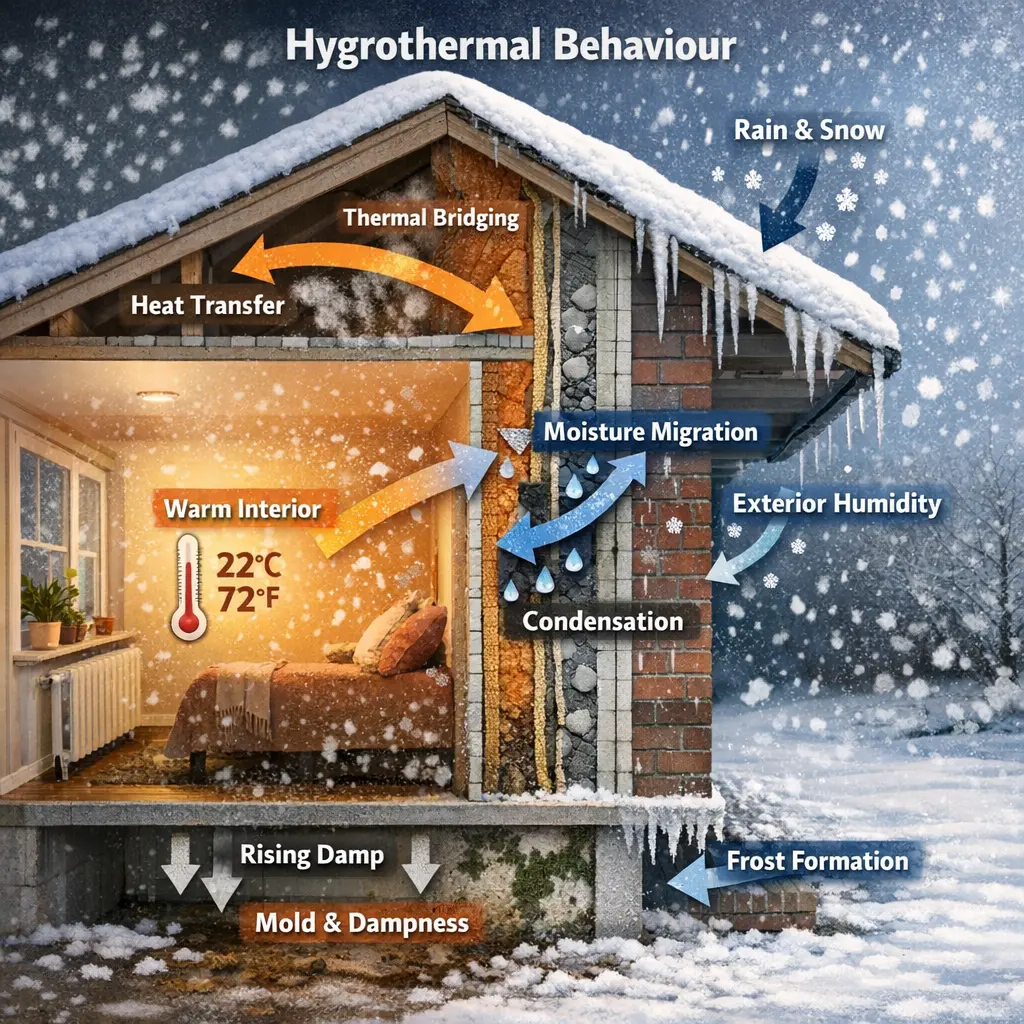
Hygrothermal behaviour refers to how materials respond to combined effects of moisture (humidity) and temperature changes. In science and materials engineering, this concept examines how water absorption, evaporation, and thermal expansion influence a material’s physical properties, durability, and performance. Understanding hygrothermal behaviour is crucial for designing buildings, insulation, and composite structures to ensure they withstand varying environmental conditions without degrading or failing.
Hygrothermal Behaviour
Hygrothermal behaviour refers to how materials respond to combined effects of moisture (humidity) and temperature changes. In science and materials engineering, this concept examines how water absorption, evaporation, and thermal expansion influence a material’s physical properties, durability, and performance. Understanding hygrothermal behaviour is crucial for designing buildings, insulation, and composite structures to ensure they withstand varying environmental conditions without degrading or failing.
💡 Key Takeaways
- Understand what hygrothermal behaviour means and why moisture and temperature together influence material properties.
- Learn how moisture movement and temperature changes can cause expansion, contraction, or degradation in materials.
- Recognize common ways to assess hygrothermal properties in simple terms (e.g., diffusion, sorption, and thermal response).
- See real-world applications such as buildings, textiles, and composites, and consider basic strategies to control hygroscopic effects through material choice and design.
❓ Frequently Asked Questions
What does hygrothermal behaviour study?
It examines how heat and moisture move through materials and how temperature, humidity, and material properties evolve together over time.
What are the main transport mechanisms in hygrothermal processes?
Heat is transferred by conduction, convection, and radiation; moisture moves by diffusion of water vapor, capillary action, and adsorption/desorption.
How does moisture affect the thermal properties of materials?
Moisture often raises a material’s thermal conductivity and can change density and heat capacity, altering heat transfer pathways in porous materials.
What is a sorption isotherm and why is it important?
A sorption isotherm links a material’s moisture content to ambient humidity at a fixed temperature, helping predict moisture storage and hygrothermal response.