
Hygrothermal Modeling and Simulation (e.g., WUFI)
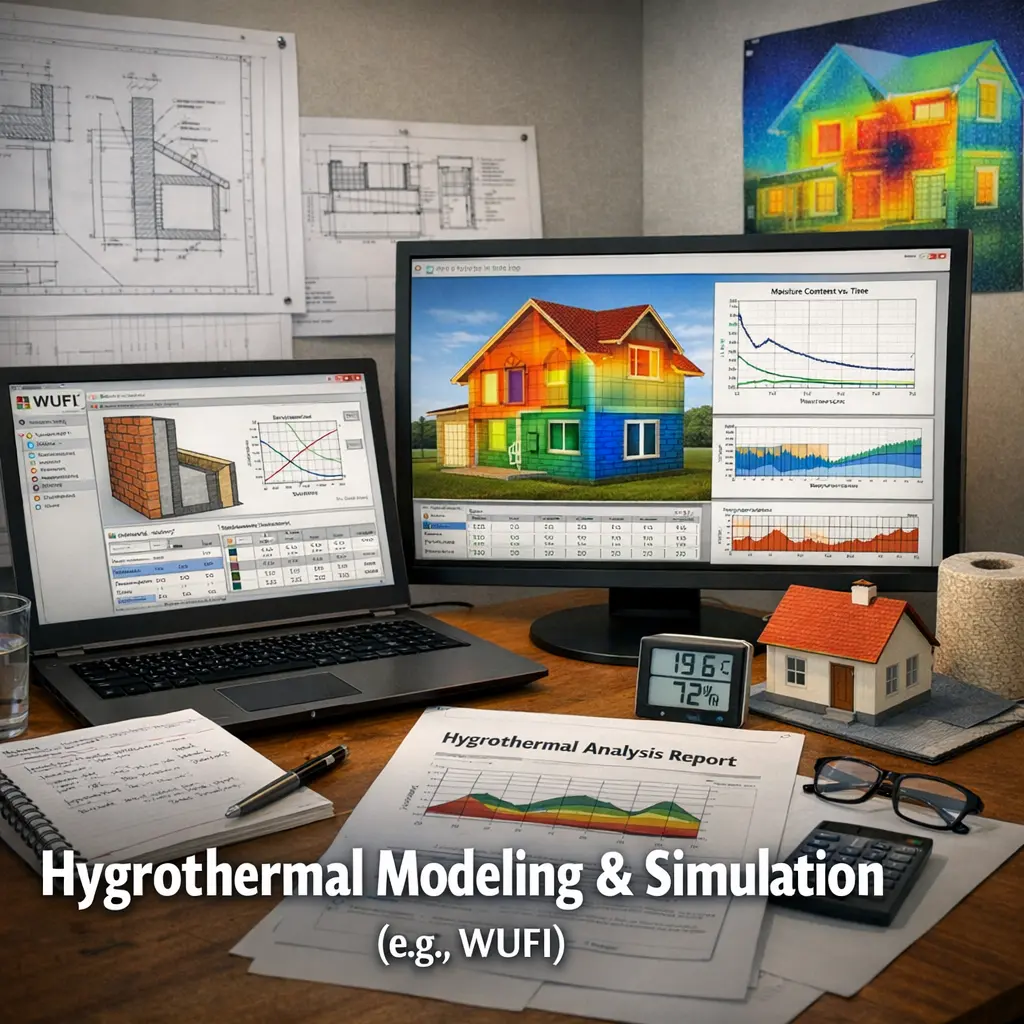
Hygrothermal modeling and simulation, such as with WUFI software, involves analyzing how heat and moisture move through building materials and assemblies. This scientific approach helps predict temperature and humidity changes within walls, roofs, or floors over time, considering climate, material properties, and construction details. The results guide material selection and design strategies to prevent issues like mold, condensation, and structural damage, ensuring energy efficiency and durability in buildings.
Hygrothermal Modeling and Simulation (e.g., WUFI)
Hygrothermal modeling and simulation, such as with WUFI software, involves analyzing how heat and moisture move through building materials and assemblies. This scientific approach helps predict temperature and humidity changes within walls, roofs, or floors over time, considering climate, material properties, and construction details. The results guide material selection and design strategies to prevent issues like mold, condensation, and structural damage, ensuring energy efficiency and durability in buildings.
💡 Key Takeaways
- Grasp how heat and moisture move together in building envelopes and how this hygrothermal coupling affects comfort and durability.
- Understand what hygrothermal modeling tools like WUFI do, simulating temperature, moisture, and humidity over time with real climate data.
- Learn how to set up a model: choose materials, boundary conditions, climate data, and initial conditions.
- Learn to interpret results to assess condensation risk, moisture damage, and effective retrofit or ventilation strategies.
❓ Frequently Asked Questions
What is hygrothermal modeling?
A simulation of heat and moisture transport in building materials over time, predicting temperatures, moisture content, and humidity to assess performance and risks like condensation.
What is WUFI and what is it used for?
WUFI is a hygrothermal simulation tool that models coupled heat and moisture transport in building components using climate data, helping assess condensation risk, moisture loads, and energy performance.
What inputs are needed to run a hygrothermal model (e.g., WUFI)?
Climate data (hourly temperature, humidity, radiation), material properties (thermal conductivity, density, moisture diffusivity, sorption isotherms), layer stack geometry, boundary and initial moisture conditions.
What outputs does the software provide and how should they be interpreted?
Outputs include time-varying temperatures, relative humidity, moisture content across layers, and condensation risk indicators; use them to identify high-risk areas and guide design or material choices.