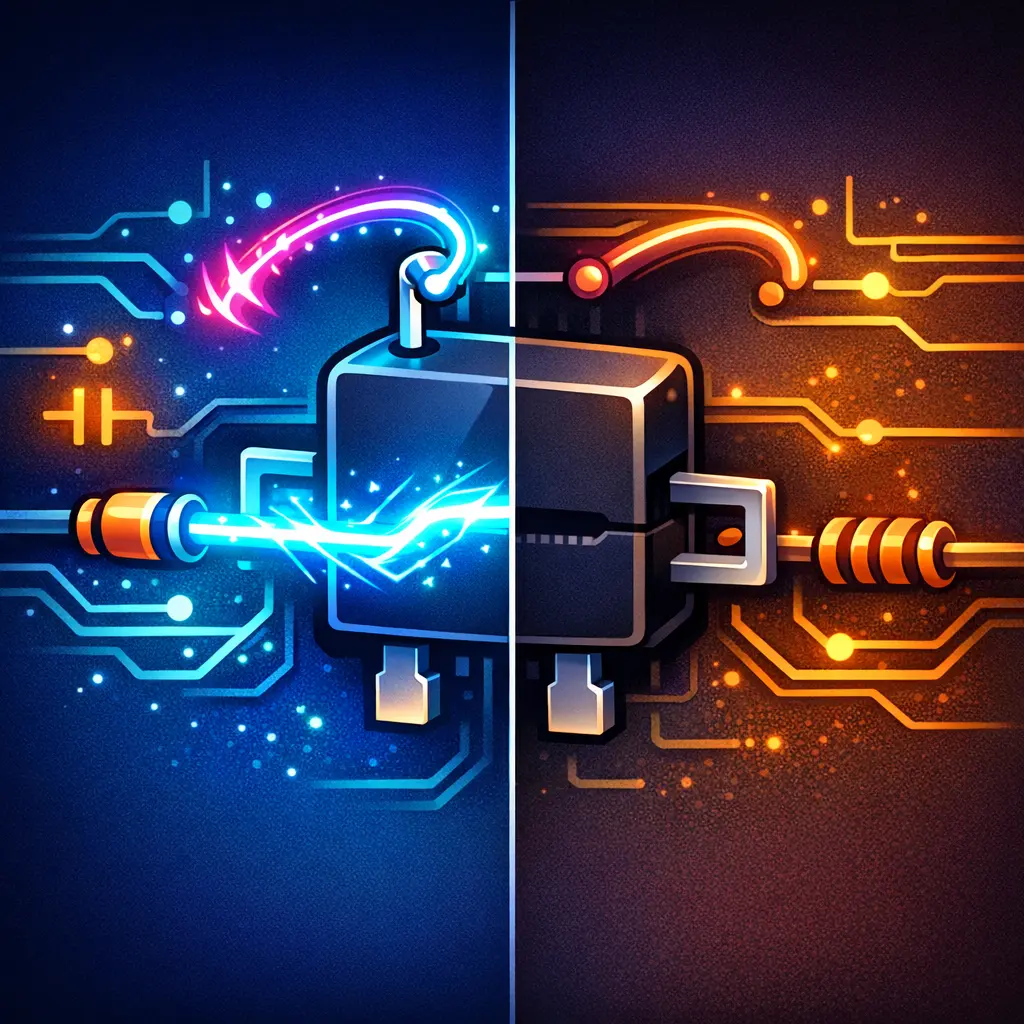
An ideal op-amp assumes infinite open-loop gain, infinite input impedance, zero output impedance, infinite bandwidth, and zero offset voltage, making it perfect for theoretical analysis. In reality, op-amps exhibit nonidealities such as finite gain, limited bandwidth, nonzero input and output impedances, input bias currents, offset voltages, and slew rate limitations. These nonideal characteristics affect circuit performance, causing deviations from expected behavior in practical electronic applications.
Ideal vs real op-amp nonidealities
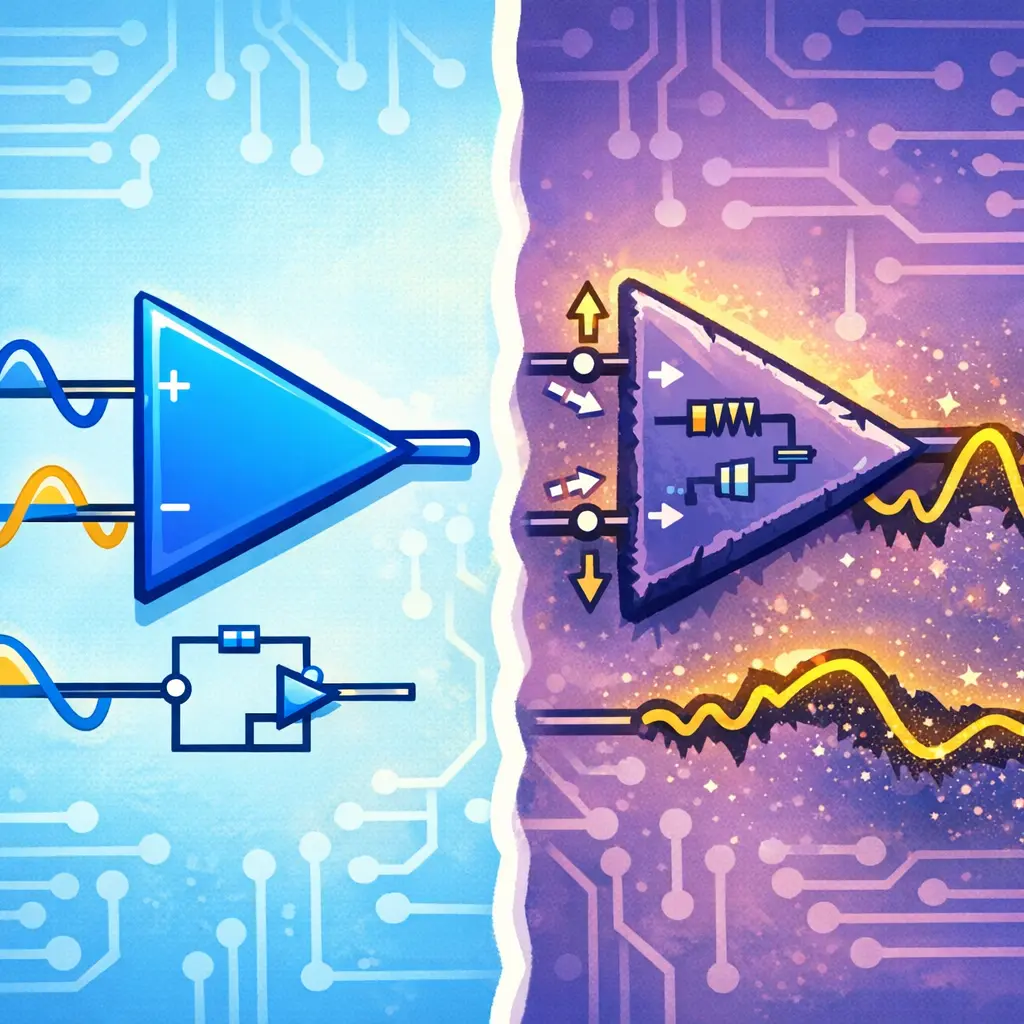
An ideal op-amp assumes infinite open-loop gain, infinite input impedance, zero output impedance, infinite bandwidth, and zero offset voltage, making it perfect for theoretical analysis. In reality, op-amps exhibit nonidealities such as finite gain, limited bandwidth, nonzero input and output impedances, input bias currents, offset voltages, and slew rate limitations. These nonideal characteristics affect circuit performance, causing deviations from expected behavior in practical electronic applications.
💡 Key Takeaways
- Compare ideal op-amp assumptions (infinite gain, infinite input impedance, zero output impedance) with real nonidealities and how they affect circuits.
- Understand finite gain-bandwidth and slew rate and how they limit closed-loop accuracy and transient response.
- Explain input offset voltage and bias currents, how they create output offsets, and simple compensation techniques for high-impedance sources.
- Recognize output saturation, rail-to-rail limitations, common-mode range, and how supply rails constrain voltage swings and loading.
- Identify temperature effects and noise (offset drift, voltage/current noise) on precision op-amp designs and basic mitigation strategies.
❓ Frequently Asked Questions
What is the difference between an ideal op-amp and a real op-amp?
An ideal op-amp has infinite gain, infinite input impedance, zero input current, zero output impedance, and infinite bandwidth. A real op-amp has finite gain, finite input/output impedances, small input bias currents, finite bandwidth, and nonzero offsets.
How does finite open-loop gain affect the accuracy of a closed-loop amplifier?
Finite gain introduces a small error in the closed-loop gain and can cause slight phase error. The deviation depends on the feedback factor and decreases as gain increases, but it worsens at higher frequencies as the open-loop gain falls.
What is slew rate and why does it matter?
Slew rate is the maximum rate at which the output voltage can change (V/µs). If the needed output change is faster than the slew rate, the waveform distorts (slew-rate limiting).
What is input offset voltage and how does it affect the output?
Input offset voltage is the tiny differential voltage that must be applied between inputs to drive the output to zero. It causes a DC offset at the output equal to the offset multiplied by the closed-loop gain.
What is gain-bandwidth product and why is it important?
GBW limits the trade-off between gain and bandwidth. In a closed-loop circuit, increasing gain reduces bandwidth; you can’t have both very high gain and wide bandwidth beyond the op-amp’s GBW.