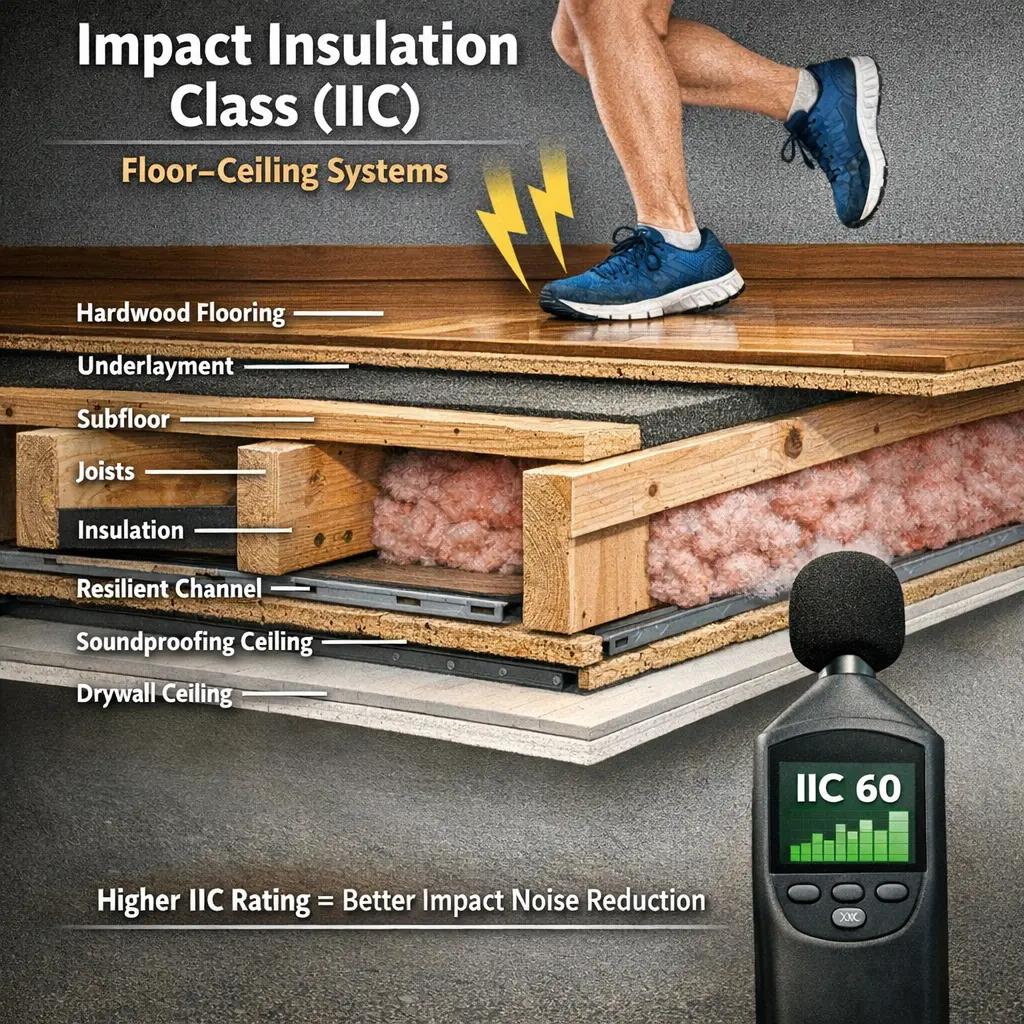
Impact Insulation Class (IIC) is a rating that measures a floor-ceiling system’s ability to reduce impact sound transmission, such as footsteps or dropped objects, between building levels. Higher IIC values indicate better sound insulation performance. Floor-ceiling systems combine materials like concrete, wood, insulation, and resilient underlayments to enhance both structural support and acoustic separation, helping to create quieter, more comfortable spaces in multi-story buildings.
Impact Insulation Class (IIC) and Floor–Ceiling Systems
Impact Insulation Class (IIC) is a rating that measures a floor-ceiling system’s ability to reduce impact sound transmission, such as footsteps or dropped objects, between building levels. Higher IIC values indicate better sound insulation performance. Floor-ceiling systems combine materials like concrete, wood, insulation, and resilient underlayments to enhance both structural support and acoustic separation, helping to create quieter, more comfortable spaces in multi-story buildings.
💡 Key Takeaways
- Understand that IIC measures how well a floor–ceiling assembly blocks impact sound between floors.
- Learn which elements of a floor–ceiling system influence the IIC rating (joists, underlayment, finish materials).
- Distinguish IIC from airborne sound ratings like STC and when each rating matters.
- Identify common methods to improve IIC (adding mass, decoupling, resilient channels, acoustic underlayment, carpeting).
- Apply considerations to specify or select floor–ceiling assemblies with higher IIC for better occupant comfort.
❓ Frequently Asked Questions
What is the Impact Insulation Class (IIC)?
IIC is a rating that measures how well a floor–ceiling assembly reduces impact noise (like footstep sounds) transferring between dwellings or rooms on different floors. Higher IIC indicates better impact sound isolation.
How is IIC measured?
IIC is determined in a standard test (ASTM E492) using a tapping machine to simulate footsteps on the floor and microphones in the receiving room to quantify transmitted impact sound. The result is an IIC rating.
What factors affect IIC in a floor–ceiling system?
Mass, stiffness and damping of the structure; decoupling between floor and ceiling (e.g., resilient channels or a floating floor); underlayment and finishes; and flanking paths influence IIC.
How can you improve the IIC of a floor–ceiling assembly?
Increase decoupling (floating or decoupled ceilings), add mass/damping (thicker underlayment or gypsum board), use carpet or resilient underlayment, and minimize flanking paths.
How is IIC different from STC, and why does it matter?
IIC measures impact noise (footstep sounds) between spaces, while STC measures airborne noise (voices, music). Both affect privacy, but improving one rating doesn’t guarantee improvements in the other.