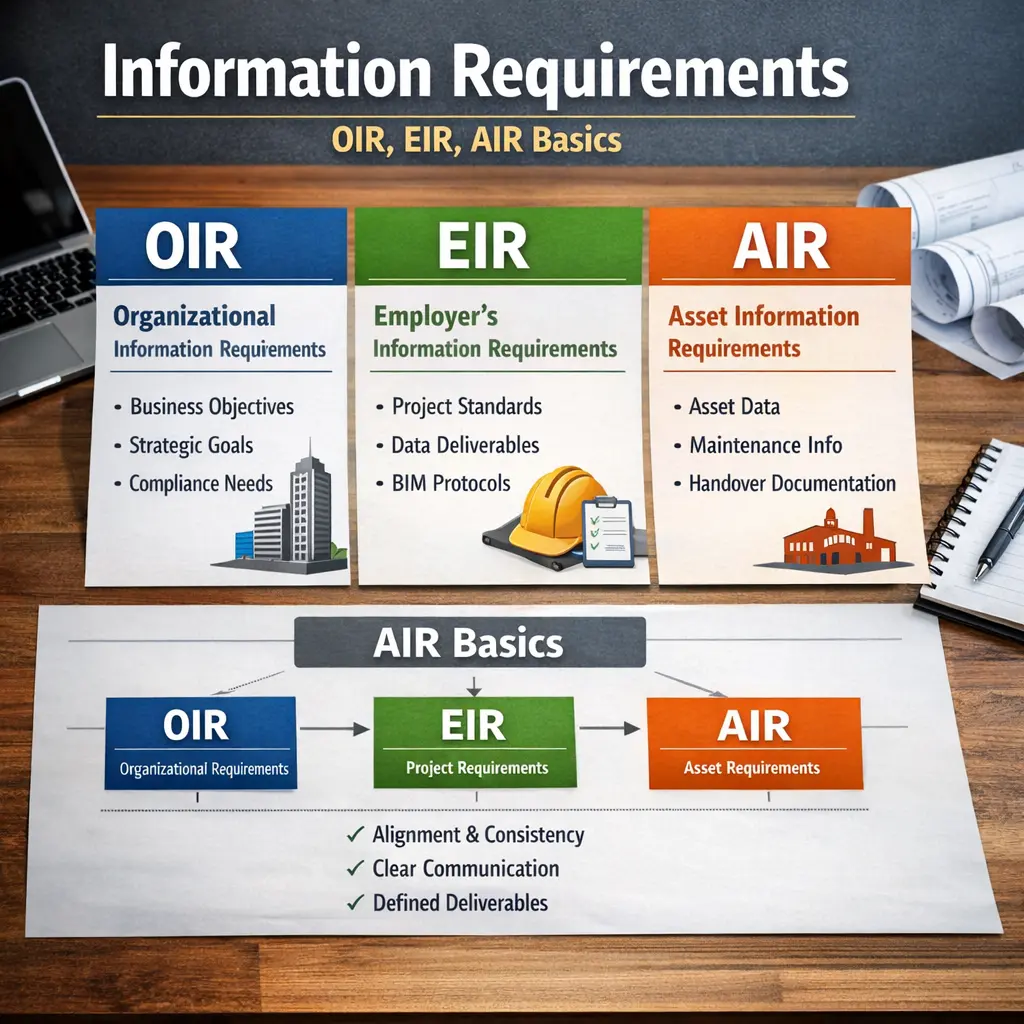
Information Requirements in digital construction refer to the structured needs for project data and documentation. OIR (Organizational Information Requirements) define what an organization needs to operate and manage assets. EIR (Exchange Information Requirements) specify information needed at project milestones for decision-making or asset delivery. AIR (Asset Information Requirements) outline data necessary for asset operation and maintenance. Together, these ensure the right information is delivered at the right time throughout a construction project’s lifecycle.
Information Requirements: OIR, EIR, AIR Basics
Information Requirements in digital construction refer to the structured needs for project data and documentation. OIR (Organizational Information Requirements) define what an organization needs to operate and manage assets. EIR (Exchange Information Requirements) specify information needed at project milestones for decision-making or asset delivery. AIR (Asset Information Requirements) outline data necessary for asset operation and maintenance. Together, these ensure the right information is delivered at the right time throughout a construction project’s lifecycle.
💡 Key Takeaways
- Understand what information requirements are and why OIR, EIR, and AIR matter.
- Distinguish the scope of OIR, EIR, and AIR to know when to use each type.
- Learn how to capture and document information needs for OIR, EIR, and AIR from stakeholders.
- Practice tracing information requirements through design, testing, and deployment.
❓ Frequently Asked Questions
What do OIR, EIR, and AIR stand for in information requirements?
OIR = Operational Information Requirements (information needed to operate and support a system); EIR = Engineering Information Requirements (information required for design, development, testing, and verification); AIR = Acquisition/Administrative Information Requirements (information needed to procure, manage, and administer the program). Note: terms can vary by context.
How do the three types differ in their primary purpose?
OIR focuses on operation and support; EIR focuses on design/development and verification; AIR focuses on procurement, contracts, and program management.
What information is typically included in each type?
OIRs include operator needs, maintenance data, training, and safety requirements. EIRs include design data, interfaces, standards, and verification criteria. AIRs include procurement data, data deliverables, contract requirements, and regulatory/compliance documentation.
How are OIR, EIR, and AIR used during a project's lifecycle?
They define what information must be produced, when it’s due, and who is responsible, ensuring designs are verifiable, operations are supported, and procurement and governance requirements are met.
Can information requirements overlap among OIR, EIR, and AIR?
Yes. Some information packages may satisfy more than one category, but each has a primary focus: operation/support (OIR), design/engineering (EIR), or acquisition/administration (AIR).