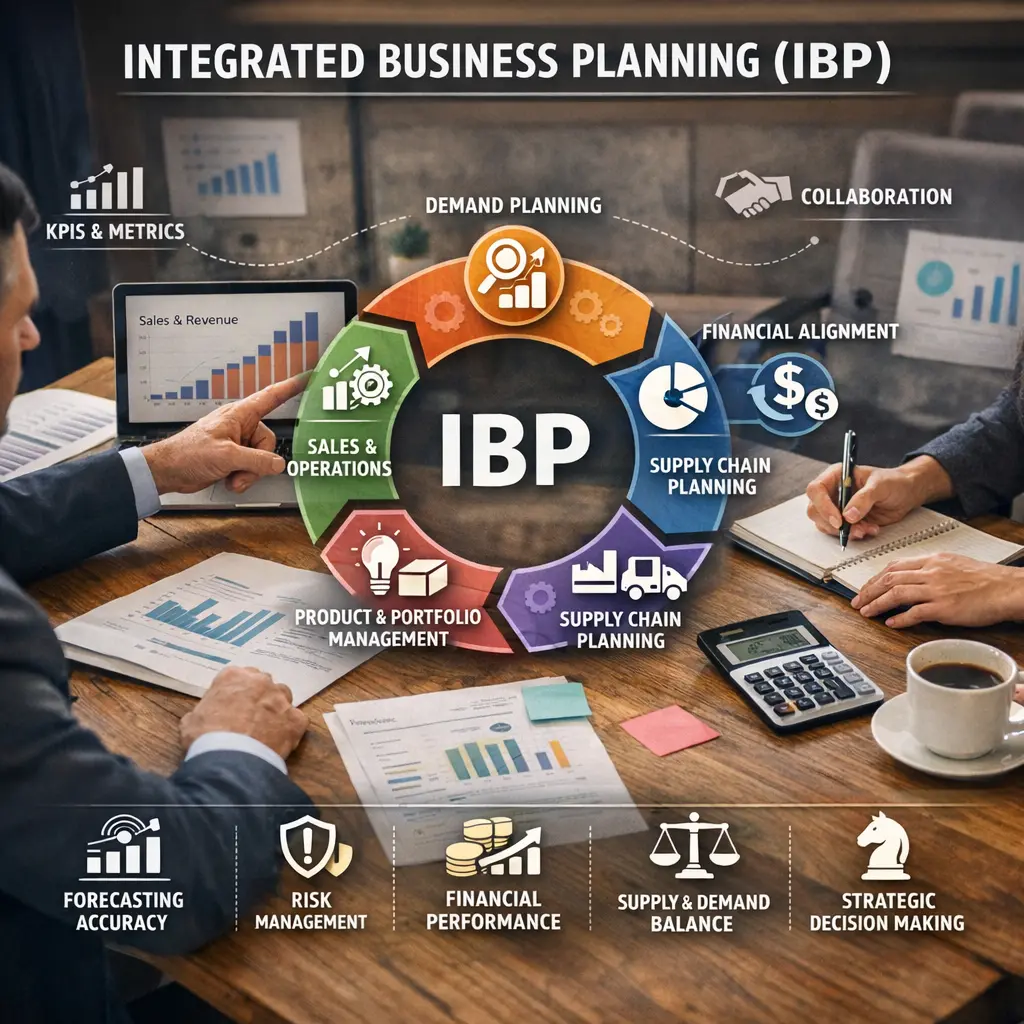
Integrated Business Planning (IBP) is a holistic approach that aligns an organization’s strategic, operational, and financial goals. By integrating sales, operations, finance, and supply chain planning, IBP enables businesses to make informed decisions, optimize resources, and improve performance. It fosters collaboration across departments, enhances forecasting accuracy, and ensures that financial management practices support overall business objectives, leading to greater agility and competitiveness in dynamic markets.
Integrated Business Planning (IBP)
Integrated Business Planning (IBP) is a holistic approach that aligns an organization’s strategic, operational, and financial goals. By integrating sales, operations, finance, and supply chain planning, IBP enables businesses to make informed decisions, optimize resources, and improve performance. It fosters collaboration across departments, enhances forecasting accuracy, and ensures that financial management practices support overall business objectives, leading to greater agility and competitiveness in dynamic markets.
💡 Key Takeaways
- Understand the core purpose of Integrated Business Planning and how it links strategy, operations, and finance.
- Learn how IBP synchronizes demand, supply, and financial plans across functions to improve alignment.
- Describe the IBP process, including horizon planning, scenario analysis, and executive-level governance.
- Identify key IBP metrics and outcomes, such as forecast accuracy, service levels, inventory turns, and financial impact.
❓ Frequently Asked Questions
What is Integrated Business Planning (IBP)?
IBP is a cross‑functional planning process that integrates demand, supply, and financial plans to align operations with strategic goals across short and long horizons.
How does IBP differ from traditional S&OP?
IBP adds financial integration, long‑range scenario planning, and executive governance, linking day‑to‑day plans to financial outcomes beyond the standard S&OP cycle.
What are the core components of IBP?
Key components include demand planning, supply planning, inventory optimization, financial integration, scenario analysis, and governance for decision making.
What are the typical benefits of implementing IBP?
Benefits include better cross‑functional alignment, improved forecast accuracy, optimized inventory, enhanced cash flow, and stronger risk management.