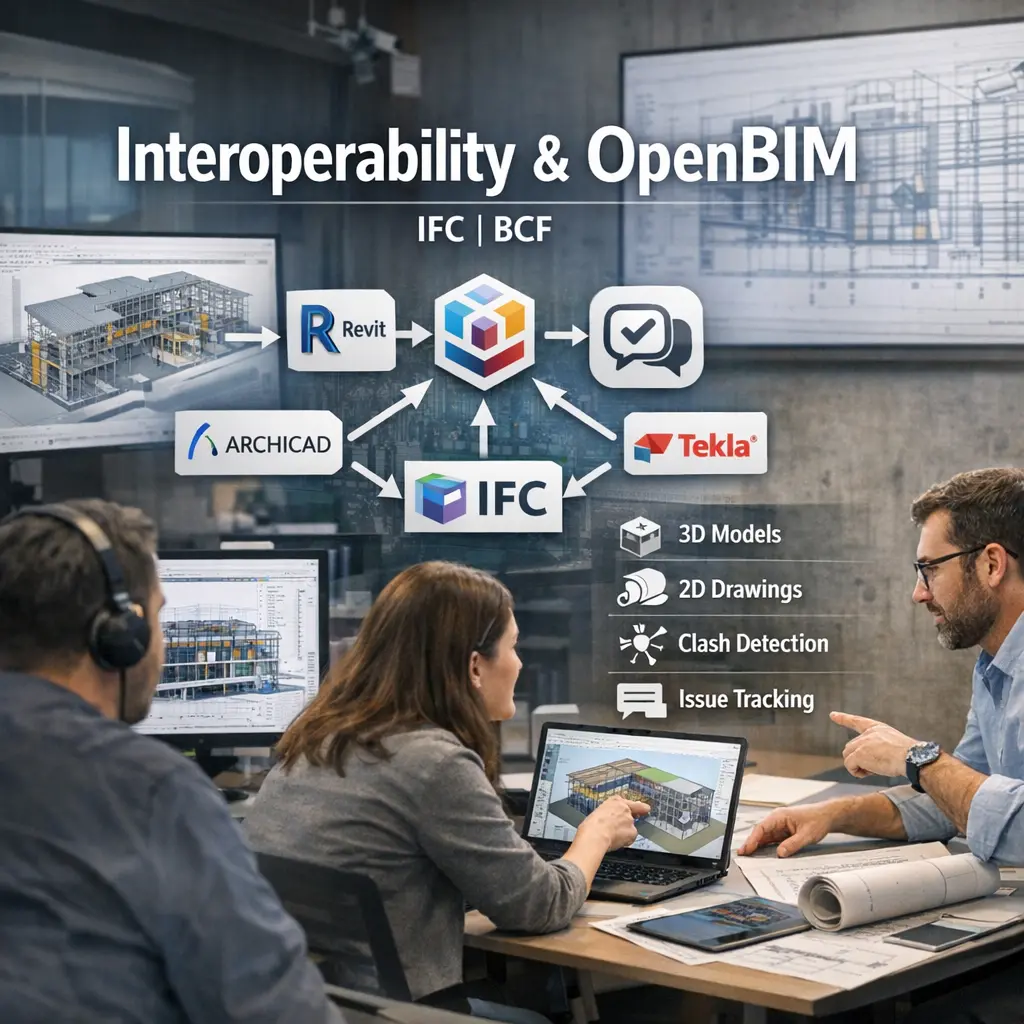
Interoperability in the construction environment refers to the seamless exchange and use of information across different software platforms and stakeholders. OpenBIM, utilizing standards like IFC (Industry Foundation Classes) and BCF (BIM Collaboration Format), enables this by providing open, non-proprietary formats for data sharing. This ensures collaboration, reduces errors, and streamlines workflows, allowing architects, engineers, and contractors to work together efficiently throughout a project’s lifecycle.
Interoperability and OpenBIM (IFC, BCF)
Interoperability in the construction environment refers to the seamless exchange and use of information across different software platforms and stakeholders. OpenBIM, utilizing standards like IFC (Industry Foundation Classes) and BCF (BIM Collaboration Format), enables this by providing open, non-proprietary formats for data sharing. This ensures collaboration, reduces errors, and streamlines workflows, allowing architects, engineers, and contractors to work together efficiently throughout a project’s lifecycle.
💡 Key Takeaways
- Define BIM interoperability and how OpenBIM enables cross-tool collaboration.
- Explain IFC and its role in exchanging geometry, properties, and relationships.
- Explain BCF and how it facilitates issue tracking and coordination across tools.
- Identify common interoperability challenges and OpenBIM best practices to mitigate them.
❓ Frequently Asked Questions
What is interoperability in BIM?
Interoperability is the ability for different BIM tools to exchange and use data—such as models, properties, and schedules—without losing meaning or detail.
What is IFC (Industry Foundation Classes) and why is it important for OpenBIM?
IFC is an open, vendor-neutral data model for building information. It enables consistent representation of geometry, properties, and relationships, supporting data exchange in OpenBIM workflows.
What is BCF (BIM Collaboration Format) and how does it help collaboration?
BCF is a lightweight format for capturing issues, viewpoints, and comments tied to a BIM model. It lets teams discuss problems without sharing large model files.
How do IFC and BCF support interoperability across software tools?
IFC provides a common data schema; BCF provides a standard for issue communication. Together they enable cross-tool model exchange and coordinated work across software.
What are common OpenBIM challenges and how can they be addressed?
Common challenges include incomplete exports, property mapping differences, and version gaps. Use up-to-date tools, validate IFC/BCF files, standardize mappings, and leverage BCF for traceable issues.