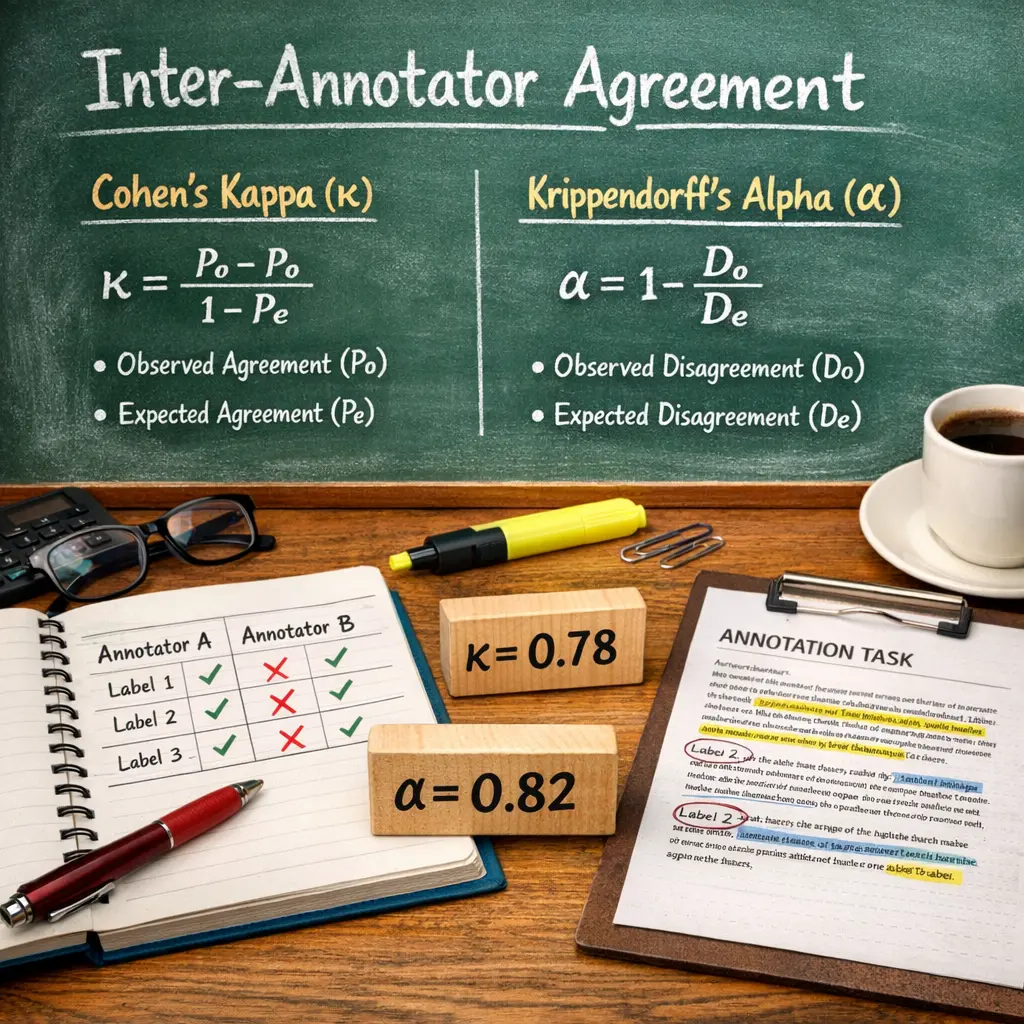
Label Noise Modeling and Rater Bias Correction in LLM evaluations refers to techniques that address inaccuracies and inconsistencies in human-annotated data used to assess large language models. Label noise arises when raters make mistakes or interpret evaluation criteria differently, leading to unreliable labels. Modeling this noise and correcting for individual rater biases help ensure that evaluation metrics more accurately reflect true model performance, resulting in fairer and more robust assessments of LLM capabilities.
Label Noise Modeling and Rater Bias Correction
Label Noise Modeling and Rater Bias Correction in LLM evaluations refers to techniques that address inaccuracies and inconsistencies in human-annotated data used to assess large language models. Label noise arises when raters make mistakes or interpret evaluation criteria differently, leading to unreliable labels. Modeling this noise and correcting for individual rater biases help ensure that evaluation metrics more accurately reflect true model performance, resulting in fairer and more robust assessments of LLM capabilities.

💡 Key Takeaways
- Understand what label noise is and how annotator errors and biases affect labels.
- Learn how label-noise models use confusion matrices and class-conditional noise to represent labeling errors.
- Discover how rater bias is detected and quantified (e.g., reliability metrics, agreement) to identify biased labels.
- Explore correction techniques: probabilistic label fusion (e.g., Dawid-Skene/EM), robust training with noisy labels, and data-cleaning or relabeling.
❓ Frequently Asked Questions
What is label noise in machine learning data?
Label noise occurs when the target labels in the training data are incorrect or unreliable, often due to human error, ambiguity, or automatic labeling.
What is rater bias in annotation?
Rater bias is a systematic tendency of annotators to favor certain labels or interpretations, leading to consistent mislabeling across samples.
What does label noise modeling involve?
It models how true labels become observed labels, typically using a noise transition matrix and algorithms to estimate the likely true labels from noisy ones.
How can we mitigate label noise and rater bias in practice?
Collect multiple annotations per item, use consensus or probabilistic models (e.g., Dawid-Skene or EM) to infer true labels, and train with noise-robust loss functions or perform data cleaning.