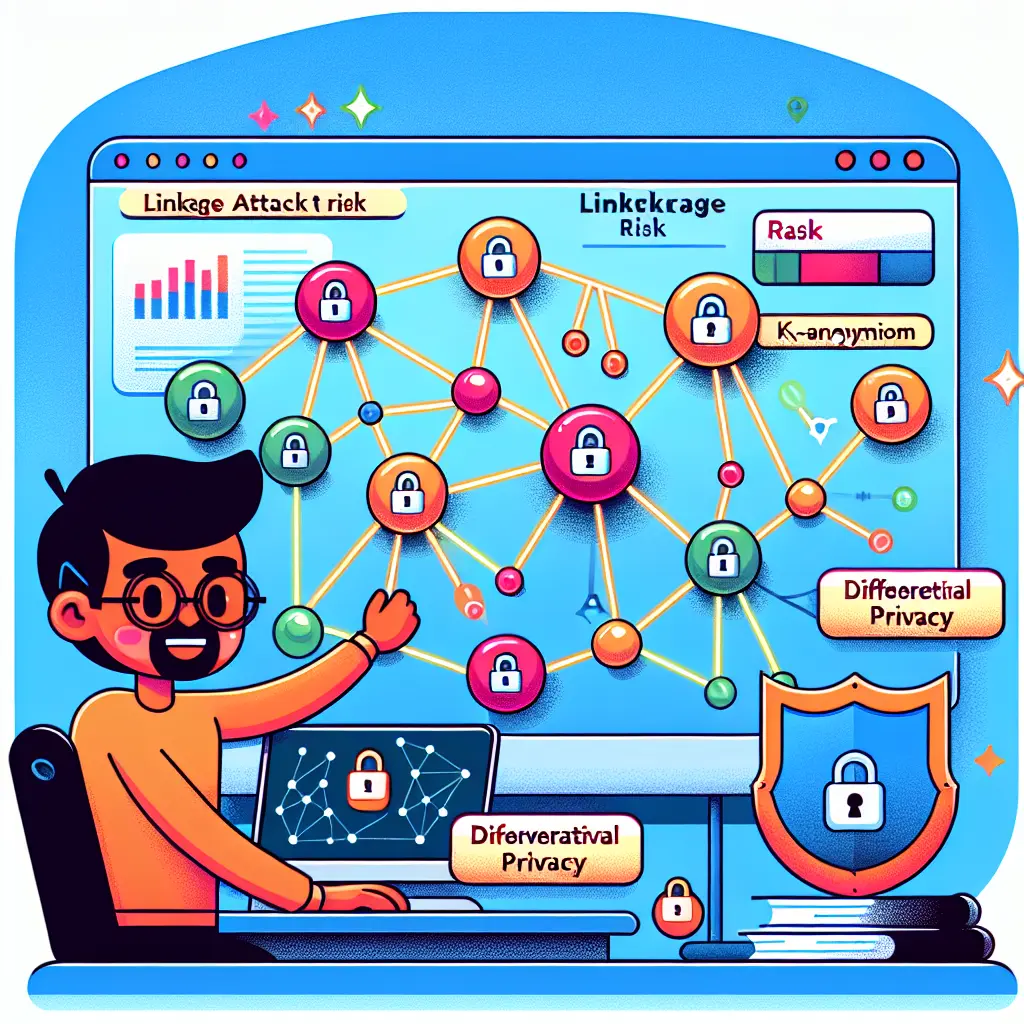
Linkage attack risk analysis involves assessing the potential for re-identifying individuals by combining multiple datasets that share common attributes. This process identifies vulnerabilities where seemingly anonymized data can be cross-referenced to reveal sensitive information. Mitigations include data minimization, use of strong de-identification techniques, applying differential privacy, and restricting data access. Regular risk assessments and robust governance policies further reduce the likelihood and impact of successful linkage attacks.
Linkage attack risk analysis and mitigations
Linkage attack risk analysis involves assessing the potential for re-identifying individuals by combining multiple datasets that share common attributes. This process identifies vulnerabilities where seemingly anonymized data can be cross-referenced to reveal sensitive information. Mitigations include data minimization, use of strong de-identification techniques, applying differential privacy, and restricting data access. Regular risk assessments and robust governance policies further reduce the likelihood and impact of successful linkage attacks.
💡 Key Takeaways
- Define what linkage attacks are and why they threaten privacy in AI data governance.
- Identify quasi-identifiers and external data sources that can enable re-identification.
- Learn how to assess linkage risk using simple metrics and risk scoring.
- Explore mitigations such as data minimization, pseudonymization, differential privacy, and strict access controls.
❓ Frequently Asked Questions
What is linkage attack risk analysis?
A process to assess how likely it is that individuals could be re-identified by combining multiple datasets that share attributes, revealing sensitive information despite anonymization.
What are quasi-identifiers and why do they matter in linkage attacks?
Quasi-identifiers are attributes that seem harmless alone (like birth year, gender, or ZIP code) but can uniquely identify someone when combined with other data.
What mitigations help reduce linkage risk in data governance?
Use data minimization, generalization/suppression (k-anonymity), add noise (differential privacy), ensure diversity (l-diversity, t-closeness), consider synthetic data, and enforce strict access controls and secure data sharing.
How is a linkage risk assessment conducted?
Identify datasets and quasi-identifiers, estimate re-identification risk (e.g., via k-anonymity), simulate attacker scenarios with external data, apply appropriate mitigations, and document results for ongoing monitoring.