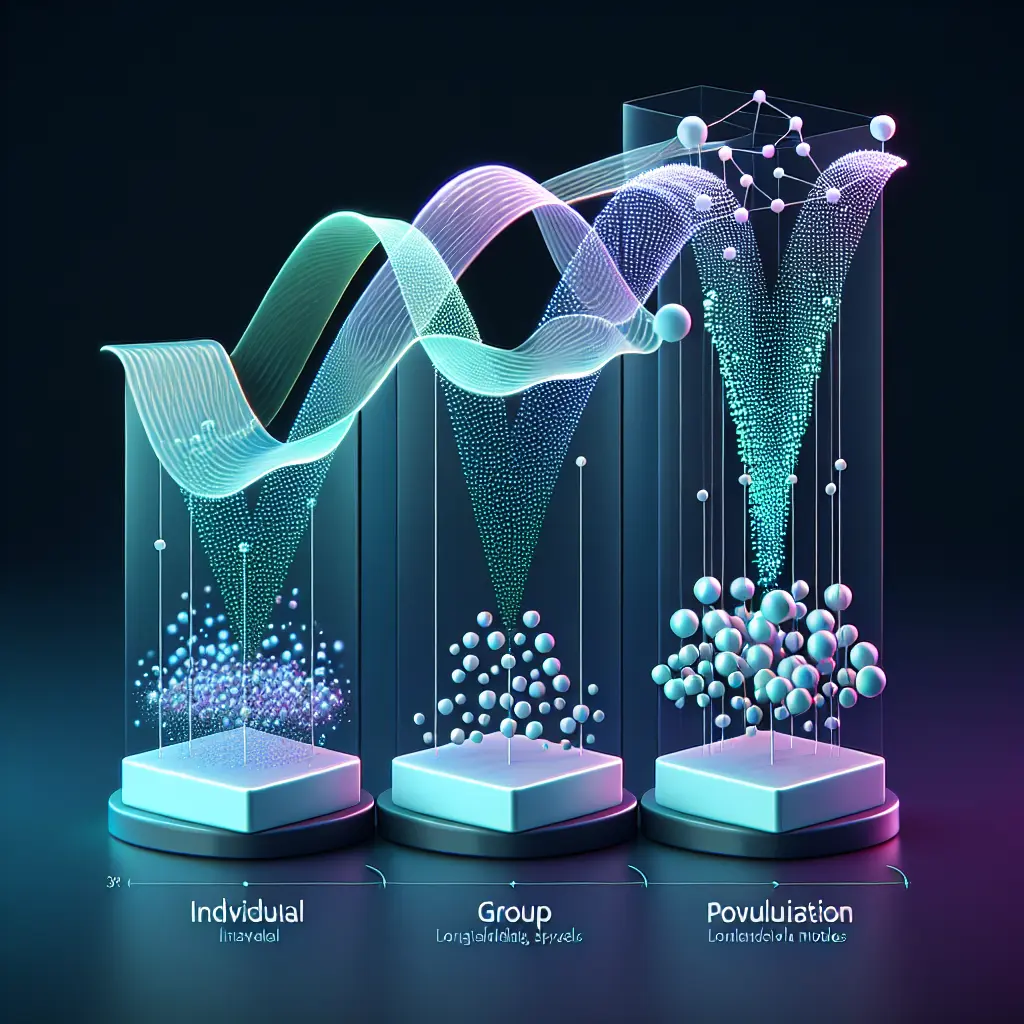
Longitudinal and multilevel modeling are advanced statistical techniques used to analyze data collected over time or nested within different levels, such as students within schools. Longitudinal modeling tracks changes within subjects across multiple time points, while multilevel modeling accounts for data hierarchies, addressing variability at each level. Together, these methods provide a nuanced understanding of complex data structures, allowing researchers to examine individual trajectories and group-level effects simultaneously.
Longitudinal and Multilevel Modeling
Longitudinal and multilevel modeling are advanced statistical techniques used to analyze data collected over time or nested within different levels, such as students within schools. Longitudinal modeling tracks changes within subjects across multiple time points, while multilevel modeling accounts for data hierarchies, addressing variability at each level. Together, these methods provide a nuanced understanding of complex data structures, allowing researchers to examine individual trajectories and group-level effects simultaneously.
💡 Key Takeaways
- Distinguish longitudinal data from cross-sectional data and know when to use time-based analyses.
- Describe how longitudinal models track intra-individual change across multiple time points (growth curves).
- Explain multilevel (hierarchical) modeling for nested data (e.g., students within schools) and how it partitions variance by level.
- Identify the roles of fixed and random effects and how to interpret them in longitudinal and multilevel models.
❓ Frequently Asked Questions
What is longitudinal modeling?
A statistical approach for analyzing how individuals change over time using repeated measurements, capturing time trends and subject-specific trajectories.
What is multilevel modeling?
A framework for analyzing data that are nested (e.g., students within schools) by modeling effects at each level and allowing observations to share information within clusters.
How are longitudinal and multilevel models related?
Longitudinal data are often analyzed with multilevel (mixed-effects) models. Time points can be treated as a level, allowing estimation of average change and how individuals differ in their trajectories.
What are common terms to know in these models?
Fixed effects describe average relationships; random effects capture individual deviations (e.g., in intercepts or slopes); time is a predictor, and the model accounts for correlation within individuals or clusters.