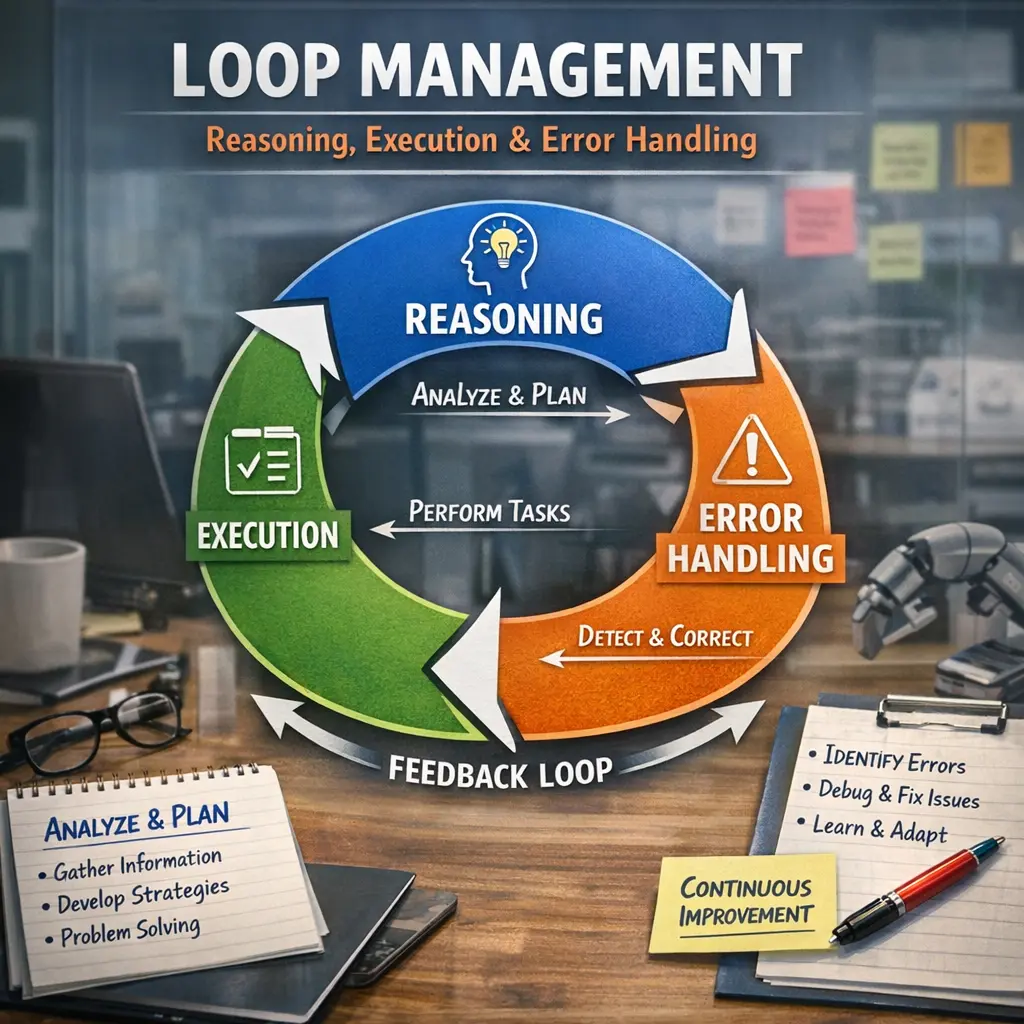
Loop Management in agent architecture refers to the systematic process where an agent continually reasons about its environment, executes planned actions, and handles any errors that arise. This cycle ensures the agent adapts to changing conditions, maintains goal-oriented behavior, and recovers from failures. Effective loop management integrates reasoning for decision-making, execution for action-taking, and error handling for resilience, forming the backbone of robust, autonomous agent operations.
Loop Management: Reasoning, Execution & Error Handling
Loop Management in agent architecture refers to the systematic process where an agent continually reasons about its environment, executes planned actions, and handles any errors that arise. This cycle ensures the agent adapts to changing conditions, maintains goal-oriented behavior, and recovers from failures. Effective loop management integrates reasoning for decision-making, execution for action-taking, and error handling for resilience, forming the backbone of robust, autonomous agent operations.
💡 Key Takeaways
- Understand loop reasoning: define goals, termination conditions, and invariants to ensure correctness.
- Master loop execution: choose appropriate looping constructs (for, while, do-while) and structure the body for predictable iteration.
- Handle errors inside loops: implement robust checks and graceful recovery to avoid state corruption.
- Debug and optimize: identify infinite loops, minimize iterations, and manage resources efficiently.
❓ Frequently Asked Questions
What is loop management in programming?
Loop management is planning and controlling how a loop starts, continues, and ends—selecting the right loop type, setting initial values, updating state, and ensuring it terminates correctly.
How does reasoning help when designing a loop?
Reasoning helps you verify the loop's exit condition and iteration count, anticipate edge cases, and prevent off-by-one errors or infinite loops before you code.
What is a good approach to error handling inside loops?
Validate inputs, use structured error handling (try/catch), and ensure an error won’t leave the program stuck in the loop; log issues and consider safe termination or retry logic.
What are common loop pitfalls and how can you avoid them?
Common pitfalls include infinite loops, off-by-one errors, and modifying the loop condition inside the loop in unintended ways. Avoid them by clear termination checks, proper variable updates, and thorough testing with edge cases.