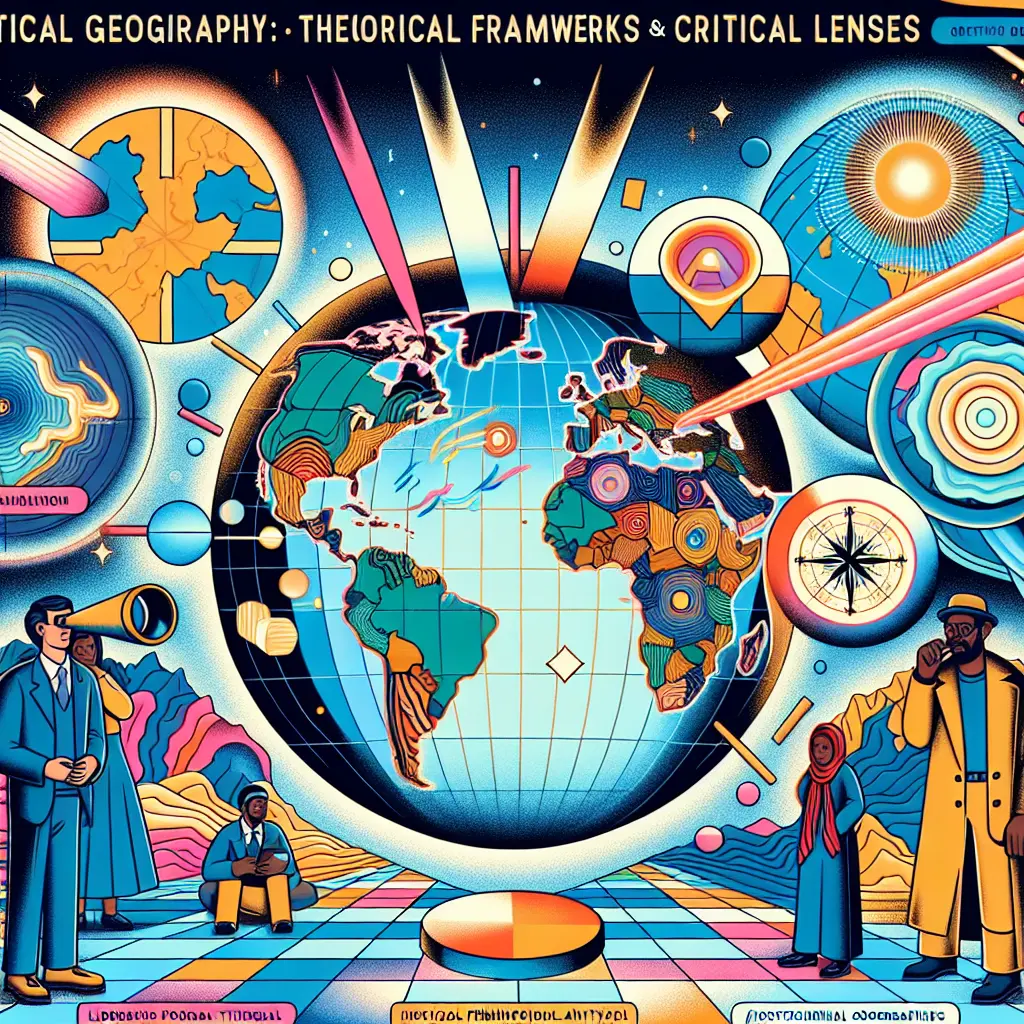
"Maps & Navigation: Theoretical Frameworks & Critical Lenses" refers to the study and interpretation of mapping and navigation through various academic theories and analytical perspectives. It involves examining how maps are constructed, the power dynamics they reflect, and the ways navigation shapes our understanding of space. Critical lenses—such as postcolonialism, feminism, or technocriticism—are used to question traditional assumptions and reveal underlying biases within cartographic practices and navigational technologies.
Maps & Navigation: Theoretical Frameworks & Critical Lenses
"Maps & Navigation: Theoretical Frameworks & Critical Lenses" refers to the study and interpretation of mapping and navigation through various academic theories and analytical perspectives. It involves examining how maps are constructed, the power dynamics they reflect, and the ways navigation shapes our understanding of space. Critical lenses—such as postcolonialism, feminism, or technocriticism—are used to question traditional assumptions and reveal underlying biases within cartographic practices and navigational technologies.

💡 Key Takeaways
- Understand how maps encode power and whose perspectives are represented or ignored
- Compare theoretical frameworks for reading maps and navigation (e.g., cartography theory, critical GIS, postcolonial lenses)
- Analyze how projections, scales, and data sources shape what is visible or hidden in geographic knowledge
- Explore how digital navigation technologies influence movement, decisions, and spatial behavior
❓ Frequently Asked Questions
What does 'theoretical frameworks' mean in Maps & Navigation?
They are conceptual approaches (e.g., critical cartography, postcolonial theory, spatial justice) used to interpret how maps are made, read, and used—focusing on representation, power, and purpose rather than just geography.
How can maps reveal power dynamics?
By showing who creates the map, what data is included or omitted, the chosen scale or projection, and how borders or routes are labeled, which reflects authority and control over space.
What is critical cartography?
A field that questions map-making assumptions, highlights biases, and seeks inclusive representation, showing who benefits from maps and how maps influence knowledge and action.
What are some critical lenses used to analyze maps and navigation?
Critical cartography, postcolonial geography, feminist geography, geopolitics, and spatial justice; they examine representation, borders, mobility, and power relations in space.
Why study theoretical frameworks in world history and geography?
To understand how maps and navigation have shaped exploration, colonization, trade, and governance, while recognizing biases and ethical implications in spatial knowledge.