Material classification in science and materials engineering involves grouping substances based on their properties and structure. Metals are typically strong, ductile, and good conductors of heat and electricity. Polymers are lightweight, flexible materials made of long molecular chains. Ceramics are brittle, hard, and resistant to heat and corrosion. Composites combine two or more different materials to achieve enhanced properties, such as increased strength or reduced weight, tailored for specific applications.
Material Classification: Metals, Polymers, Ceramics, Composites+50
Material classification in science and materials engineering involves grouping substances based on their properties and structure. Metals are typically strong, ductile, and good conductors of heat and electricity. Polymers are lightweight, flexible materials made of long molecular chains. Ceramics are brittle, hard, and resistant to heat and corrosion. Composites combine two or more different materials to achieve enhanced properties, such as increased strength or reduced weight, tailored for specific applications.
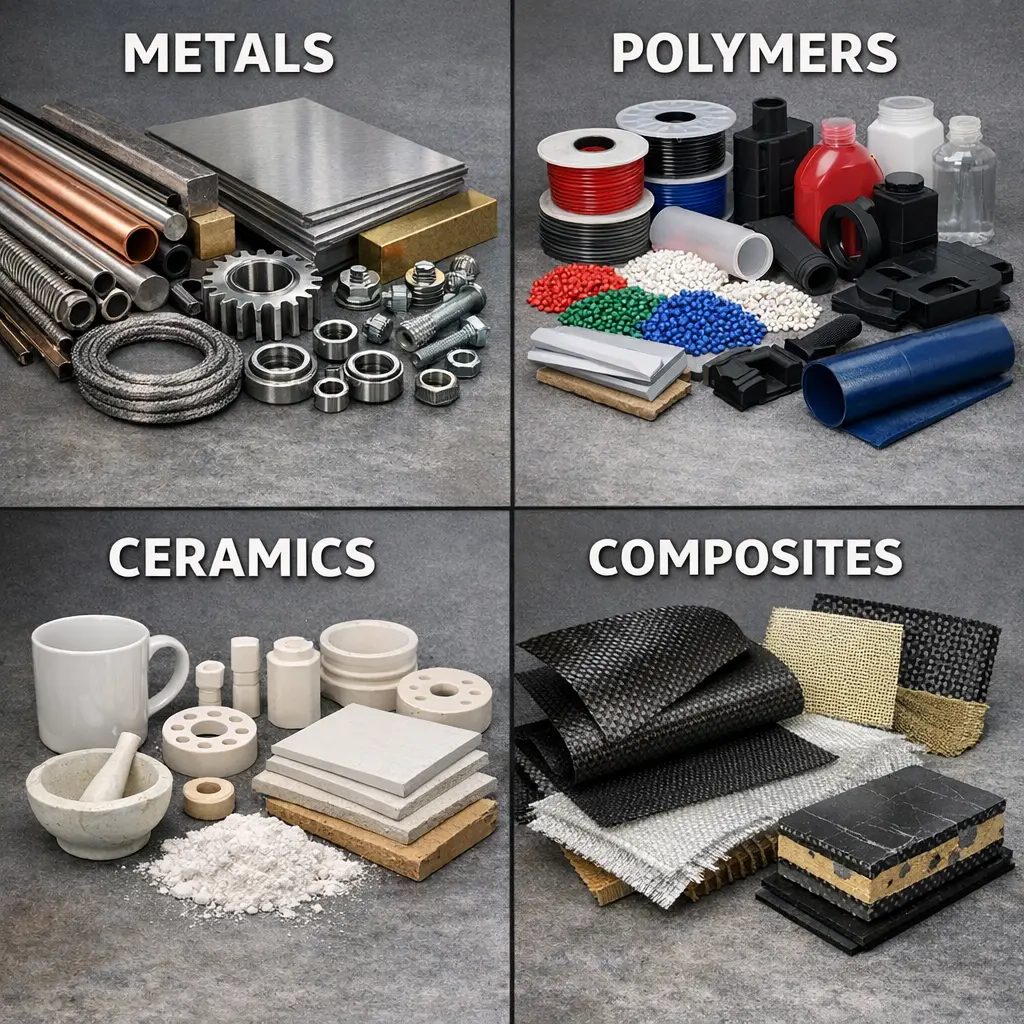
💡 Key Takeaways
- Learn how metals, polymers, ceramics, and composites are categorized by structure and properties.
- Metals are typically strong, ductile, and good conductors of heat and electricity.
- Polymers are lightweight, flexible materials made of long molecular chains.
- Ceramics are usually hard and heat resistant but can be brittle; composites blend materials to tailor properties for specific applications.
❓ Frequently Asked Questions
What is material classification in science and materials engineering?
Material classification groups substances by properties and structure (e.g., metals, polymers, ceramics, composites) to guide selection, processing, and design decisions.
What are the typical properties of metals?
Metals are usually strong, ductile, and good conductors of heat and electricity; they often have high density and metallic bonding.
How do polymers differ from metals and ceramics?
Polymers are lightweight, flexible materials made of long molecular chains; they often have lower stiffness, good impact resistance, and can be insulators of heat and electricity.
What are ceramics, and what are their common traits?
Ceramics are inorganic, nonmetallic solids that are typically hard and brittle, with high temperature resistance and good electrical insulation.
What are composites and why are they used?
Composites combine two or more materials to achieve properties not possible with a single material, such as higher strength-to-weight or tailored stiffness (e.g., fiberglass, carbon fiber-reinforced plastics).