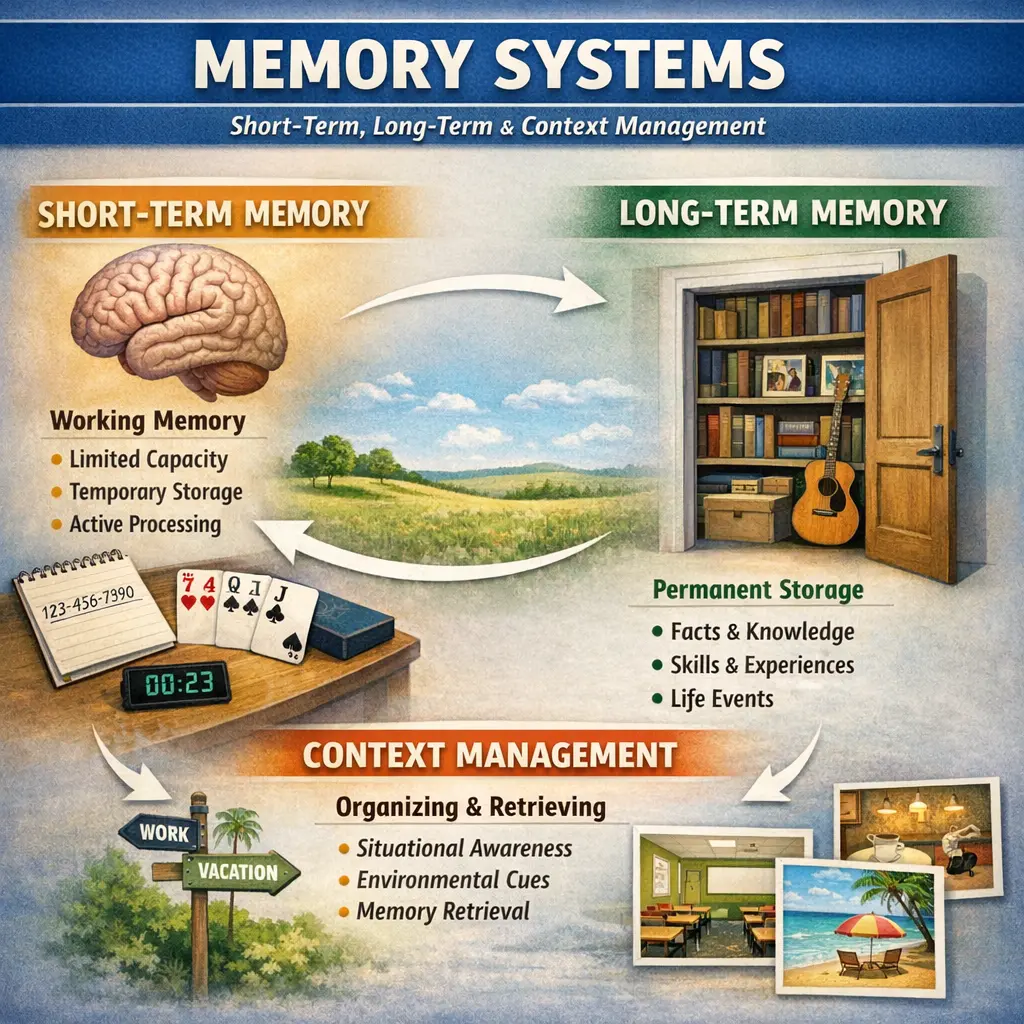
Memory systems in agent architecture refer to mechanisms for storing and retrieving information. Short-term memory holds immediate, temporary data relevant to current tasks, enabling quick decision-making. Long-term memory stores knowledge and experiences for future reference, supporting learning and adaptation. Context management involves tracking environmental and situational factors, allowing the agent to interpret information appropriately and adjust behavior. Together, these systems enable intelligent, context-aware actions and efficient problem-solving in complex environments.
Memory Systems: Short-Term, Long-Term & Context Management
Memory systems in agent architecture refer to mechanisms for storing and retrieving information. Short-term memory holds immediate, temporary data relevant to current tasks, enabling quick decision-making. Long-term memory stores knowledge and experiences for future reference, supporting learning and adaptation. Context management involves tracking environmental and situational factors, allowing the agent to interpret information appropriately and adjust behavior. Together, these systems enable intelligent, context-aware actions and efficient problem-solving in complex environments.
💡 Key Takeaways
- Understand the roles of short-term memory as fast, temporary data for the current task and long-term memory as persistent knowledge for future use.
- Explain how context management ties memories to the current task, guiding what is retrieved and how decisions are made.
- Describe the core memory operations—encoding, storage, retrieval, and forgetting/ejection—and how they affect learning and performance.
- Recognize design trade-offs in memory systems (speed vs. accuracy, capacity, interference) and how these choices shape agent behavior.
❓ Frequently Asked Questions
What are the main memory types in agent architecture?
Short-term memory, long-term memory, and context management. Short-term memory holds immediate data for current tasks; long-term memory stores knowledge and experiences for future reference; context management tracks situational factors to guide memory use and decision-making.
What is short-term memory in the context of agents?
A fast, temporary store for current observations, variables, and intermediate results that the agent uses to make quick decisions.
What is long-term memory in agent systems?
A persistent store for knowledge, rules, models, and past experiences that the agent can recall and learn from over time.
What is context management in memory systems?
Mechanisms that capture and use contextual information (task, user, environment, time) to influence what is stored, retrieved, and applied in decision making.
How do these memory components work together to support learning?
Short-term memory handles immediate data for decisions; long-term memory provides reusable knowledge; context management selects relevant data and guides retrieval, enabling adaptation and learning across tasks.