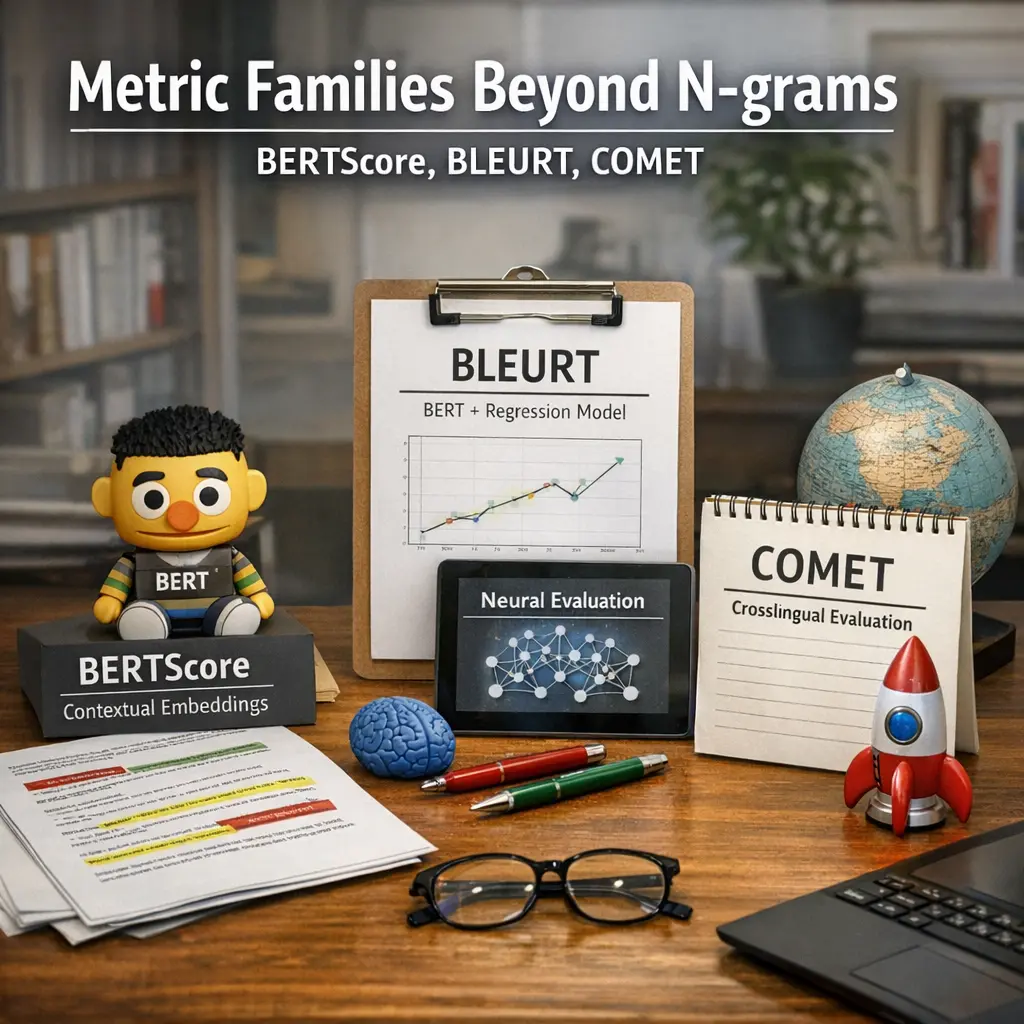
Metric families beyond n-grams, such as BERTScore, BLEURT, and COMET, represent advanced evaluation methods for language models. Unlike traditional n-gram metrics that rely on surface-level word overlaps, these metrics leverage deep learning and contextual embeddings to assess semantic similarity and meaning. They provide more nuanced and accurate evaluations of text generation, making them valuable tools for Large Language Model (LLM) evaluations and improving the assessment of natural language understanding and generation tasks.
Metric Families Beyond N-grams: BERTScore, BLEURT, COMET
Metric families beyond n-grams, such as BERTScore, BLEURT, and COMET, represent advanced evaluation methods for language models. Unlike traditional n-gram metrics that rely on surface-level word overlaps, these metrics leverage deep learning and contextual embeddings to assess semantic similarity and meaning. They provide more nuanced and accurate evaluations of text generation, making them valuable tools for Large Language Model (LLM) evaluations and improving the assessment of natural language understanding and generation tasks.
💡 Key Takeaways
- Understand what BERTScore, BLEURT, and COMET are and how they differ from traditional n-gram metrics.
- Learn how BERTScore uses contextual word representations to measure semantic similarity between candidate and reference texts.
- Explore how BLEURT and COMET are trainable metrics that leverage human judgments to capture quality, fluency, and adequacy beyond surface-form matches.
- Identify practical guidance for when to use these metrics, their language support and computational considerations, and how to interpret their scores in evaluation tasks such as MT and summarization.
❓ Frequently Asked Questions
What are BERTScore, BLEURT, and COMET, and how do they differ from traditional n-gram metrics?
They are evaluation methods that focus on semantic similarity and learned judgments rather than exact word overlap. They often align better with human judgments than n-gram metrics like BLEU.
How does BERTScore calculate its score?
It uses contextual token embeddings (e.g., from BERT) for candidate and reference texts, computes token-level similarities, and aggregates them (precision/recall/F1) to a score between 0 and 1.
What is BLEURT and what does it measure?
BLEURT is a learned metric trained to predict human judgments about text quality. It captures fluency and semantic adequacy and outputs a score, typically between 0 and 1, with higher being better.
What is COMET and when should I use it?
COMET is a neural evaluation framework that predicts quality scores aligned with human judgments (often for MT/NLG). It supports multilingual data and is useful when semantic-level quality estimates are needed.