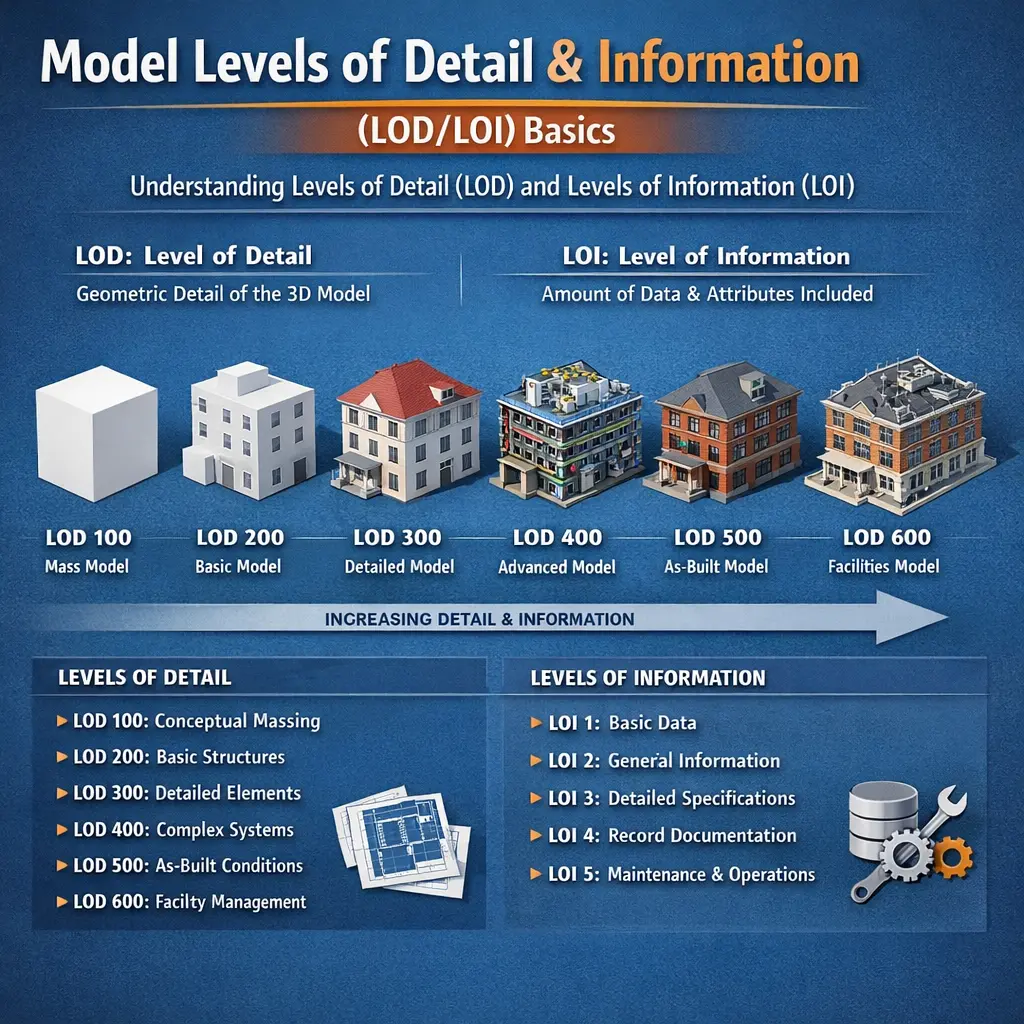
Model Levels of Detail and Information (LOD/LOI) refer to standardized stages in digital construction models, indicating the progression of both geometric detail (LOD) and associated data (LOI). These basics ensure that digital models accurately reflect the project's development, from conceptual design to construction and operation. By defining what information and detail must be present at each stage, LOD/LOI supports effective collaboration, decision-making, and information management in digital construction processes.
Model Levels of Detail and Information (LOD/LOI) Basics
Model Levels of Detail and Information (LOD/LOI) refer to standardized stages in digital construction models, indicating the progression of both geometric detail (LOD) and associated data (LOI). These basics ensure that digital models accurately reflect the project's development, from conceptual design to construction and operation. By defining what information and detail must be present at each stage, LOD/LOI supports effective collaboration, decision-making, and information management in digital construction processes.
💡 Key Takeaways
- Define Levels of Detail (LOD) and Levels of Information (LOI) and their roles in models and data.
- Compare high-detail vs low-detail representations and their impact on performance and accuracy.
- List common LOD/LOI techniques (geometric simplification, data aggregation, attribute pruning) and when to apply them.
- Explain how to choose LOD/LOI thresholds based on use case, viewer distance, and system constraints.
❓ Frequently Asked Questions
What is Level of Detail (LOD) in modeling?
LOD defines how much geometry and how accurate it is for an element at a project stage. Higher LOD means more complex shapes and more precise dimensions.
What is Level of Information (LOI) in modeling?
LOI describes the data attached to each element (properties, specifications, metadata). A higher LOI means richer information for design, procurement, or operations.
How do LOD and LOI work together?
LOD governs geometry and visuals; LOI governs data. Together they specify both how the model looks and what information it carries at each phase.
What are common LOD levels and what do they mean?
Typical progression: LOD 100 conceptual, LOD 200 approximate geometry, LOD 300 accurate geometry, LOD 350–400 for fabrication/installation details, LOD 500 as-built/field-verified. LOI levels follow a similar idea for data richness.