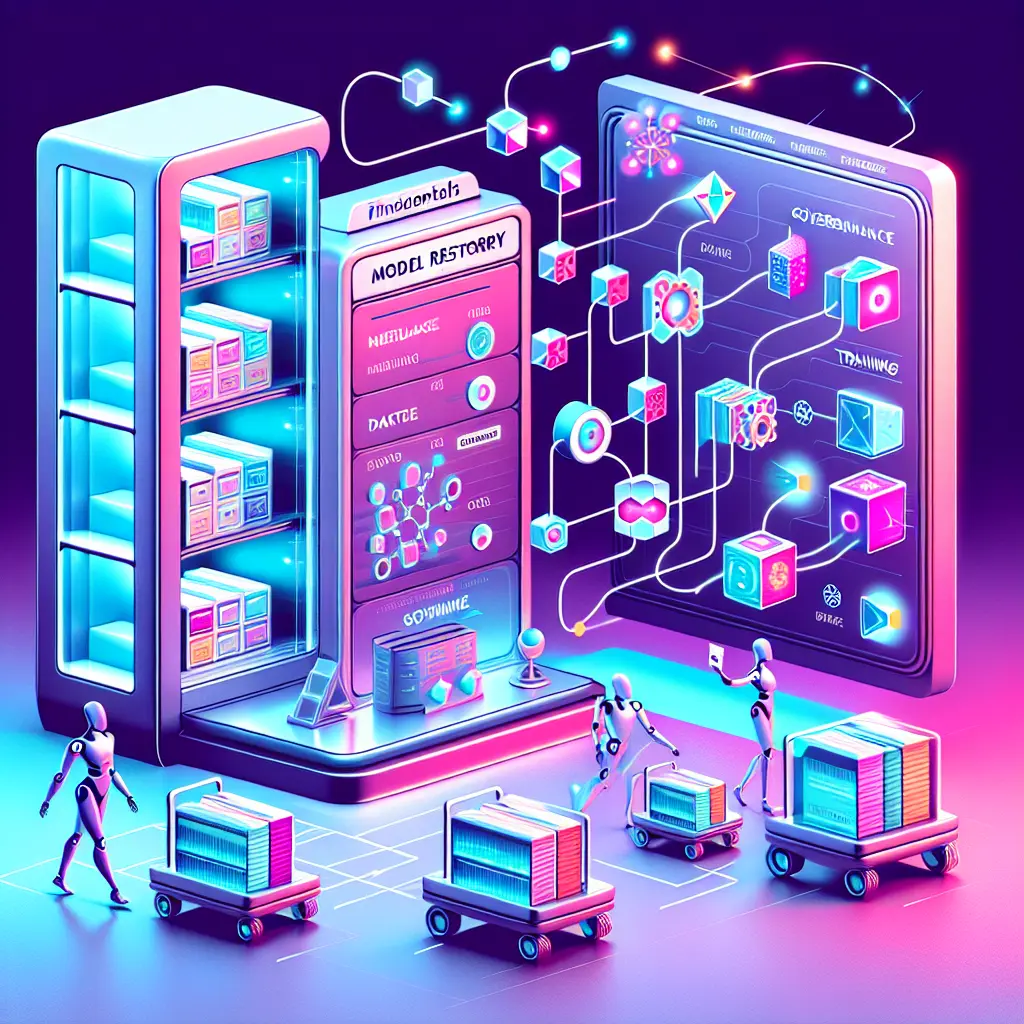
Model registry and lineage fundamentals involve systematically tracking, managing, and storing different versions of machine learning models throughout their lifecycle. A model registry serves as a centralized repository for registering, organizing, and retrieving models, ensuring reproducibility and governance. Model lineage refers to documenting the origin, evolution, and dependencies of models, including training data, code, and parameters. Together, they enable transparency, traceability, and efficient collaboration in machine learning workflows.
Model registry and lineage fundamentals
Model registry and lineage fundamentals involve systematically tracking, managing, and storing different versions of machine learning models throughout their lifecycle. A model registry serves as a centralized repository for registering, organizing, and retrieving models, ensuring reproducibility and governance. Model lineage refers to documenting the origin, evolution, and dependencies of models, including training data, code, and parameters. Together, they enable transparency, traceability, and efficient collaboration in machine learning workflows.
💡 Key Takeaways
- Understand the purpose of a model registry and how it stores and versions ML models across their lifecycle.
- Learn how model lineage ties together data, training runs, environments, and model artifacts to enable reproducibility.
- Explore common registry practices such as registering, organizing, tagging, and promoting models through stages (development, staging, production).
- Recognize governance benefits like audit trails, easy rollback, collaboration, and reproducible experimentation.
❓ Frequently Asked Questions
What is a model registry?
A centralized repository for storing, versioning, and organizing machine learning models, enabling registration, discovery, retrieval, and governance.
What is model lineage?
The traceability of a model's development, including data, features, code, parameters, and training runs, showing how a model was created and evolved.
How do registry and lineage support reproducibility?
The registry stores versioned artifacts with metadata, while lineage records dependencies and training context, allowing exact re-creation of a model and its results.
What information is typically stored in a model registry?
Version, stage (e.g., development, staging, production), metadata (metrics, data version, hyperparameters), provenance (code and data sources), and links to training runs and deployments.