Moisture transport in materials involves the movement of water through diffusion, capillarity, and sorption. Diffusion refers to water vapor migrating from areas of high to low concentration. Capillarity describes liquid water moving through tiny pores due to surface tension. Sorption encompasses the absorption or adsorption of moisture by materials. Together, these mechanisms influence how moisture interacts with and moves within various scientific and construction materials, affecting their properties and durability.
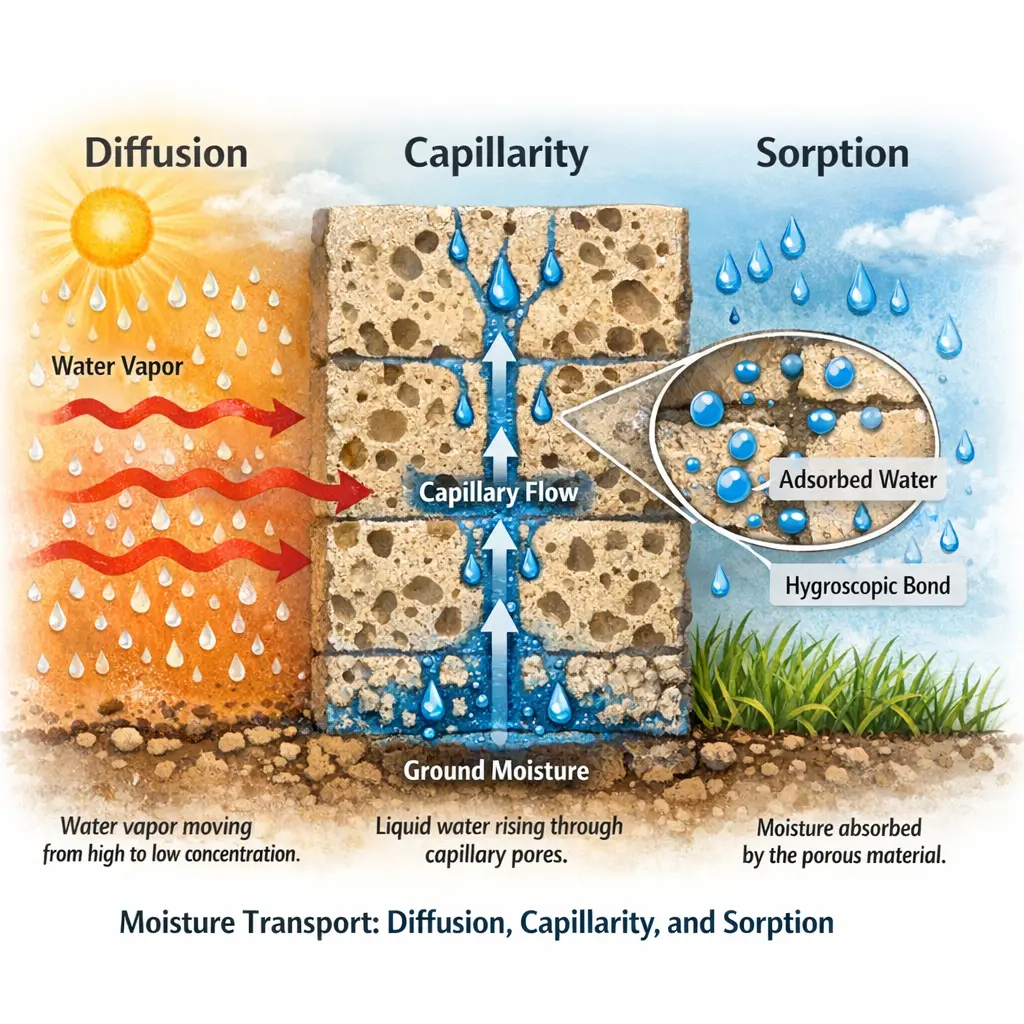
Moisture Transport: Diffusion, Capillarity, and Sorption
Moisture transport in materials involves the movement of water through diffusion, capillarity, and sorption. Diffusion refers to water vapor migrating from areas of high to low concentration. Capillarity describes liquid water moving through tiny pores due to surface tension. Sorption encompasses the absorption or adsorption of moisture by materials. Together, these mechanisms influence how moisture interacts with and moves within various scientific and construction materials, affecting their properties and durability.
💡 Key Takeaways
- Explain diffusion as the movement of moisture driven by concentration gradients within materials.
- Describe capillarity and how capillary forces move moisture through narrow pores and porous networks.
- Understand sorption (adsorption/desorption) and sorption isotherms, and how moisture is stored and released in materials.
- Identify practical applications: how diffusion, capillarity, and sorption affect drying, storage, and processing of materials.
❓ Frequently Asked Questions
What is diffusion in moisture transport?
Diffusion is the net movement of water molecules from regions of higher moisture content to lower moisture content, driven by a gradient in chemical potential. In porous materials this is often described by Fick's law using an effective diffusivity.
What is capillarity in porous materials?
Capillarity (capillary action) is the movement of liquid water through small pores due to capillary forces from surface tension and solid–liquid interactions. It can raise water in narrow pores and drive transport even against gravity.
What is sorption in moisture transport?
Sorption encompasses adsorption (moisture on surfaces) and absorption (moisture into the material bulk). It describes how moisture is taken up or released as humidity changes, often summarized by sorption isotherms.
How do diffusion, capillarity, and sorption interact in moisture transport?
Sorption sets the material's moisture content at a given humidity, capillarity drives liquid flow in pores, and diffusion governs movement of water molecules through the material. The dominant mechanism depends on pore size, humidity, and material properties.