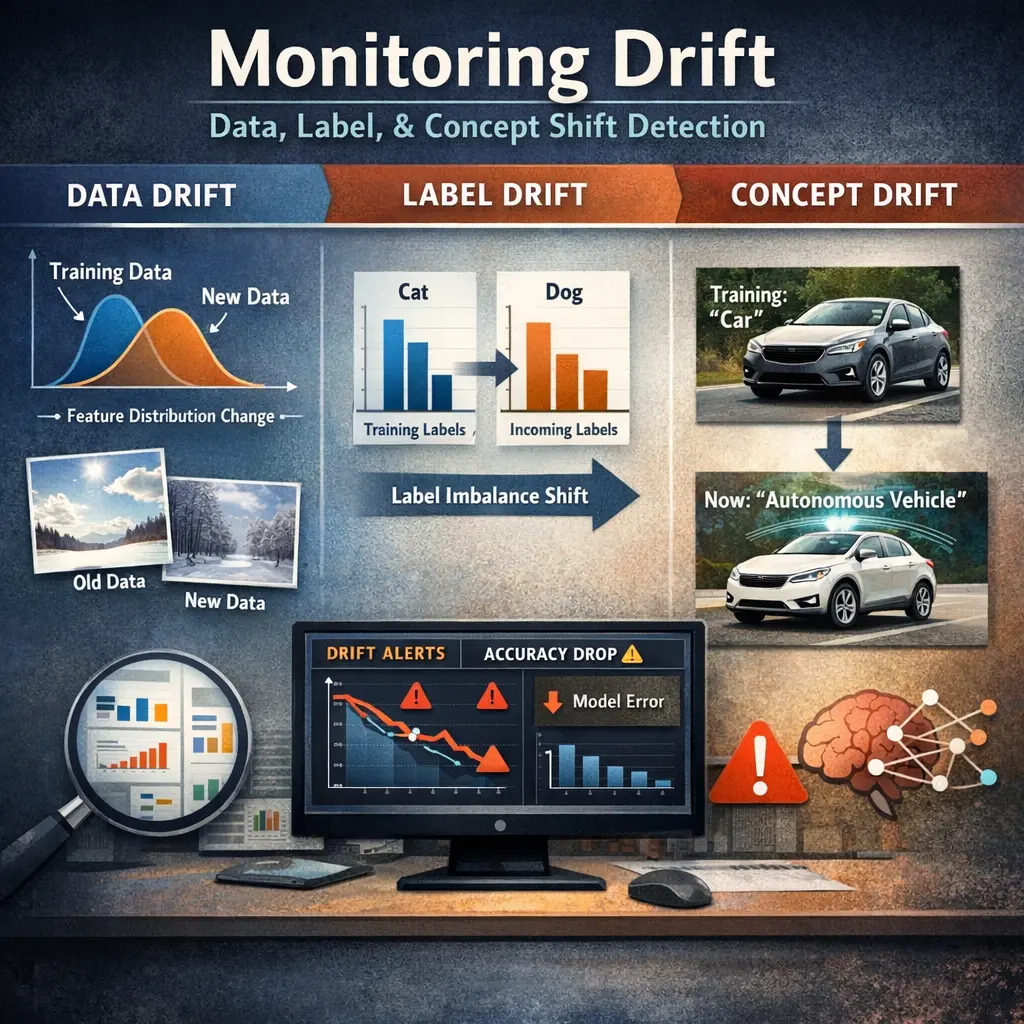
Monitoring drift involves tracking changes in data distributions, label definitions, or underlying concepts over time, which can impact machine learning model performance. In the context of LLM evaluations (evals), this process detects when input data, output labels, or the relationships between them shift, potentially degrading model accuracy. Early detection enables timely interventions, such as retraining or updating models, ensuring consistent reliability and effectiveness in real-world applications.
Monitoring Drift: Data, Label, and Concept Shift Detection
Monitoring drift involves tracking changes in data distributions, label definitions, or underlying concepts over time, which can impact machine learning model performance. In the context of LLM evaluations (evals), this process detects when input data, output labels, or the relationships between them shift, potentially degrading model accuracy. Early detection enables timely interventions, such as retraining or updating models, ensuring consistent reliability and effectiveness in real-world applications.
💡 Key Takeaways
- Differentiate data drift, label drift, and concept drift and understand how each type can impact model predictions.
- Identify practical drift signals in production data, such as shifts in feature distributions, changes in label distribution, and drops in model performance.
- Learn common drift-detection techniques and metrics (e.g., KS test, KL divergence, PSI, and basic performance monitoring) and when to apply them.
- Define actionable responses to detected drift, including retraining triggers, feature engineering adjustments, and data-quality improvements.
- Build a simple drift-monitoring workflow with data validation, automated alerts, and versioning for datasets and models.
❓ Frequently Asked Questions
What is data drift, label drift, and concept drift, and how do they differ?
Data drift is when the input feature distributions change over time. Label drift is a shift in the target variable's distribution. Concept drift occurs when the relationship between inputs and the target changes.
How can you detect data drift in practice?
Compare current feature distributions to a baseline using statistics like KS test (continuous features) or chi-square (categorical), compute PSI, and monitor drift indicators with alerts.
What is concept drift, and why does it matter for models?
Concept drift means the input–target mapping changes over time, which can degrade model accuracy. It is often detected by declining performance and drift-detection methods.
What should you do when drift is detected?
Investigate causes, collect updated data, retrain or update the model with current data, adjust features as needed, and refresh monitoring and thresholds.