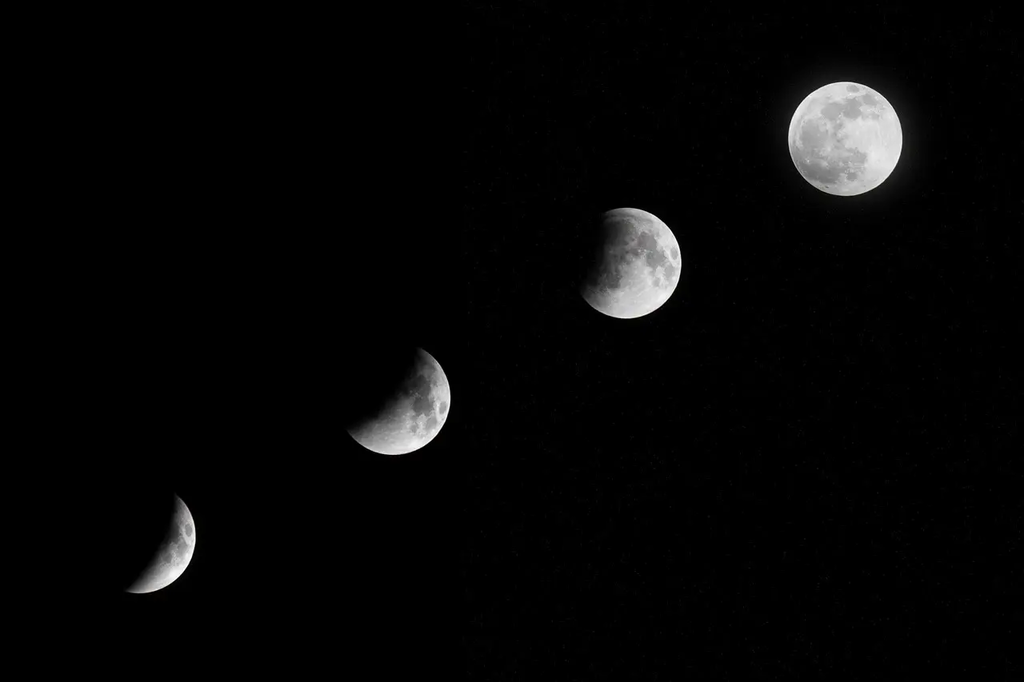
The Moon’s phases are the changing appearances of the Moon as seen from Earth, caused by its orbit around our planet and the varying angles of sunlight. These phases include new moon, crescent, first quarter, gibbous, and full moon. Eclipses occur when the Earth, Moon, and Sun align perfectly. A lunar eclipse happens when Earth’s shadow falls on the Moon, while a solar eclipse occurs when the Moon blocks sunlight from reaching Earth.
Moon's Phases and Eclipses
The Moon’s phases are the changing appearances of the Moon as seen from Earth, caused by its orbit around our planet and the varying angles of sunlight. These phases include new moon, crescent, first quarter, gibbous, and full moon. Eclipses occur when the Earth, Moon, and Sun align perfectly. A lunar eclipse happens when Earth’s shadow falls on the Moon, while a solar eclipse occurs when the Moon blocks sunlight from reaching Earth.
💡 Key Takeaways
- Identify the eight Moon phases in order from New Moon through a full cycle (New, Waxing Crescent, First Quarter, Waxing Gibbous, Full, Waning Gibbous, Last Quarter, Waning Crescent).
- Explain how the Sun–Moon–Earth alignment changes the Moon’s apparent shape.
- Describe how solar and lunar eclipses occur and the alignments required (relative positions of Sun, Moon, and Earth).
- Understand why eclipses happen only during eclipse seasons and not every month.
❓ Frequently Asked Questions
What causes the Moon's phases?
The Moon orbits Earth and we see varying portions of its sunlit side as the Sun–Moon–Earth alignment changes.
What are the main Moon phases (new moon, first quarter, full moon, last quarter)?
They reflect how much of the Moon's sunlit hemisphere is visible from Earth during its orbit.
How long does a full Moon cycle take?
About 29.5 days (a synodic month), from one new Moon to the next.
What is the difference between a solar eclipse and a lunar eclipse?
Solar eclipse: the Moon blocks the Sun from our view. Lunar eclipse: Earth blocks sunlight from reaching the Moon.
What are total, partial, and annular solar eclipses?
Total: Sun fully covered; Partial: only part of the Sun is obscured; Annular: Moon is farther away, leaving a bright Sun ring visible.