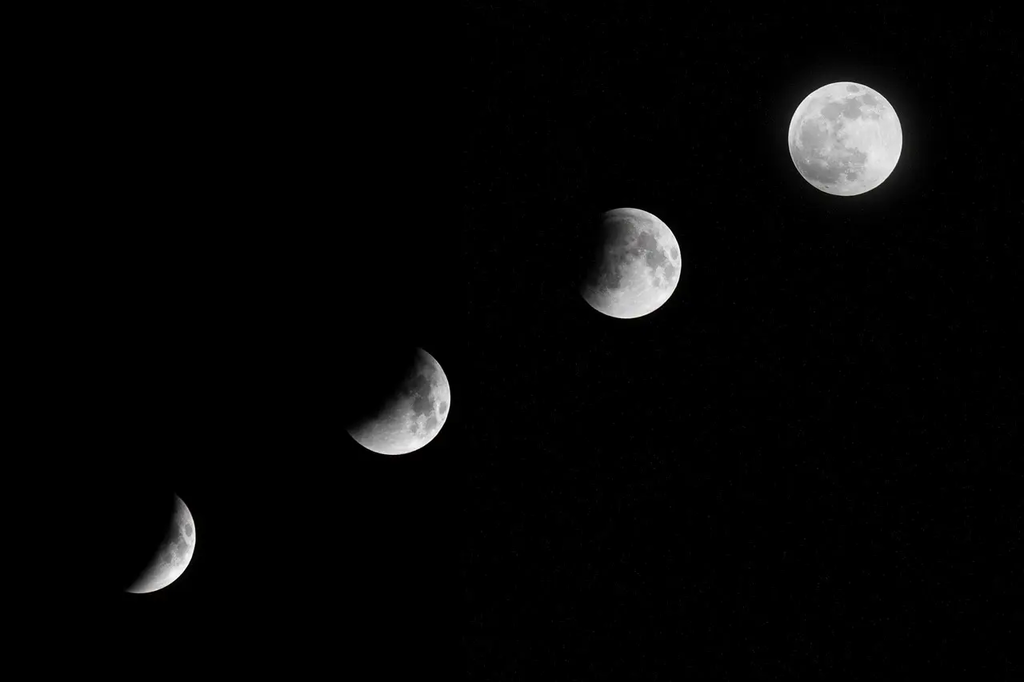
The Moon plays a crucial role in space-time research by serving as a stable reference point for measuring gravitational effects and time dilation predicted by Einstein’s theories. Its consistent orbit and proximity to Earth allow scientists to test fundamental physics principles, study tidal forces, and conduct precise lunar laser ranging experiments. These investigations help refine our understanding of gravity, relativity, and the broader structure of space-time in the universe.
Moon's Role in Space-Time Research
The Moon plays a crucial role in space-time research by serving as a stable reference point for measuring gravitational effects and time dilation predicted by Einstein’s theories. Its consistent orbit and proximity to Earth allow scientists to test fundamental physics principles, study tidal forces, and conduct precise lunar laser ranging experiments. These investigations help refine our understanding of gravity, relativity, and the broader structure of space-time in the universe.
💡 Key Takeaways
- Understand how the Moon's gravity and orbit affect space-time measurements.
- Learn how lunar laser ranging tests gravity and spacetime predictions.
- Discover how Moon data helps test general relativity and alternative gravity theories.
- See how the Moon helps calibrate clocks and navigation for space missions.
❓ Frequently Asked Questions
What is lunar laser ranging and how does it relate to space-time research?
Lunar laser ranging uses laser pulses from Earth to retroreflectors on the Moon, measuring the round-trip time to centimeter accuracy. This data tests gravity theories, checks the equivalence principle, and constrains any variation of the gravitational constant over time.
How does the Moon help test the equivalence principle?
The equivalence principle says all objects fall with the same acceleration in a given gravitational field. By comparing Earth's and Moon's free-fall toward the Sun with LLR, any tiny difference would signal EP violation; current measurements show no violation within very tight limits.
What is geodetic (de Sitter) precession, and does the Moon provide a test?
Geodetic precession is a small rotation of an orbit caused by spacetime curvature in General Relativity. The Moon's orbit experiences a tiny precession that can be measured with LLR, helping confirm GR's predictions about spacetime.
What are post-Newtonian parameters and how does the Moon constrain them?
Post-Newtonian parameters like gamma and beta quantify deviations from Newtonian gravity in the weak-field regime. The Moon's precise orbit, via LLR and other measurements, bounds these parameters to be very close to 1, aligning with General Relativity.
Do lunar measurements say anything about whether G changes over time?
Yes. Lunar laser ranging monitors the Earth–Moon system for any slow drift in the gravitational constant G. So far, no significant time variation is detected, setting tight limits on dG/dt.