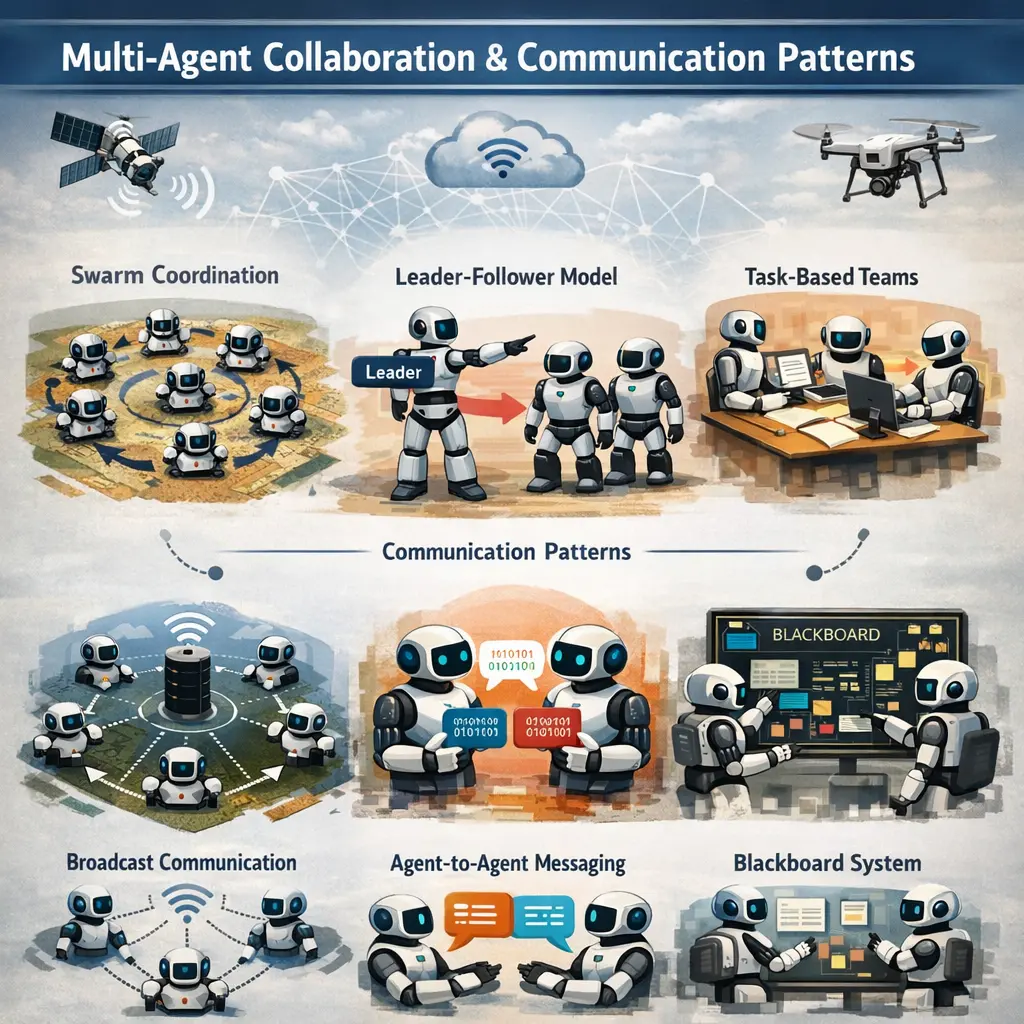
Multi-agent collaboration and communication patterns refer to the structured ways in which multiple autonomous agents interact, share information, and coordinate actions to achieve common or individual goals within a system. Agent architecture defines roles, protocols, and communication channels, enabling agents to negotiate, cooperate, or compete efficiently. These patterns enhance problem-solving, adaptability, and scalability in complex environments by facilitating effective teamwork and information exchange among distributed intelligent agents.
Multi-Agent Collaboration & Communication Patterns
Multi-agent collaboration and communication patterns refer to the structured ways in which multiple autonomous agents interact, share information, and coordinate actions to achieve common or individual goals within a system. Agent architecture defines roles, protocols, and communication channels, enabling agents to negotiate, cooperate, or compete efficiently. These patterns enhance problem-solving, adaptability, and scalability in complex environments by facilitating effective teamwork and information exchange among distributed intelligent agents.
💡 Key Takeaways
- Understand the role of agents in a multi-agent system and how they coordinate to achieve shared goals.
- Identify common inter-agent communication patterns (direct messaging, broadcast, publish-subscribe, and request-reply) and their typical use cases.
- Compare centralized versus distributed coordination and the trade-offs for scalability, robustness, and potential single points of failure.
- Recognize collaboration challenges such as synchronization, conflict resolution, and consensus, and know basic strategies to address them.
❓ Frequently Asked Questions
What is a multi-agent system (MAS)?
A system composed of multiple autonomous agents that perceive their environment, reason about goals, and act to achieve individual or shared objectives, often by collaborating.
What are common communication patterns in multi-agent systems?
Direct agent-to-agent messages, publish/subscribe event patterns, and shared workspaces like the blackboard pattern, enabling asynchronous coordination and information sharing.
What is the blackboard pattern in MAS?
A shared data space where agents post, read, and react to information, allowing indirect, decoupled coordination without direct messaging.
How do collaboration and coordination differ in MAS?
Collaboration means agents work toward a common goal with aligned efforts, while coordination manages timing, dependencies, and resource usage to prevent conflicts.