Multivariable Calculus: Multiple Integrals involve integrating functions of two or more variables over a region in space, such as double or triple integrals. These integrals are used to calculate quantities like area, volume, mass, and center of mass for objects with varying densities or shapes. Multiple integrals extend the concept of single-variable integration to higher dimensions, allowing for more complex and realistic problem-solving in mathematics, physics, and engineering.
Multivariable Calculus: Multiple Integrals
Multivariable Calculus: Multiple Integrals involve integrating functions of two or more variables over a region in space, such as double or triple integrals. These integrals are used to calculate quantities like area, volume, mass, and center of mass for objects with varying densities or shapes. Multiple integrals extend the concept of single-variable integration to higher dimensions, allowing for more complex and realistic problem-solving in mathematics, physics, and engineering.
💡 Key Takeaways
- Set up and evaluate double and triple integrals over regions to find area, volume, mass, and center of mass.
- Choose and switch between coordinate systems (rectangular, cylindrical, spherical) with the appropriate Jacobian.
- Determine region bounds and compute iterated integrals, using Fubini's theorem and changing the order when helpful.
- Apply symmetry and geometric intuition to simplify computations and verify results.
❓ Frequently Asked Questions
What is a double integral and what can it be used to compute?
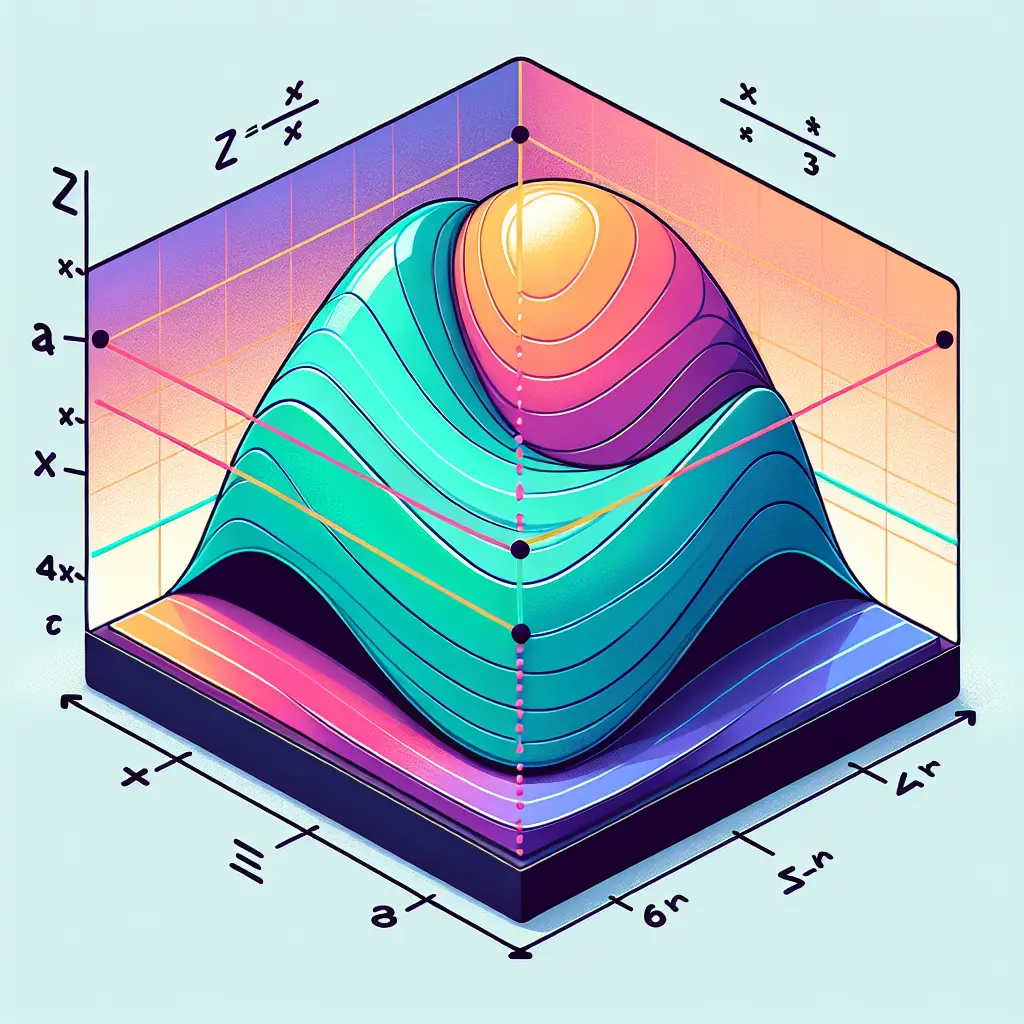
A double integral ∫∫_R f(x,y) dA integrates a function over a region R in the plane. It can compute quantities like the mass of a lamina with density f, or area when f = 1. For a surface z = f(x,y), ∫∫_R f(x,y) dA gives the volume under the surface above R.
What is Fubini's theorem and how do you set up and evaluate iterated integrals?
Fubini's theorem lets you compute a double integral as an iterated integral by integrating one variable at a time. Set up ∫_{a}^{b} ∫_{g1(x)}^{g2(x)} f(x,y) dy dx (or with the order reversed). If the region is simple or the integrand is continuous, you can switch the order to simplify the computation.
What is the Jacobian and why is it important when changing variables in multiple integrals?
The Jacobian is the determinant of the change-of-variables matrix and scales the volume element: dA = |J| du dv and dV = |J| du dv dw. It accounts for stretching or compressing of the region. Examples: polar coordinates have dA = r dr dθ, cylindrical coordinates have dV = r dz dr dθ, spherical coordinates have dV = ρ^2 sinφ dρ dφ dθ.
How do you compute mass and center of mass of a solid with density function ρ(x,y,z) using triple integrals?
Mass M = ∭_E ρ(x,y,z) dV. The center of mass is x̄ = (1/M) ∭_E x ρ dV, ȳ = (1/M) ∭_E y ρ dV, z̄ = (1/M) ∭_E z ρ dV, where E is the solid region.