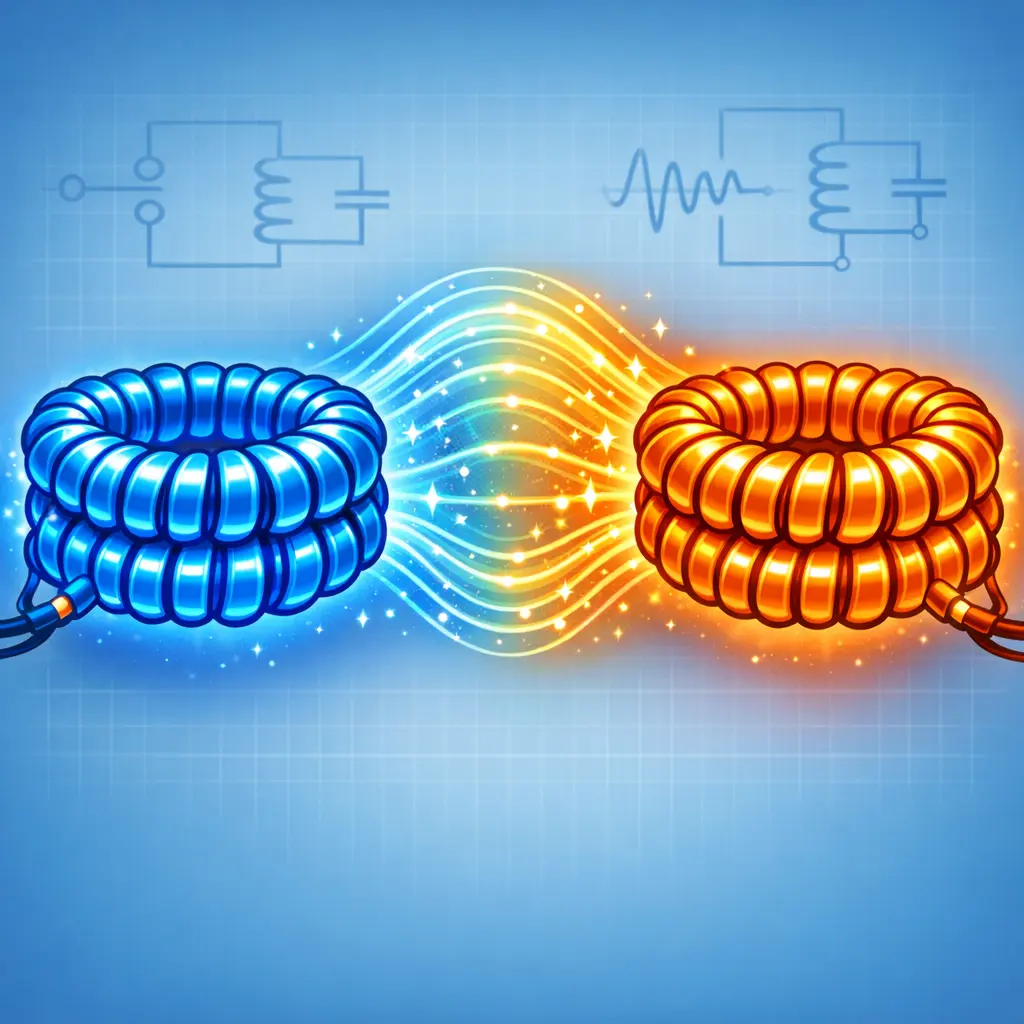
Mutual inductance refers to the phenomenon where a change in electric current in one coil induces a voltage in a nearby coil due to their magnetic fields interacting. Coupled coils are two or more coils positioned so that the magnetic field from one links with the other, allowing energy transfer without direct electrical connection. This principle is fundamental in transformers and many electrical devices, enabling efficient energy transfer and signal processing in circuits.
Mutual Inductance & Coupled Coils Basics
Mutual inductance refers to the phenomenon where a change in electric current in one coil induces a voltage in a nearby coil due to their magnetic fields interacting. Coupled coils are two or more coils positioned so that the magnetic field from one links with the other, allowing energy transfer without direct electrical connection. This principle is fundamental in transformers and many electrical devices, enabling efficient energy transfer and signal processing in circuits.
💡 Key Takeaways
- Understand the concept of mutual inductance and how current in one coil induces voltage in another.
- Recognize the role of the coupling coefficient (k) and how coil geometry and orientation affect coupling.
- Identify common formulas: mutual inductance (M), induced EMF (V2 = -M dI1/dt), and M = k√(L1L2).
- Differentiate between loosely and tightly coupled coils and their impact on voltage transfer and efficiency.
- Explore real-world applications such as transformers and wireless power transfer as examples of coupled coils.
❓ Frequently Asked Questions
What is mutual inductance?
Mutual inductance M measures how effectively a change in current in one coil induces voltage in a neighboring coil. It depends on geometry, core material, and flux linkage; units are henries (H).
What is the coupling coefficient k?
k = M / sqrt(L1 * L2); ranges from 0 (no coupling) to 1 (perfect coupling). It indicates how well flux from one coil links the other.
How do coil orientation and the dot convention affect the induced voltage?
Dots indicate equivalent polarity. Same orientation yields additive induced voltages; opposite orientation yields opposing signs. Misalignment or air gaps reduce coupling.
How can mutual inductance be increased?
Increase turns, use a shared high-permeability core, place coils close and aligned, and minimize air gaps to improve flux linkage.
What is the basic voltage relationship for coupled coils?
General form: v1 = L1 di1/dt + M di2/dt and v2 = M di1/dt + L2 di2/dt. If only i1 changes, v2 ≈ M di1/dt.