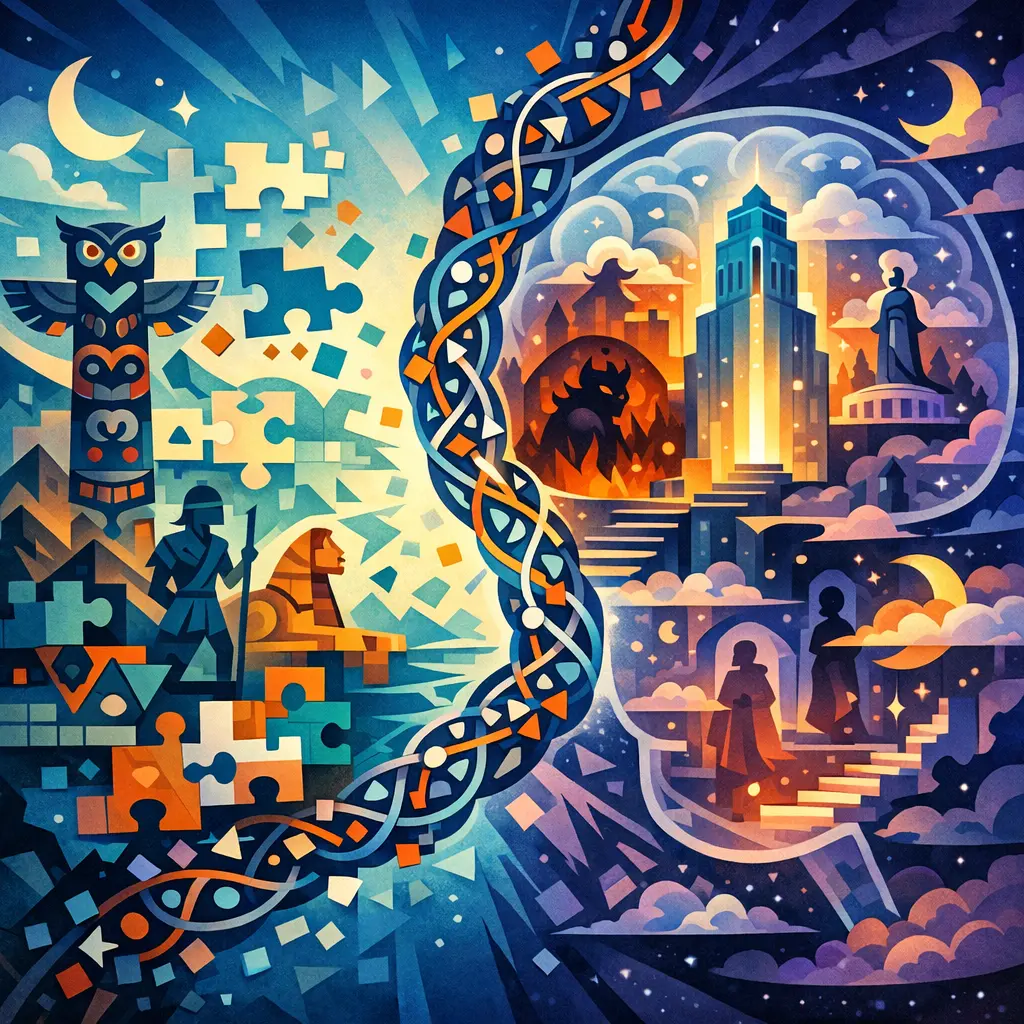
This phrase refers to the evolution of approaches used to interpret myths within the fields of culture, religion, and society. Structuralism analyzes myths by uncovering underlying patterns and binary oppositions, focusing on universal structures within human thought. Psychoanalysis, on the other hand, interprets myths as expressions of unconscious desires, fears, and conflicts, often drawing on Freudian or Jungian theories. Both approaches reveal how myths reflect and shape societal values and beliefs.
Myth Interpretation: Structuralism to Psychoanalysis
This phrase refers to the evolution of approaches used to interpret myths within the fields of culture, religion, and society. Structuralism analyzes myths by uncovering underlying patterns and binary oppositions, focusing on universal structures within human thought. Psychoanalysis, on the other hand, interprets myths as expressions of unconscious desires, fears, and conflicts, often drawing on Freudian or Jungian theories. Both approaches reveal how myths reflect and shape societal values and beliefs.
💡 Key Takeaways
- Understand how structuralism analyzes myths by uncovering their underlying structures and binary oppositions.
- Learn how psychoanalysis interprets myths through symbols, archetypes, and subconscious desires.
- Compare structuralist and psychoanalytic methods to see different explanations for myth, memory, and meaning.
- Apply these approaches to a myth text to identify key structural elements and psychological symbols.
❓ Frequently Asked Questions
What is structuralism in myth interpretation?
Structuralism analyzes myths by uncovering the underlying universal structures that generate stories, such as binary oppositions and recurring motifs, rather than focusing on individual events or authors.
Who are the key figures in structuralist myth analysis?
Claude Lévi-Strauss is the central figure; his work explores how myths reveal the human mind’s shared structures across cultures.
How does a psychoanalytic reading differ from a structuralist one?
Psychoanalytic readings interpret myths as expressions of unconscious wishes and conflicts (symbols, dreams, and desires), while structuralist readings look for universal patterns that organize myths.
What is the value of combining structuralism and psychoanalysis in myth study?
Combining approaches reveals both universal cognitive patterns and deeper symbolic meanings, offering a fuller understanding of myths.