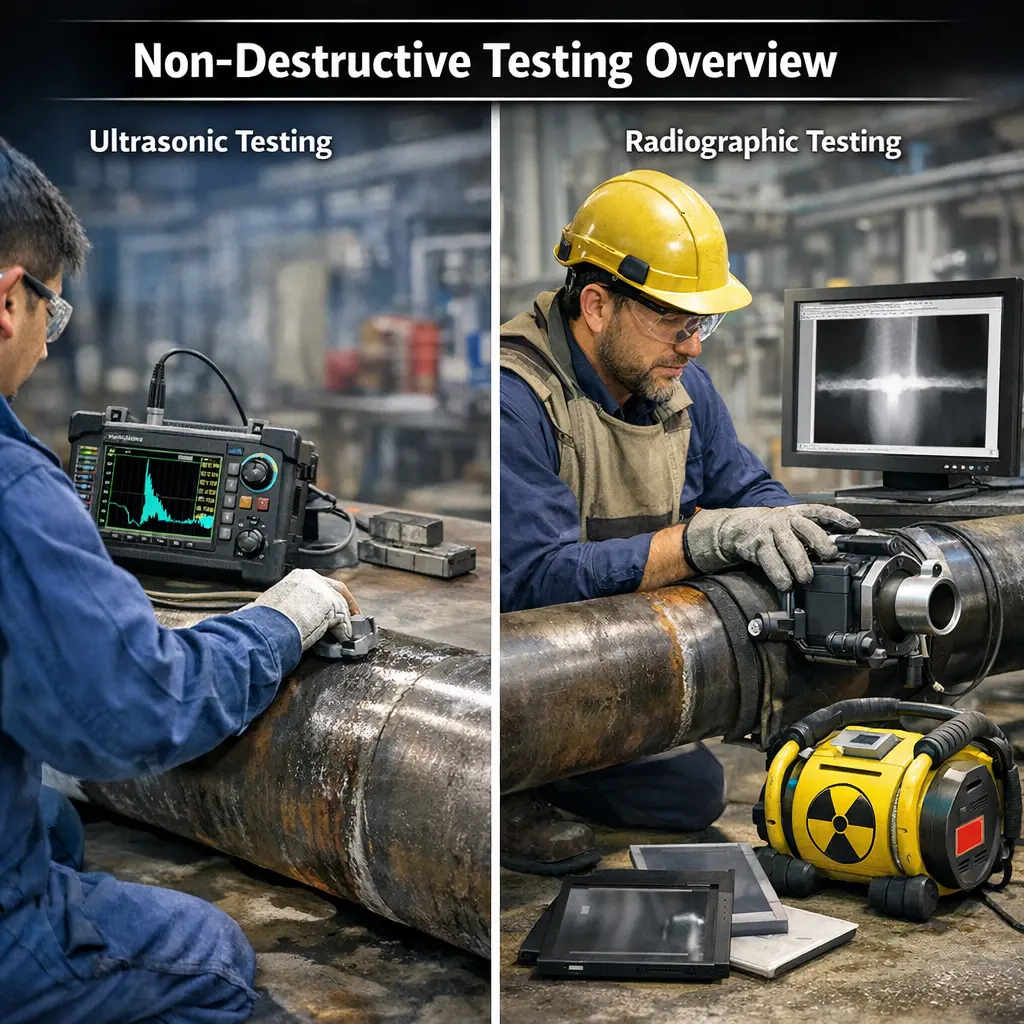
Non-Destructive Testing (NDT) refers to techniques used to evaluate the properties of materials or structures without causing damage. Ultrasonic testing uses high-frequency sound waves to detect internal flaws or measure thickness, while radiography employs X-rays or gamma rays to reveal hidden defects within materials. Both methods are crucial in science and materials engineering, ensuring safety, reliability, and quality control in industries such as aerospace, construction, and manufacturing.
Non-Destructive Testing Overview (Ultrasonic, Radiography)
Non-Destructive Testing (NDT) refers to techniques used to evaluate the properties of materials or structures without causing damage. Ultrasonic testing uses high-frequency sound waves to detect internal flaws or measure thickness, while radiography employs X-rays or gamma rays to reveal hidden defects within materials. Both methods are crucial in science and materials engineering, ensuring safety, reliability, and quality control in industries such as aerospace, construction, and manufacturing.
💡 Key Takeaways
- Understand what non-destructive testing (NDT) is and its goal to assess material integrity without damage.
- Learn Ultrasonic Testing (UT): principle of high-frequency sound waves, flaw detection, and thickness measurement using time-of-flight.
- Learn Radiography Testing (RT): principle of X-ray/gamma-ray imaging to reveal internal features such as cracks and corrosion.
- Compare UT and RT: choose appropriate method based on defect type, material, geometry, inspection speed, and safety considerations.
❓ Frequently Asked Questions
What is non-destructive testing (NDT) and why is it used?
NDT assesses materials and structures for flaws without causing damage, helping ensure safety and reliability by detecting cracks, corrosion, and porosity early.
How does ultrasonic testing (UT) work?
UT sends high-frequency sound into the material; reflections from flaws or boundaries are analyzed to locate, size, and characterize defects, and it can also measure thickness.
How does radiographic testing (RT) work?
RT uses X-rays or gamma rays to penetrate the object; variations in attenuation create an image that reveals internal features and hidden flaws.
When should you choose UT vs RT?
Choose UT for surface-accessible areas and near-surface defects (plus thickness measurements); choose RT for complex geometries or when a volumetric internal image is needed, keeping safety considerations in mind.