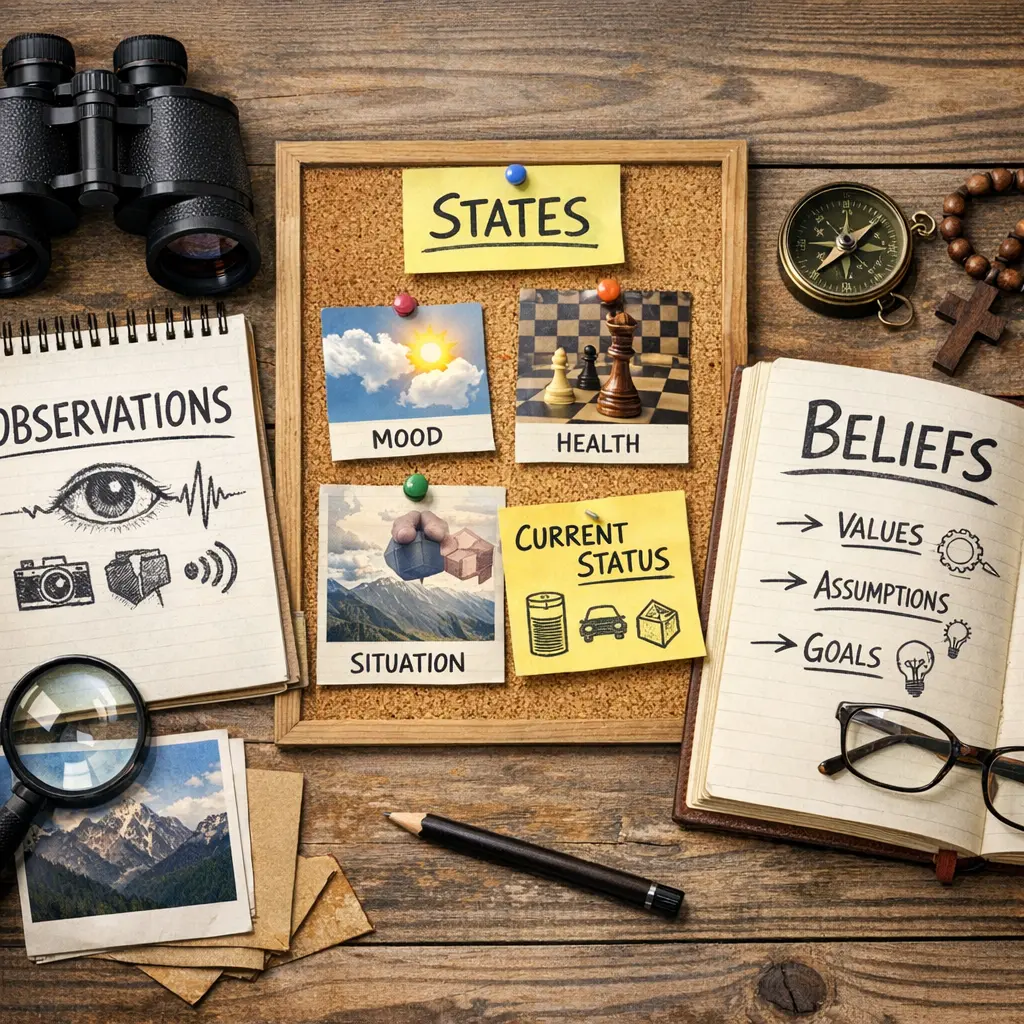
"Observations, States & Beliefs" in agent architecture refer to how an intelligent agent perceives and understands its environment. Observations are the raw data or inputs the agent receives. States represent the actual situation of the environment, which may not be fully visible to the agent. Beliefs are the agent’s internal representation or estimation of the current state, formed by interpreting observations, often under uncertainty or incomplete information.
Observations, States & Beliefs+50
"Observations, States & Beliefs" in agent architecture refer to how an intelligent agent perceives and understands its environment. Observations are the raw data or inputs the agent receives. States represent the actual situation of the environment, which may not be fully visible to the agent. Beliefs are the agent’s internal representation or estimation of the current state, formed by interpreting observations, often under uncertainty or incomplete information.
💡 Key Takeaways
- Differentiate between observations, system states, and personal beliefs.
- Recognize how observations can be influenced by biases and assumptions.
- Learn how new evidence can update or revise beliefs about states.
- Apply a simple framework to map observations to states and beliefs in real-life scenarios.
❓ Frequently Asked Questions
What is an observation?
An observation is data you can verify directly, using your senses or instruments; it describes what happened, not what you think about it.
What does 'state' mean in this context?
A state refers to the current condition or status of something (e.g., a system’s condition, a person’s mood) at a specific moment.
What is a belief?
A belief is a proposition you accept as true, which may or may not be proven; beliefs can be influenced by evidence, experience, and reasoning.
How are observations related to beliefs?
Observations provide evidence that can support or challenge beliefs; good reasoning updates beliefs when reliable observations contradict or confirm them.
What common pitfalls should you avoid when interpreting observations?
Watch for biases like confirmation bias (favoring data that supports your view) and mistaking correlation for causation; seek diverse evidence and consider uncertainty.