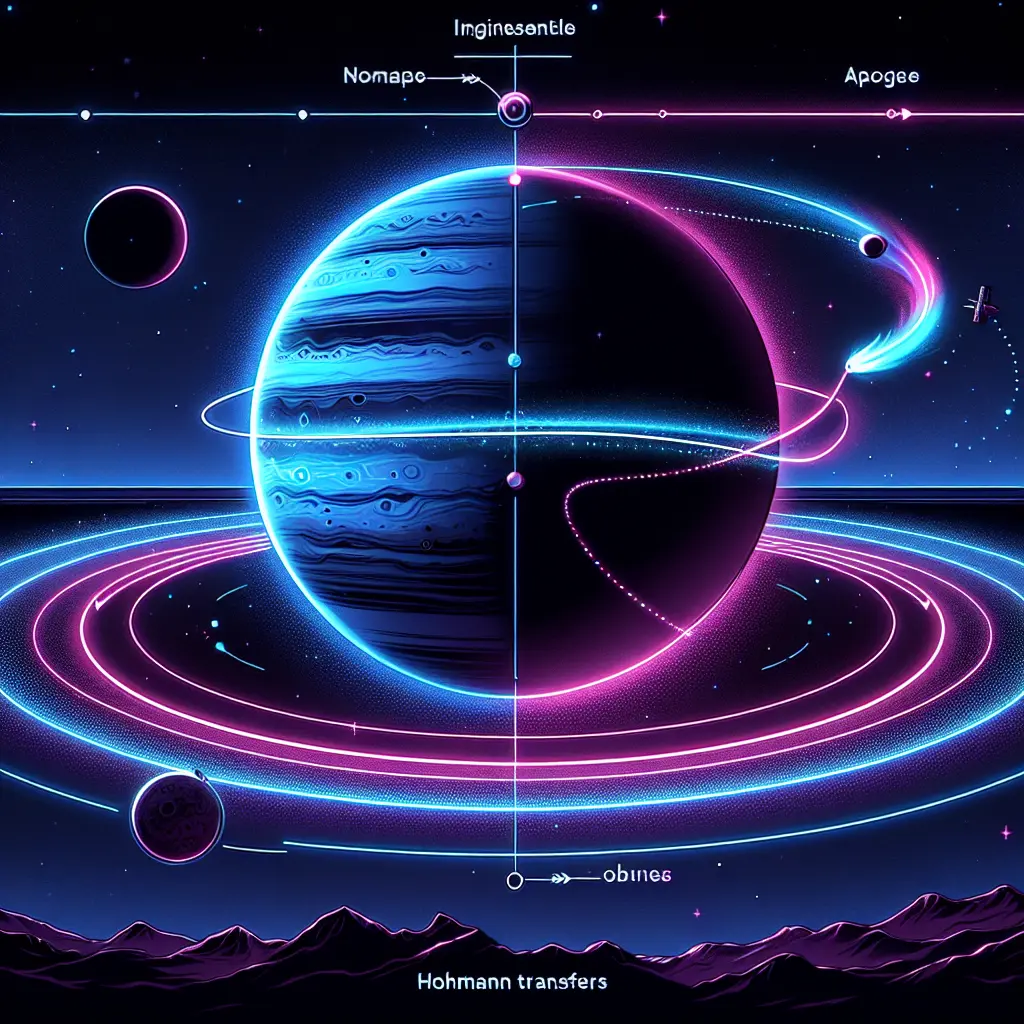
Orbital mechanics involves the study of how objects move in space under gravity. Hohmann transfers are efficient maneuvers to move a spacecraft between two circular orbits using two engine burns, minimizing fuel use. Plane changes, on the other hand, adjust the inclination or orientation of an orbit, usually requiring significant energy. Both techniques are fundamental for planning satellite deployments, interplanetary missions, and rendezvous in space exploration.
Orbital Mechanics: Hohmann Transfers and Plane Changes
Orbital mechanics involves the study of how objects move in space under gravity. Hohmann transfers are efficient maneuvers to move a spacecraft between two circular orbits using two engine burns, minimizing fuel use. Plane changes, on the other hand, adjust the inclination or orientation of an orbit, usually requiring significant energy. Both techniques are fundamental for planning satellite deployments, interplanetary missions, and rendezvous in space exploration.
💡 Key Takeaways
- Understand the basics of orbital mechanics and how gravity governs spacecraft motion.
- Explain why a Hohmann transfer uses two burns to move between circular orbits and how it minimizes fuel use.
- Learn how to estimate the delta-v for a Hohmann transfer based on the radii of the initial and target orbits.
- Describe plane changes, how changing inclination affects velocity, and why changes are most efficient at certain orbital points.
- Identify practical planning considerations for transfers, including timing, sequencing of maneuvers, and real-world effects.
❓ Frequently Asked Questions
What is a Hohmann transfer?
A two-burn maneuver that moves a spacecraft between two circular orbits by using an elliptical transfer orbit that touches both orbits, followed by a burn to circularize at the destination.
Why is a Hohmann transfer fuel-efficient?
For coplanar circular orbits, it uses the minimum total delta-v with two burns by changing velocity at the transfer orbit’s key points to reach the target orbit.
What is a plane change in orbital mechanics?
A maneuver that changes the orbital plane's inclination or orientation, done by a burn perpendicular to the velocity vector; the required delta-v grows with the tilt and current speed.
Can you combine a plane change with a Hohmann transfer?
Yes. A plane change can be integrated into transfer timing or performed at a favorable point to reduce delta-v, though planners balance separate versus combined burns for efficiency.