Oscilloscope probing, grounding, and bandwidth are crucial concepts in basic electricity and circuits. Proper probing ensures accurate signal capture, while correct grounding prevents noise and measurement errors. Bandwidth refers to the oscilloscope's ability to accurately display high-frequency signals; insufficient bandwidth can distort waveforms. Understanding these aspects helps users obtain precise readings, avoid artifacts, and analyze circuit behavior effectively, making them essential skills for anyone working with electronic measurements.
Oscilloscope Probing, Grounding & Bandwidth
Oscilloscope probing, grounding, and bandwidth are crucial concepts in basic electricity and circuits. Proper probing ensures accurate signal capture, while correct grounding prevents noise and measurement errors. Bandwidth refers to the oscilloscope's ability to accurately display high-frequency signals; insufficient bandwidth can distort waveforms. Understanding these aspects helps users obtain precise readings, avoid artifacts, and analyze circuit behavior effectively, making them essential skills for anyone working with electronic measurements.
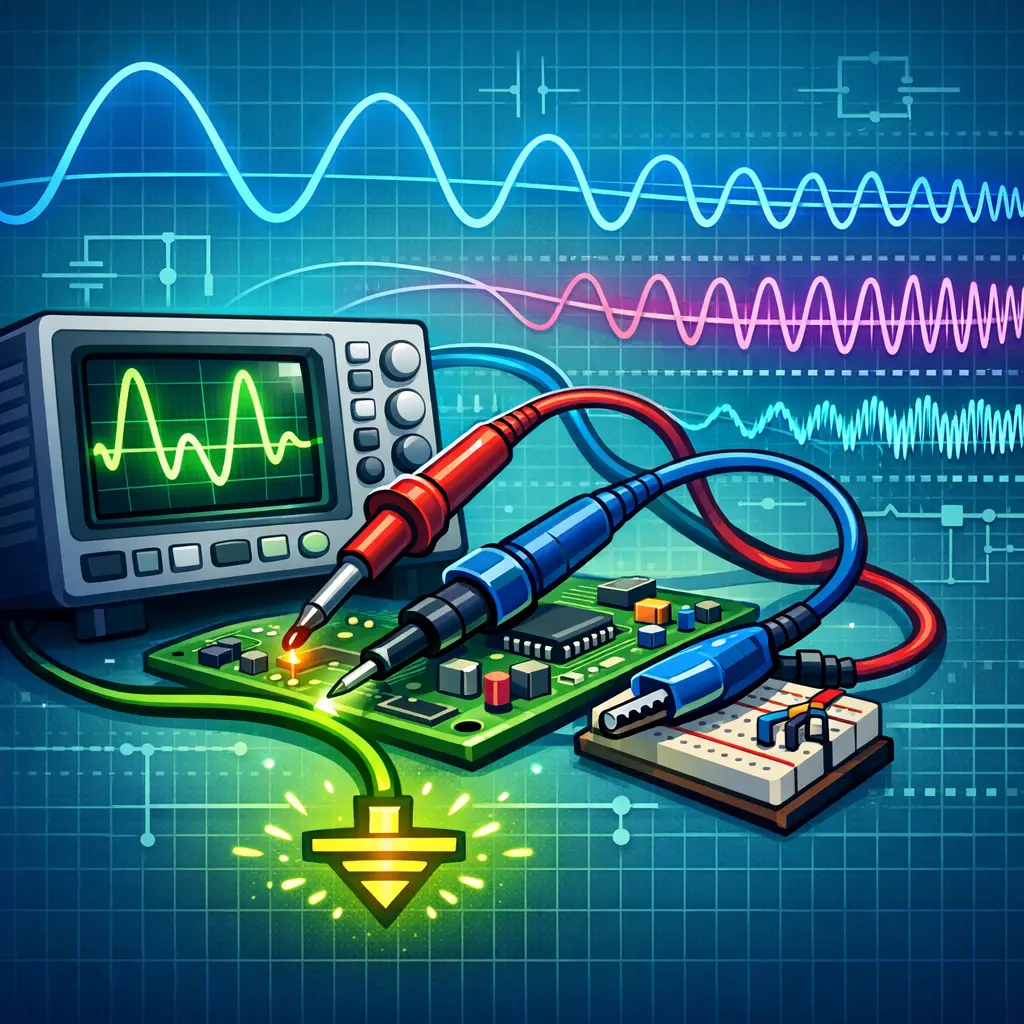
💡 Key Takeaways
- Learn proper oscilloscope probing techniques to minimize circuit loading and measurement error.
- Understand grounding practices, including avoiding ground loops and using proper reference points for safe, noise-free measurements.
- Understand how probe bandwidth affects signal fidelity and how to choose the right bandwidth for your signal.
- Differentiate probe types (passive vs. active) and know how to compensate probes to ensure accurate waveform reproduction.
❓ Frequently Asked Questions
What is oscilloscope probing and why does probe type matter?
Oscilloscope probing means attaching a probe to a circuit to measure voltage signals. Probe type (1x vs 10x, passive vs active) affects how much the circuit is loaded, the usable bandwidth, and how accurately the waveform is reproduced.
How should grounding be handled when probing signals?
Always reference measurements to a solid ground near the test point; use a short ground lead or ground spring to minimize inductance and ground loops; keep wiring tidy to reduce noise.
What does bandwidth mean in an oscilloscope/probe, and why is it important?
Bandwidth is the highest frequency the instrument and probe can accurately reproduce with minimal attenuation. Higher bandwidth lets you capture faster edges. Ensure bandwidth is well above the signal’s content; a common rule is rise time ≈ 0.35 / bandwidth.
What is probe compensation and why is it important?
Compensation tunes the probe to match the oscilloscope input capacitance so attenuation stays flat across frequencies. Incorrect compensation distorts waveforms, especially square waves; adjust using the calibration signal.
What are practical tips to minimize measurement error when probing?
Use a 10x probe for high-impedance nodes; keep ground leads very short (or use a ground spring); verify probe compensation; ensure the scope’s bandwidth covers the signal; avoid ground loops.