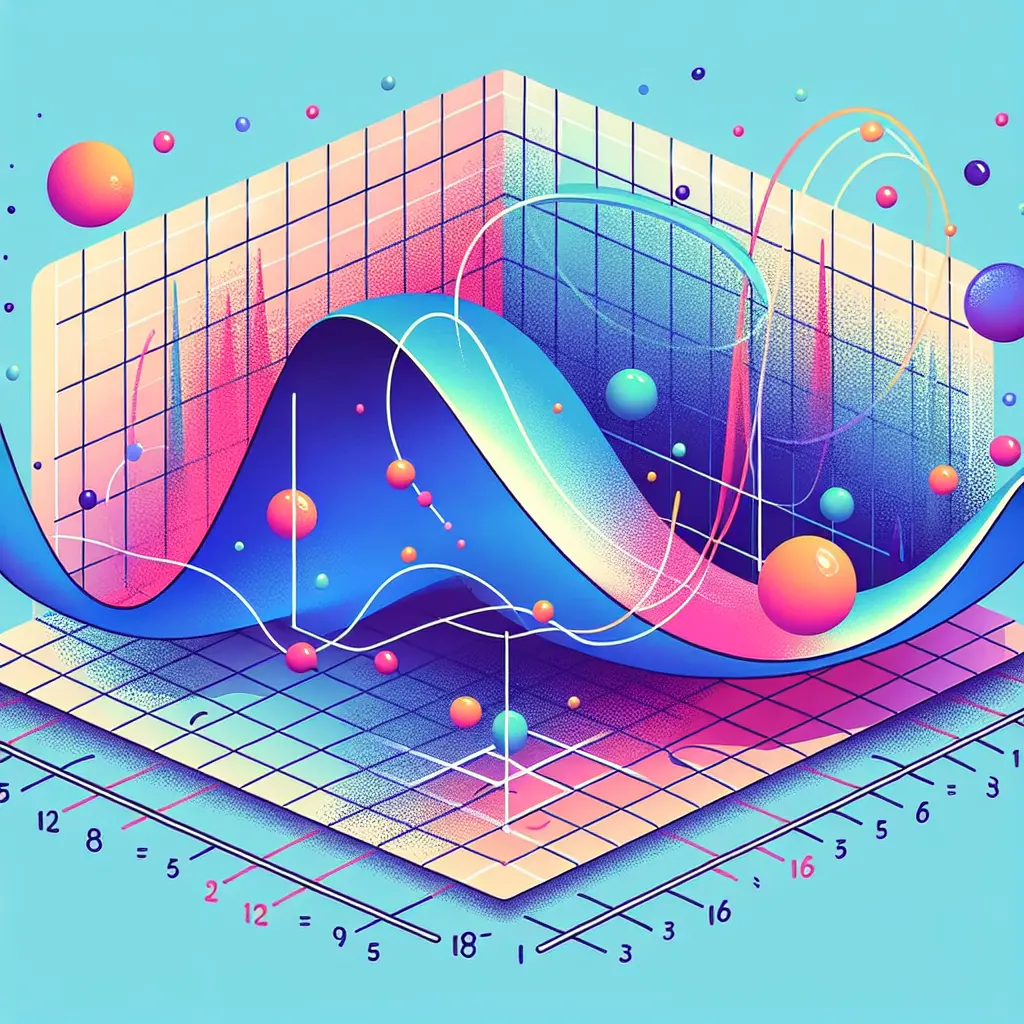
This phrase refers to the study of partial differential equations (PDEs), focusing on the technique of separation of variables and the use of Fourier series. Separation of variables is a method to solve certain PDEs by expressing the solution as a product of functions, each depending on a single variable. Fourier series are used to represent periodic functions as sums of sines and cosines, aiding in solving PDEs with boundary and initial conditions.
PDEs II: Separation of Variables & Fourier Series
This phrase refers to the study of partial differential equations (PDEs), focusing on the technique of separation of variables and the use of Fourier series. Separation of variables is a method to solve certain PDEs by expressing the solution as a product of functions, each depending on a single variable. Fourier series are used to represent periodic functions as sums of sines and cosines, aiding in solving PDEs with boundary and initial conditions.

💡 Key Takeaways
- Form solutions by separation of variables: express the solution as a product of single-variable functions and derive the corresponding ODEs.
- Solve the resulting eigenvalue problems from boundary conditions to identify allowable modes.
- Represent initial data and forcing terms with Fourier series and compute the Fourier coefficients.
- Apply these techniques to classic PDEs (wave, heat, Laplace) and interpret the physical meaning of the modes.
❓ Frequently Asked Questions
What is the method of separation of variables in PDEs?
A technique to solve certain linear PDEs by assuming a solution of the form u(x,t) = X(x)T(t). Substituting yields ODEs for X and T with a shared separation constant; the boundary conditions fix eigenvalues/eigenfunctions, and the full solution is built by superposition of separated solutions.
How are Fourier series used in solving PDEs after separation?
The spatial part from separation provides eigenfunctions. The given initial or boundary data are expanded in these eigenfunctions via a Fourier series; the expansion coefficients are found from orthogonality, and each term evolves in time according to the separated ODE.
What problems are typical for separation of variables and Fourier series?
Linear PDEs with homogeneous boundary conditions on simple domains. Common examples include the heat equation, the wave equation, and Laplace equation on rectangular or cylindrical domains.
What is the role of boundary conditions in these methods?
They determine the allowed eigenvalues and eigenfunctions. Homogeneous boundary conditions lead to clean sine and cosine eigenfunctions and orthogonal bases; nonhomogeneous conditions may require transforming the problem or expanding the data accordingly.