Photodiodes and phototransistors are semiconductor devices used to detect light. Photodiodes generate a current when exposed to light, making them ideal for precise light measurement and fast response applications. Phototransistors, on the other hand, amplify the current produced by light exposure, providing higher sensitivity. Both components are widely used in optical sensors, communication systems, and safety devices, converting light signals into electrical signals for further processing in electronic circuits.
Photodiodes and phototransistors
Photodiodes and phototransistors are semiconductor devices used to detect light. Photodiodes generate a current when exposed to light, making them ideal for precise light measurement and fast response applications. Phototransistors, on the other hand, amplify the current produced by light exposure, providing higher sensitivity. Both components are widely used in optical sensors, communication systems, and safety devices, converting light signals into electrical signals for further processing in electronic circuits.
💡 Key Takeaways
- Learn how photodiodes and phototransistors convert light into electrical signals and their basic operating principles.
- Compare photodiodes and phototransistors in terms of speed, sensitivity, noise, and typical sensing applications.
- Explore common circuit configurations, biasing (such as reverse bias for photodiodes), and how to interface them with microcontrollers or logic circuits.
- Identify key performance metrics such as responsivity, rise/fall time, dark current, and how wavelength affects sensing.
❓ Frequently Asked Questions
What is a photodiode?
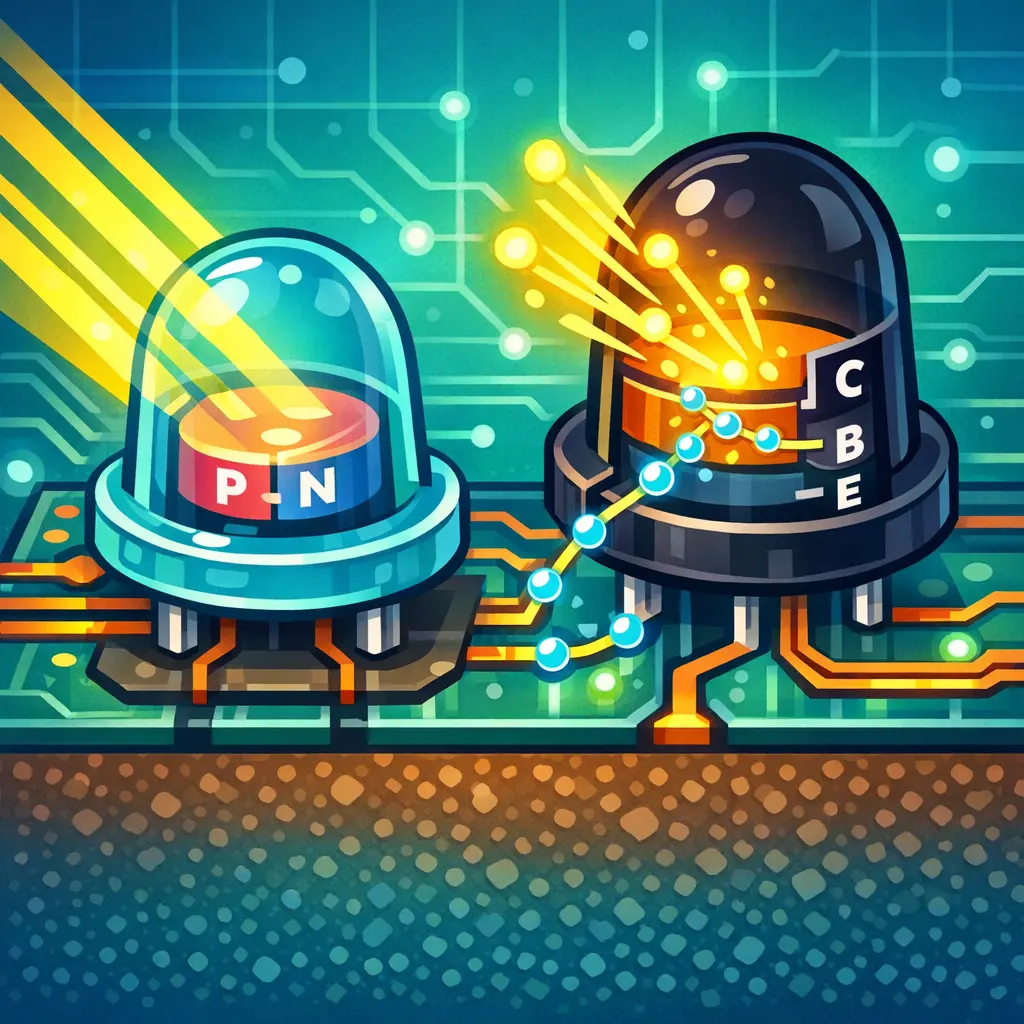
A light-sensitive diode (PN or PIN) that generates an electrical current when illuminated; usually operated in reverse bias for faster, more linear response.
What is a phototransistor?
A transistor whose base current is driven by light, providing amplified output current; higher sensitivity but typically slower than a photodiode.
How do photodiodes operate in photovoltaic vs photoconductive mode?
Photovoltaic mode uses zero external bias to generate a small voltage under light; photoconductive mode applies reverse bias for faster response and higher responsivity (with more dark current).
What is responsivity?
The output current (or voltage) per unit of incident light power, usually expressed in A/W; depends on wavelength and the device material.
What are common applications for photodiodes and phototransistors?
Photodiodes: optical receivers, fiber-optic links, light sensors. Phototransistors: ambient light sensors, IR receivers, proximity/IR sensing in consumer electronics.