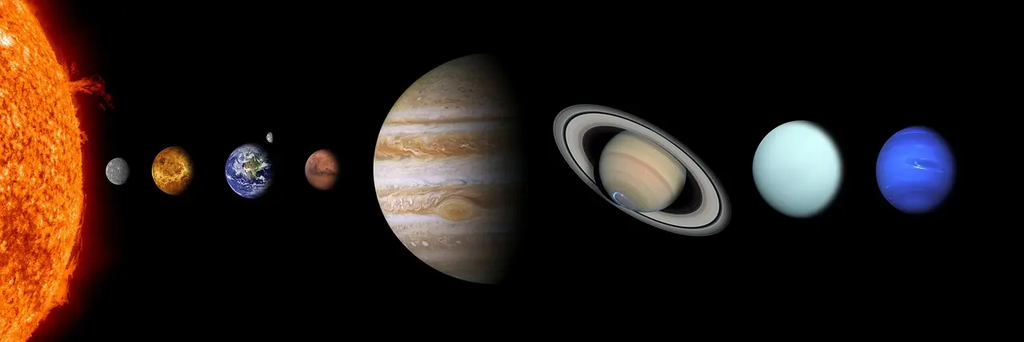
The planets of the Solar System are eight major celestial bodies that orbit the Sun, arranged by distance: Mercury, Venus, Earth, Mars, Jupiter, Saturn, Uranus, and Neptune. Each planet is unique in its size, composition, and atmosphere, ranging from rocky terrestrial planets to massive gas giants. Together, they form a dynamic system, accompanied by moons, asteroids, and other objects, all bound by the Sun’s gravitational pull.
Planets of the Solar System+50
The planets of the Solar System are eight major celestial bodies that orbit the Sun, arranged by distance: Mercury, Venus, Earth, Mars, Jupiter, Saturn, Uranus, and Neptune. Each planet is unique in its size, composition, and atmosphere, ranging from rocky terrestrial planets to massive gas giants. Together, they form a dynamic system, accompanied by moons, asteroids, and other objects, all bound by the Sun’s gravitational pull.
💡 Key Takeaways
- Identify the eight planets in order from the Sun and name a key fact about each.
- Differentiate terrestrial planets from gas/ice giants and explain how their composition shapes their atmospheres and surfaces.
- Compare notable features across the planets—size, distance from the Sun, rings, and major moons.
- Explain how scientists study planets (space missions, telescopes) and what discoveries reveal about the Solar System.
❓ Frequently Asked Questions
How many planets are in the Solar System?
There are 8 planets (Mercury through Neptune). Pluto is classified as a dwarf planet.
Which planet is known as the Red Planet?
Mars.
Which planet has the most prominent ring system?
Saturn.
Which planet is closest to the Sun?
Mercury.
Which planet is the largest in the Solar System?
Jupiter.