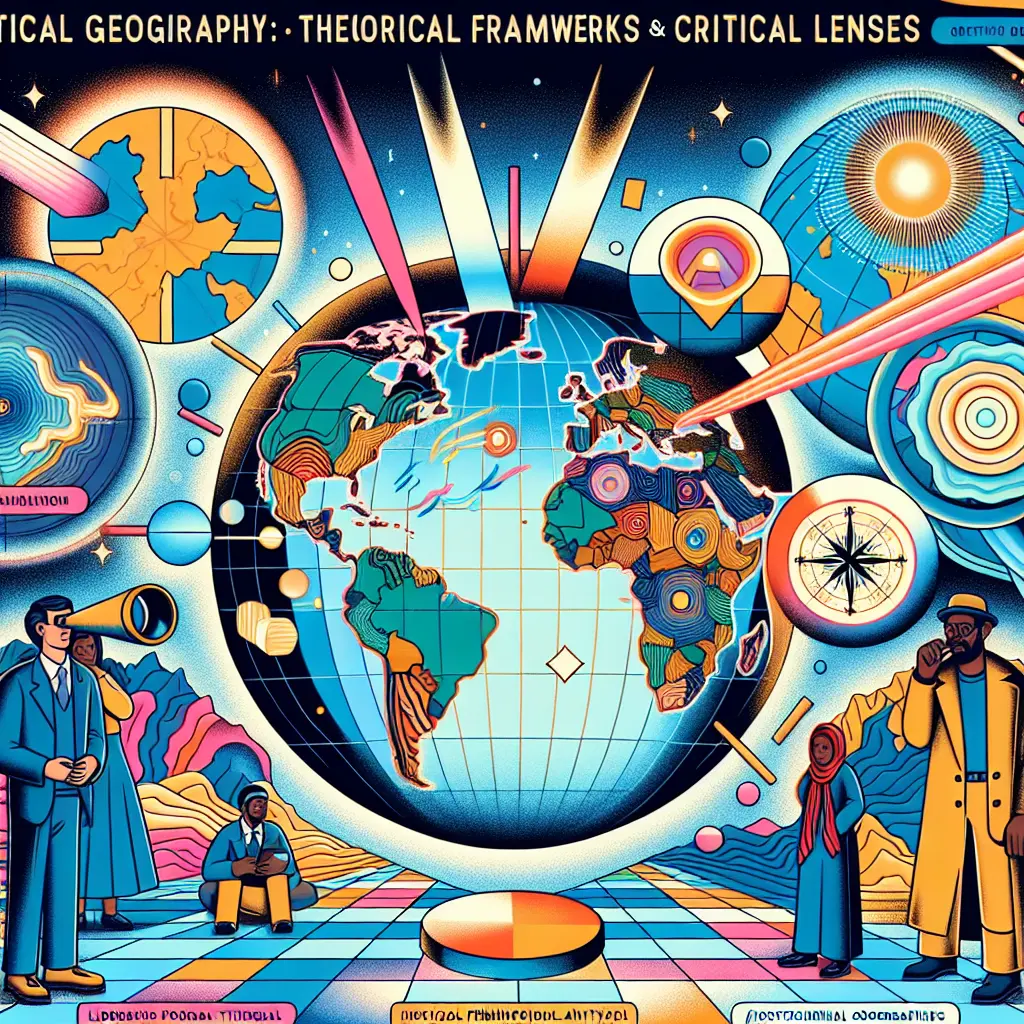
Political Geography: Theoretical Frameworks & Critical Lenses refers to the various conceptual tools and perspectives used to analyze the spatial organization of political processes and power relations. These frameworks help scholars understand how boundaries, territories, states, and identities are constructed and contested. Critical lenses, such as feminism, postcolonialism, or Marxism, challenge traditional views by highlighting issues of inequality, representation, and the impact of historical and social contexts on political landscapes.
Political Geography: Theoretical Frameworks & Critical Lenses
Political Geography: Theoretical Frameworks & Critical Lenses refers to the various conceptual tools and perspectives used to analyze the spatial organization of political processes and power relations. These frameworks help scholars understand how boundaries, territories, states, and identities are constructed and contested. Critical lenses, such as feminism, postcolonialism, or Marxism, challenge traditional views by highlighting issues of inequality, representation, and the impact of historical and social contexts on political landscapes.
💡 Key Takeaways
- Identify common political geography frameworks (e.g., critical geopolitics, territoriality, geostructural analysis) and their core questions.
- Explain how borders, boundaries, and territorial claims shape power, sovereignty, and national identity.
- Compare critical lenses (postcolonial, feminist, and critical geopolitics) to reveal biases in traditional, state-centered analyses.
- Analyze how space, place, and scale influence governance, resource distribution, and the legitimacy of political authority.
- Apply theory to real-world cases such as border disputes, state formation, diasporas, and regional integration.
❓ Frequently Asked Questions
What is political geography?
Political geography studies how geography shapes politics—how borders, territories, locations, and spaces influence power, sovereignty, and political behavior.
What are some major theoretical frameworks used in political geography?
Key frameworks include geopolitics, territoriality/border studies, and perspectives on state/nation formation that analyze how space, sovereignty, resources, and identity organize political life.
What are critical lenses in political geography?
Critical lenses examine power and inequality in space, such as critical geopolitics, feminist geopolitics, and postcolonial geopolitics, to reveal how spatial arrangements produce and contest power.
How do boundaries and borders influence politics?
Boundaries shape governance, security, resource access, and everyday life; they can be formal or informal, legal or social, and may be contested or fluid.