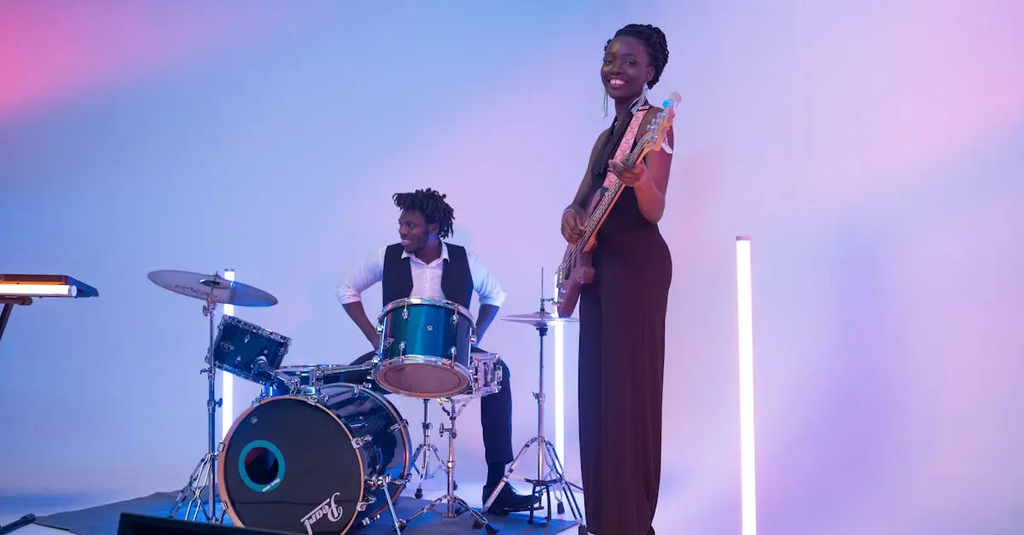
Polyrhythms and odd time signatures refer to advanced rhythmic concepts in music. Polyrhythms involve layering two or more contrasting rhythms simultaneously, creating complex and textured patterns. Odd time signatures use unconventional meter counts, such as 5/4 or 7/8, instead of the standard 4/4 or 3/4, giving music an unpredictable or unique rhythmic feel. Both techniques challenge performers and add depth and interest to musical compositions.
Polyrhythms & Odd Time Signatures
Polyrhythms and odd time signatures refer to advanced rhythmic concepts in music. Polyrhythms involve layering two or more contrasting rhythms simultaneously, creating complex and textured patterns. Odd time signatures use unconventional meter counts, such as 5/4 or 7/8, instead of the standard 4/4 or 3/4, giving music an unpredictable or unique rhythmic feel. Both techniques challenge performers and add depth and interest to musical compositions.

💡 Key Takeaways
- Understand what polyrhythms are and how layering two or more rhythms creates texture in music.
- Recognize and count common odd time signatures (e.g., 5/4, 7/8) and feel their unique pulse.
- Practice simple strategies to internalize and apply polyrhythms in your playing or listening.
- See how artists, including celebrities, use unusual meters to shape groove and musical identity.
❓ Frequently Asked Questions
What is a polyrhythm?
A rhythm that layers two or more contrasting rhythms at the same time, creating a textured groove.
How do you count a 3:2 polyrhythm?
Subdivide the beat into six equal parts; the three notes land on counts 1, 3, 5 and the two notes land on counts 1 and 4 (three in the time of two).
What is an odd time signature? Could you give examples?
An odd time signature uses a meter other than 4/4, such as 5/4 or 7/8. Count by grouping the beats, e.g., 5/4 as 3+2 or 2+3; 7/8 as 3+2+2 or 2+2+3.
Which famous musicians or songs are known for polyrhythms or odd meters?
Dave Brubeck’s Take Five popularized 5/4; bands like Tool, Rush, King Crimson, Frank Zappa, and Radiohead are known for using polyrhythms and odd meters.