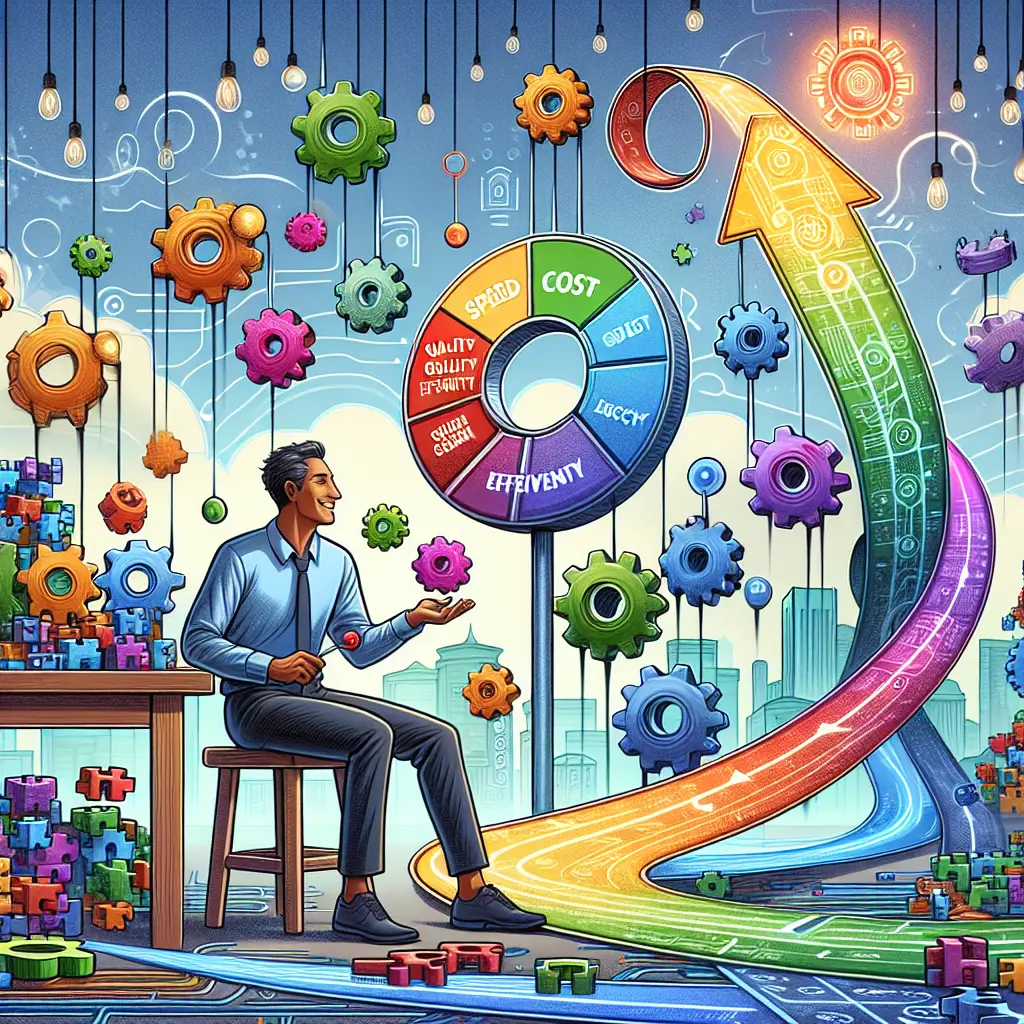
Problem solving often involves optimization trade-offs, where achieving the best possible outcome in one area may require compromising in another. These trade-offs arise because resources like time, cost, and quality are limited. Decision-makers must balance competing objectives, prioritizing what matters most while accepting that perfect solutions are rarely feasible. Effective problem solving, therefore, means identifying and managing these trade-offs to achieve the most satisfactory overall result.
Problem Solving: Optimization Trade-offs
Problem solving often involves optimization trade-offs, where achieving the best possible outcome in one area may require compromising in another. These trade-offs arise because resources like time, cost, and quality are limited. Decision-makers must balance competing objectives, prioritizing what matters most while accepting that perfect solutions are rarely feasible. Effective problem solving, therefore, means identifying and managing these trade-offs to achieve the most satisfactory overall result.
💡 Key Takeaways
- Understand what optimization trade-offs are and why improving one outcome may require sacrificing another due to limited resources.
- Identify key resources (time, cost, quality) that constrain decisions and how they interact.
- Learn simple ways to balance competing objectives, such as prioritizing criteria and evaluating trade-offs with Pareto-like thinking.
- Apply quick decision heuristics to choose practical, acceptable compromises in real-world problems.
❓ Frequently Asked Questions
What are optimization trade-offs in problem solving?
They arise when resources like time, money, or effort are limited; improving one objective (e.g., speed) may require compromising another (e.g., accuracy or cost).
Why can't you maximize all objectives at once?
Because improving one objective often worsens another due to constraints; you must balance competing aims.
What is a Pareto optimal solution?
A solution where no objective can be improved without hurting at least one other; it helps identify balanced options.
How should you approach decision-making with trade-offs?
Define the goal, list constraints, evaluate how each option affects time, cost, and quality, and choose the option with the best overall fit.
Can you give a simple example of a trade-off?
In a brain teaser, speeding up might increase mistakes; taking more time can boost accuracy at the expense of time.