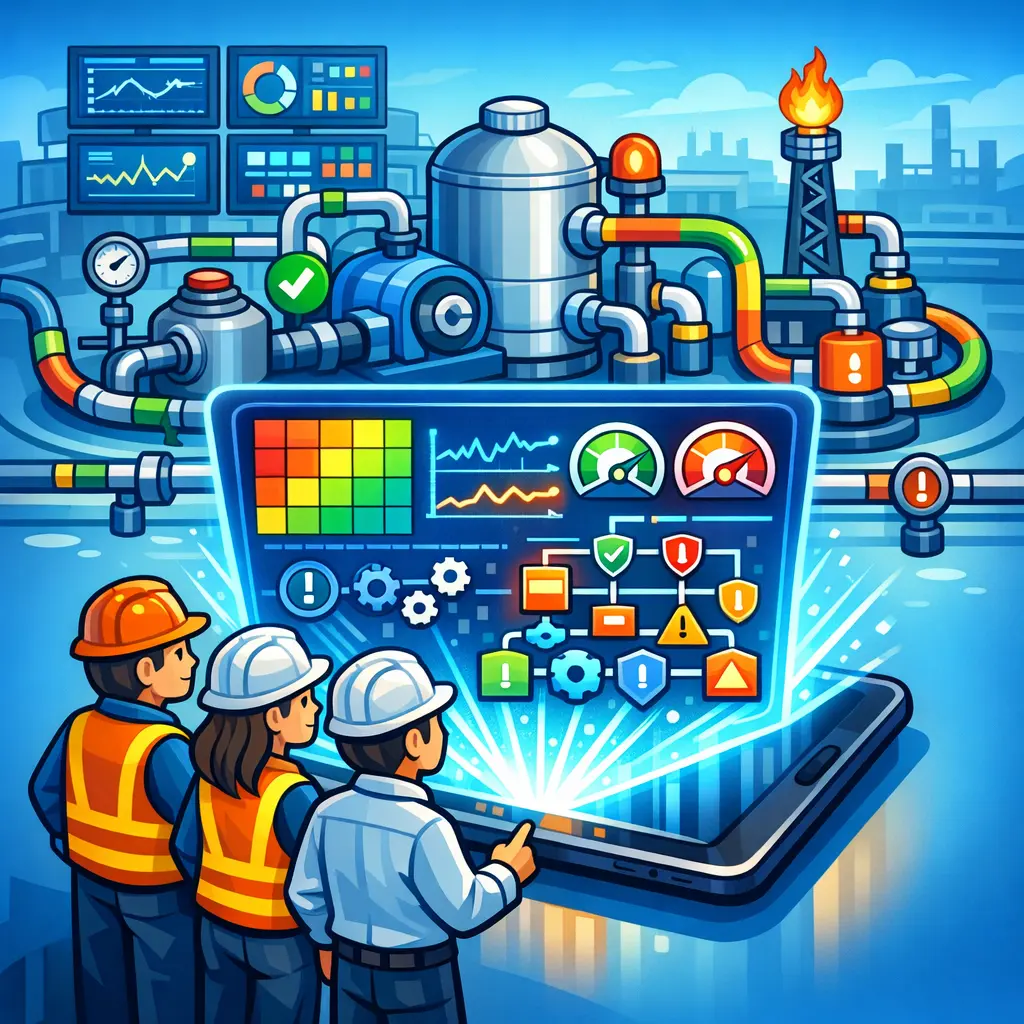
Process Safety, Risk & Reliability Engineering focuses on identifying, assessing, and mitigating hazards in industrial processes to ensure safe and efficient operations. Professionals in this field analyze potential risks, develop safety protocols, and design systems to prevent accidents or equipment failures. Their work is critical in industries like oil and gas, chemicals, and manufacturing, where they help protect people, the environment, and assets by ensuring compliance with safety standards and enhancing system reliability.
Process Safety, Risk & Reliability Engineering
Process Safety, Risk & Reliability Engineering focuses on identifying, assessing, and mitigating hazards in industrial processes to ensure safe and efficient operations. Professionals in this field analyze potential risks, develop safety protocols, and design systems to prevent accidents or equipment failures. Their work is critical in industries like oil and gas, chemicals, and manufacturing, where they help protect people, the environment, and assets by ensuring compliance with safety standards and enhancing system reliability.
💡 Key Takeaways
- Grasp how process safety, risk assessment, and reliability engineering connect in industrial operations
- Identify hazards and perform risk assessments using methods like HAZOP and LOPA to mitigate risk
- Apply reliability concepts (MTBF, maintainability, redundancy) to design safer, more resilient systems
- Understand safety instrumentation, SIS/SIL levels, and incident investigation for continuous safety improvement
❓ Frequently Asked Questions
What is process safety, and why is it essential in process industries?
Process safety aims to prevent or limit the consequences of hazardous chemical releases and incidents. It focuses on identifying hazards, assessing risks, and implementing safeguards, operating procedures, and a robust management of change to protect people, the environment, and assets.
What are common methods used for process safety risk assessments?
Common methods include HAZOP (Hazard and Operability Study) for identifying deviations, LOPA (Layer of Protection Analysis) for evaluating risk reduction, and Bow-tie diagrams or FMEA to visualize causes, controls, and consequences.
What is a Safety Instrumented System (SIS) and what does Safety Integrity Level (SIL) mean?
A Safety Instrumented System is an engineered system that detects hazardous conditions and takes protective actions. SIL 1–4 specifies the required risk-reduction level, with higher numbers indicating greater reduction; it guides design, validation, and maintenance of protective functions.
How does reliability engineering relate to process safety, and what are key metrics?
Reliability engineering focuses on keeping systems operating reliably. Key metrics include MTBF (mean time between failures) and availability. Techniques include reliability-centered maintenance (RCM), redundancy, preventive maintenance, and condition monitoring.
What is inherently safer design, and what are its core principles?
Inherently safer design aims to eliminate or reduce hazards at the source. Core principles include avoidance, substitution, minimization, simplification, and moderation of hazardous materials and energy, applied early in the design process.