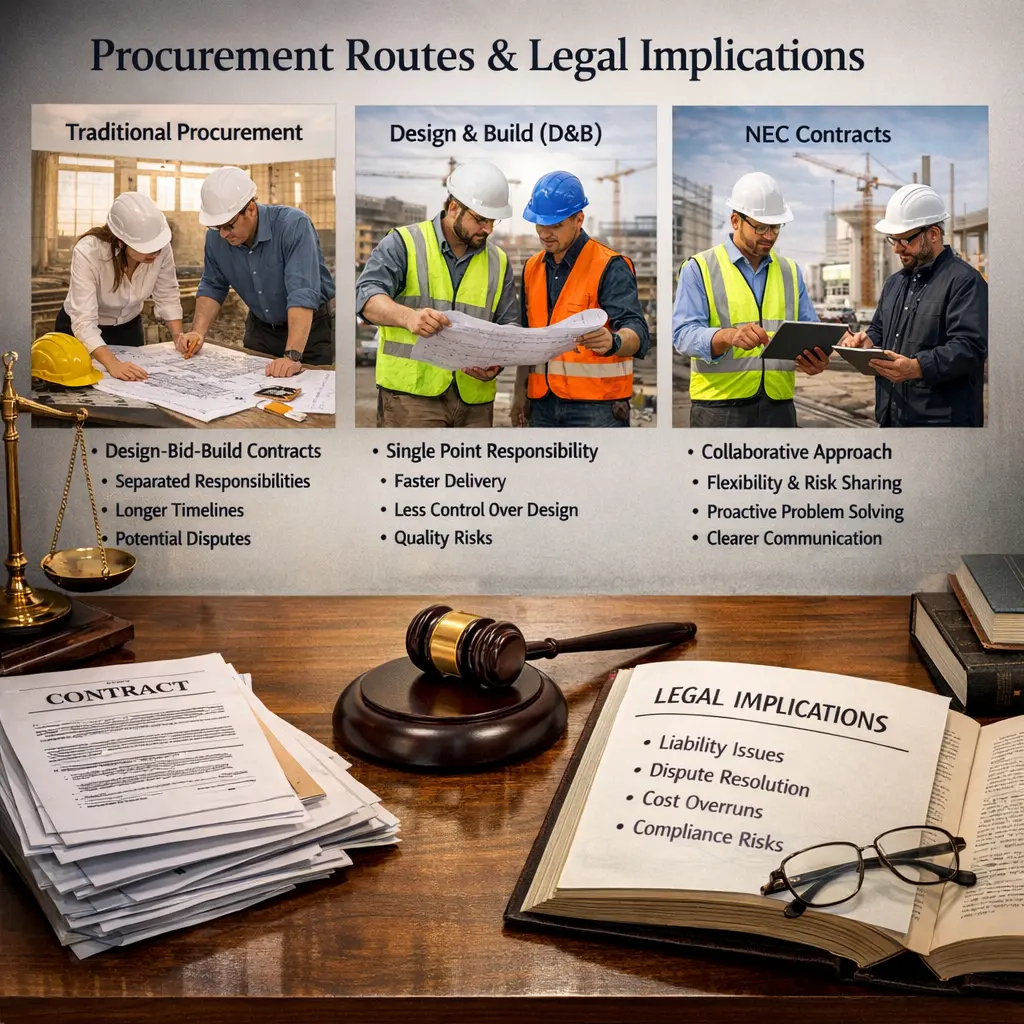
Procurement routes like traditional, Design & Build (D&B), and NEC contracts each have distinct legal and statutory implications. Traditional procurement separates design and construction, often leading to clear legal responsibilities but potential disputes. D&B combines design and construction under one entity, shifting legal risks to the contractor. NEC contracts emphasize flexibility and collaboration, but require strict compliance with procedures. Each route must adhere to statutory requirements, such as health, safety, and contractual obligations.
Procurement routes and legal implications (traditional, D&B, NEC)
Procurement routes like traditional, Design & Build (D&B), and NEC contracts each have distinct legal and statutory implications. Traditional procurement separates design and construction, often leading to clear legal responsibilities but potential disputes. D&B combines design and construction under one entity, shifting legal risks to the contractor. NEC contracts emphasize flexibility and collaboration, but require strict compliance with procedures. Each route must adhere to statutory requirements, such as health, safety, and contractual obligations.
💡 Key Takeaways
- Understand who is responsible for design, construction, and contract administration in traditional, D&B, and NEC procurement.
- Identify the main legal implications of each route, including risk allocation, liability, and change control processes.
- Learn how NEC contracts encourage collaboration through early warnings and compensation events, compared with traditional or D&B methods.
- Evaluate how the procurement route affects cost certainty, schedule visibility, and dispute risk.
❓ Frequently Asked Questions
What is traditional procurement in construction?
A separate design and construction process: designers prepare the design and quantities, then a contractor is invited to build to that design. The client bears more design risk, and payment is usually based on measured works against the design.
What is Design and Build (D&B) procurement?
A single contractor is responsible for both design and construction. This gives a single point of accountability and often faster delivery, but transfers design risk to the contractor and reduces client control over design.
What is NEC procurement and what are its key legal features?
NEC is a family of collaborative contracts (e.g., NEC4 ECC) that emphasize early warnings, clear change control, and cooperative risk management. Legally, it supports proactive changes, defined compensation events, and transparent payment and liability.
How do changes and risk management differ between these routes?
Traditional: changes require formal variations and can raise disputes over design responsibility. D&B: changes flow through a single contractor with client approvals for design changes. NEC: changes are managed via compensation events and early warnings, promoting shared risk and open communication.