Public-Private Partnerships (PPP) Procurement refers to the structured process through which government entities collaborate with private sector companies to deliver public infrastructure or services. This involves tendering, where competitive bids are solicited from private firms, and procurement, which encompasses the selection, negotiation, and contracting phases. PPP procurement aims to leverage private sector expertise, innovation, and financing, while ensuring transparency, value for money, and risk allocation in public projects.
Public-Private Partnerships (PPP) Procurement
Public-Private Partnerships (PPP) Procurement refers to the structured process through which government entities collaborate with private sector companies to deliver public infrastructure or services. This involves tendering, where competitive bids are solicited from private firms, and procurement, which encompasses the selection, negotiation, and contracting phases. PPP procurement aims to leverage private sector expertise, innovation, and financing, while ensuring transparency, value for money, and risk allocation in public projects.
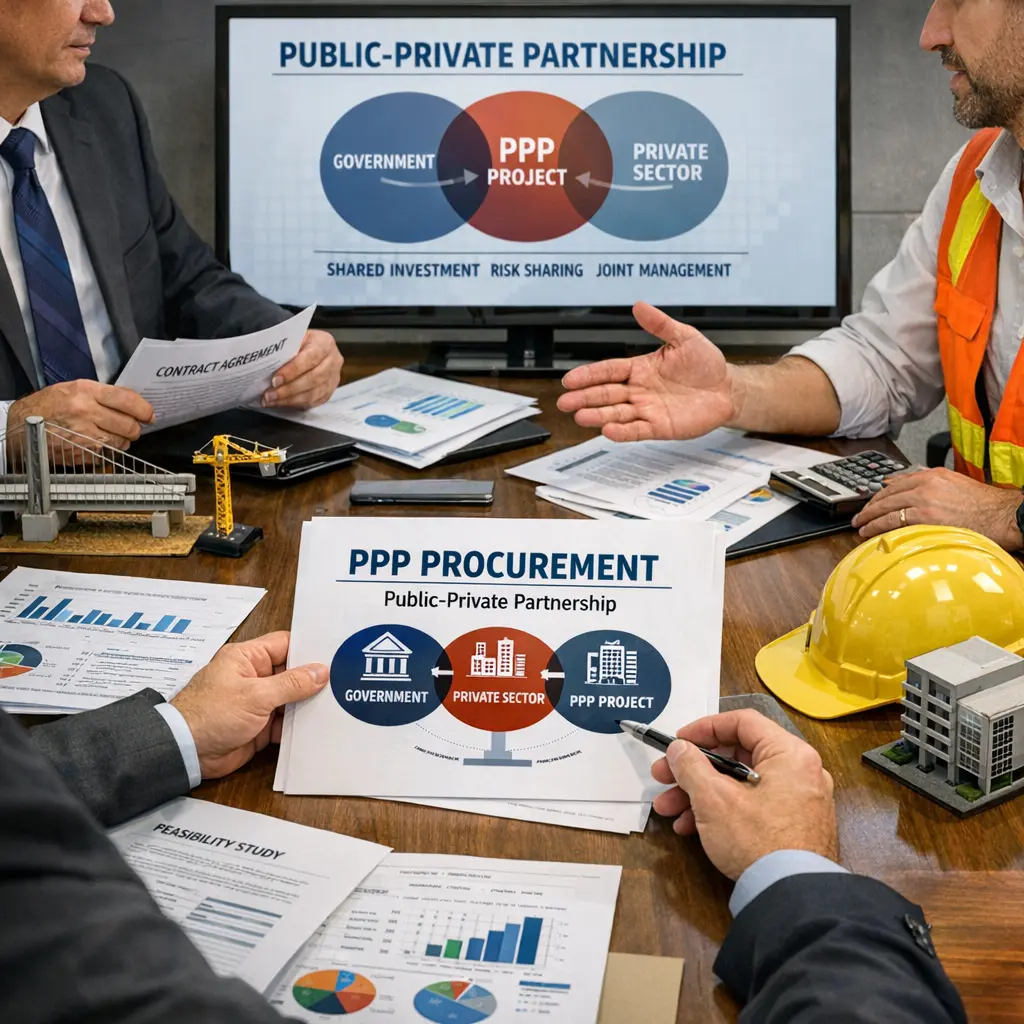
💡 Key Takeaways
- Define PPP and how it differs from traditional procurement.
- Identify common PPP contract models and procurement approaches.
- Explain risk transfer and value-for-money in PPP projects.
- Outline the PPP procurement lifecycle from business case to contract management.
❓ Frequently Asked Questions
What is a Public-Private Partnership (PPP) in procurement?
A PPP is a long-term collaboration where a public entity contracts a private partner to finance, design, build, operate, and maintain an asset or service, with payments tied to performance and outcomes.
How does PPP procurement differ from traditional procurement?
The private sector funds and runs the asset over a long contract, with risk transferred to the private partner and payments tied to availability or performance, rather than a one-off capital purchase by the public sector.
What are common PPP procurement models?
Examples include BOT (Build-Operate-Transfer), BOO (Build-Own-Operate), DBFOM/DBFO (Design-Build-Finance-Operate-Maintain / Design-Build-Finance-Operate), and availability-based PPPs.
What are the key stages in a PPP procurement process?
Feasibility and scoping, market sounding, bid/tendering, risk allocation and contract design, evaluation and award, and contract management with performance monitoring.