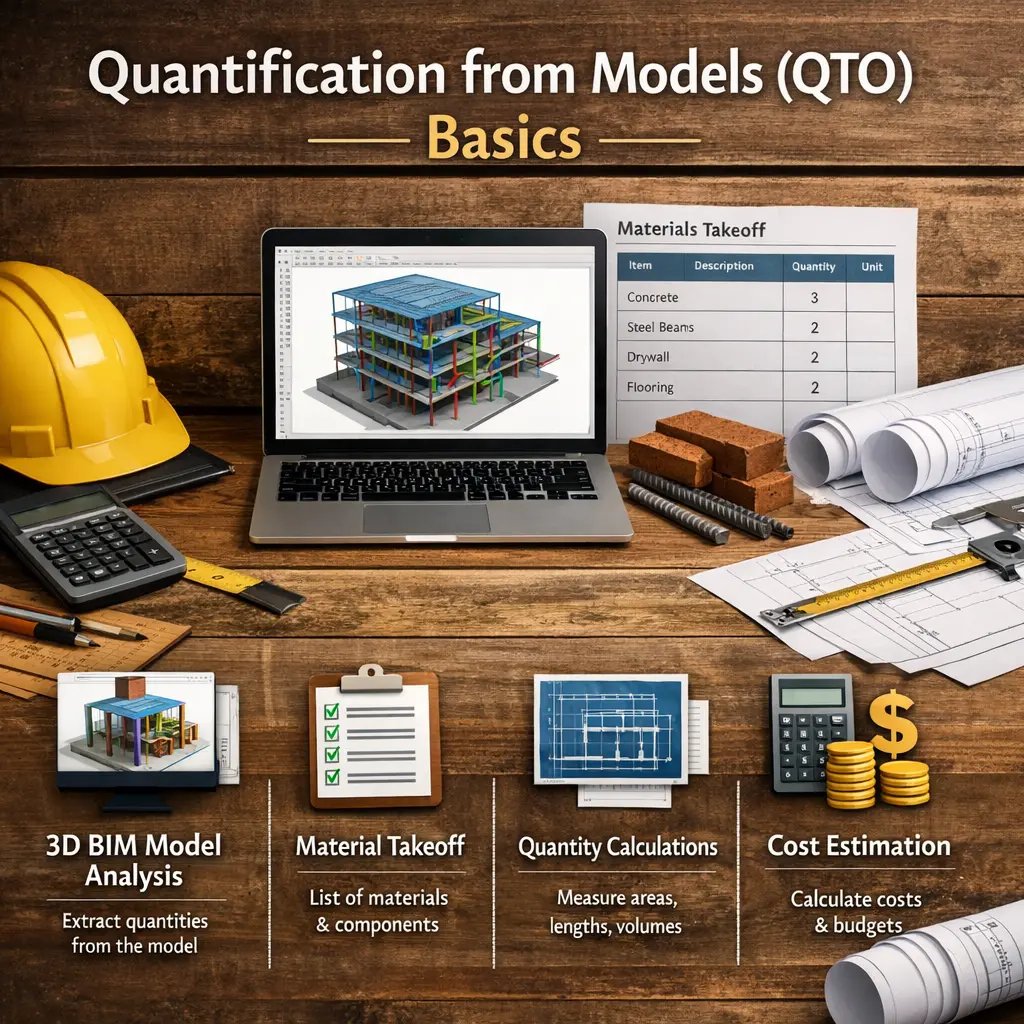
Quantification from Models (QTO) Basics refers to the process of extracting precise measurements and quantities, such as areas, volumes, and counts, directly from digital building models, typically created using Building Information Modeling (BIM) software. In digital applications for construction information, QTO streamlines estimating, procurement, and project management by automating data extraction, reducing errors, and enhancing accuracy compared to manual takeoffs from traditional drawings. This approach improves efficiency and supports better decision-making in construction projects.
Quantification from Models (QTO) Basics
Quantification from Models (QTO) Basics refers to the process of extracting precise measurements and quantities, such as areas, volumes, and counts, directly from digital building models, typically created using Building Information Modeling (BIM) software. In digital applications for construction information, QTO streamlines estimating, procurement, and project management by automating data extraction, reducing errors, and enhancing accuracy compared to manual takeoffs from traditional drawings. This approach improves efficiency and supports better decision-making in construction projects.
💡 Key Takeaways
- Define Quantification from Models (QTO) and how it focuses on estimating group-level quantities rather than individual predictions.
- Learn when QTO is appropriate to estimate class prevalences or distribution shifts in data.
- Explore basic QTO methods such as adjusting observed counts and simple calibration techniques to correct biases.
- Understand evaluation approaches for QTO, including relevant metrics and considerations for multi-class and shifting datasets.
❓ Frequently Asked Questions
What is quantification in the context of QTO?
Quantification estimates the prevalence (proportions) of each class in a dataset, focusing on group-level distributions rather than predicting a label for every individual item.
How is QTO different from standard classification?
Classification predicts a label for each item; quantification aims to determine the overall class distribution in a set, and may account for distribution shifts between training and target data.
What are common approaches to Quantification from Models (QTO)?
Typical methods include (a) classify-and-count, (b) adjusted counts using the classifier’s confusion matrix, (c) probabilistic estimation using predicted probabilities, and (d) model-based or calibration approaches to estimate true class priors under drift.
How is QTO performance evaluated?
Use prevalence-focused metrics such as Absolute Error (L1) between true and estimated proportions, Relative Error, and distribution divergences like KL or Jensen-Shannon; sometimes counts accuracy is also considered.