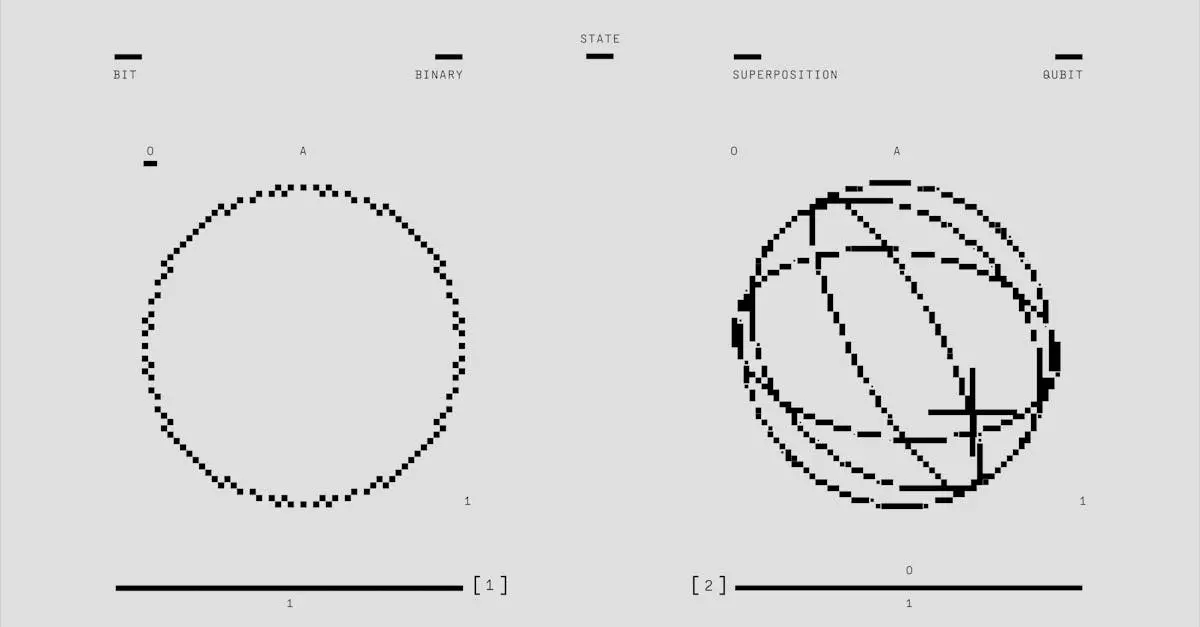
Quantum computing basics involve the use of quantum bits, or qubits, which can exist in multiple states simultaneously due to superposition. Unlike classical bits that represent either 0 or 1, qubits enable more complex computations. Quantum computers also utilize entanglement, a phenomenon where qubits become interconnected and influence each other’s states. These principles allow quantum computers to solve certain problems much faster than traditional computers, revolutionizing fields like cryptography and optimization.
Quantum Computing Basics
Quantum computing basics involve the use of quantum bits, or qubits, which can exist in multiple states simultaneously due to superposition. Unlike classical bits that represent either 0 or 1, qubits enable more complex computations. Quantum computers also utilize entanglement, a phenomenon where qubits become interconnected and influence each other’s states. These principles allow quantum computers to solve certain problems much faster than traditional computers, revolutionizing fields like cryptography and optimization.
💡 Key Takeaways
- Understand what a qubit is and how it differs from a classical bit.
- Grasp the concept of superposition and how it allows qubits to represent multiple states.
- Learn about entanglement and its role in linking qubits for complex computations.
- Consider software development implications when working with quantum algorithms, including handling probabilistic results and multiple executions.
❓ Frequently Asked Questions
What is a qubit and how does it differ from a classical bit?
A qubit is the quantum equivalent of a bit. Unlike a classical bit that is 0 or 1, a qubit can be in a superposition of both states, described by amplitudes, until it is measured.
What is superposition and why does it matter for computation?
Superposition lets a qubit represent 0 and 1 at the same time, enabling parallel exploration of many states. This can speed up certain computations when combined with interference and entanglement.
What is entanglement and why is it useful in quantum computing?
Entanglement creates correlations between qubits such that the state of one qubit depends on others. This shared state expands the computational space and enables powerful quantum algorithms.
What happens when you measure a quantum state?
Measurement collapses the qubit's superposition to a definite 0 or 1, with probabilities determined by the state's amplitudes. Measurement also disrupts the quantum state.
How does quantum programming differ from classical programming for software developers?
Quantum programs describe sequences of quantum gates acting on qubits and must account for noise and error correction. They run on quantum hardware or simulators and typically complement classical code.