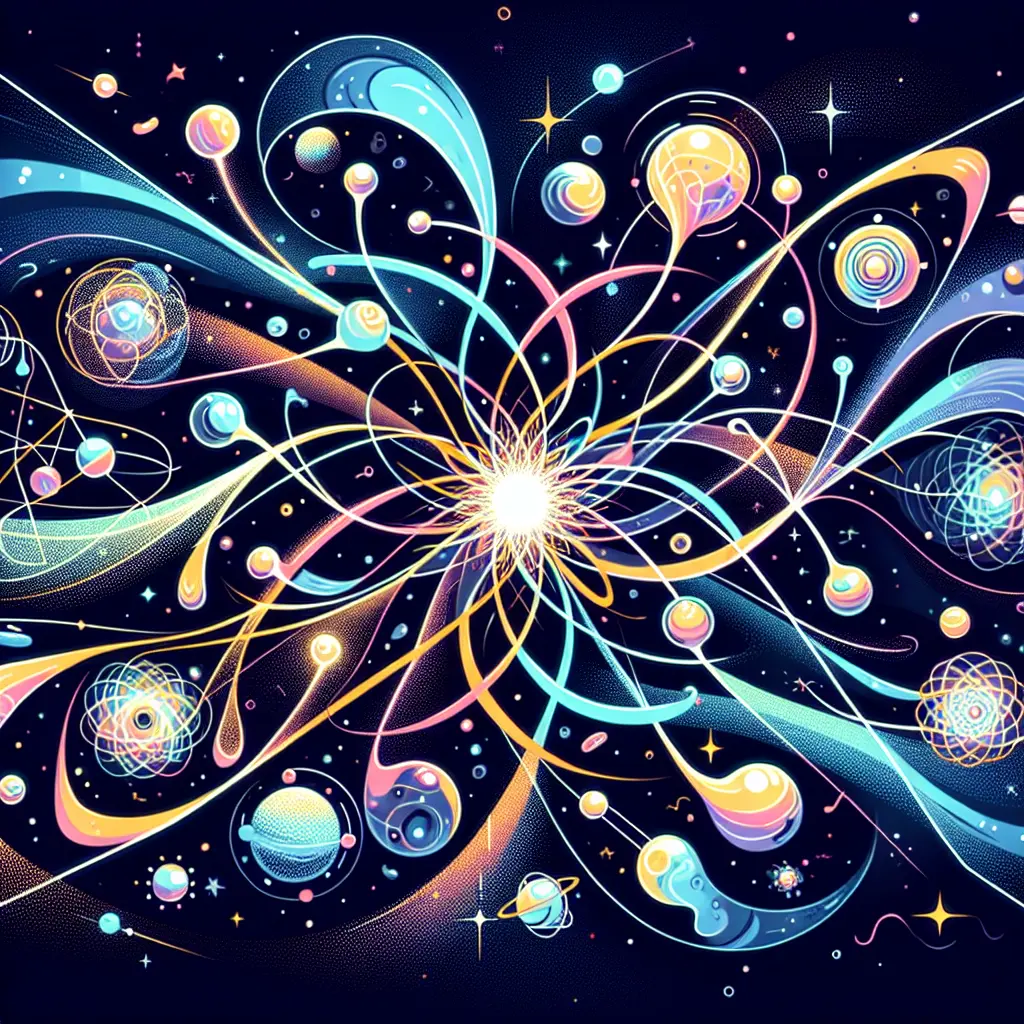
"Quantum Realms & Many-Worlds" refers to concepts in quantum physics where reality operates on a subatomic level, governed by probabilistic and often counterintuitive rules. The "Quantum Realms" represent these microscopic domains, while "Many-Worlds" is a theory suggesting that every quantum event branches into multiple, parallel universes, each representing different possible outcomes. Together, they evoke the idea of a reality far more complex and layered than our everyday experience suggests.
Quantum Realms & Many‑Worlds
"Quantum Realms & Many-Worlds" refers to concepts in quantum physics where reality operates on a subatomic level, governed by probabilistic and often counterintuitive rules. The "Quantum Realms" represent these microscopic domains, while "Many-Worlds" is a theory suggesting that every quantum event branches into multiple, parallel universes, each representing different possible outcomes. Together, they evoke the idea of a reality far more complex and layered than our everyday experience suggests.
💡 Key Takeaways
- Distinguish quantum realms (microscopic domains) from everyday reality.
- Grasp how probability governs quantum events and the roles of superposition and measurement.
- Understand the Many-Worlds interpretation and its claim of parallel universes for each quantum event.
- Explore how quantum ideas inspire fiction, franchises, and stories that feature alternate or branching universes.
❓ Frequently Asked Questions
What are Quantum Realms?
Quantum Realms refer to the microscopic domains where quantum effects dominate—such as atoms and particles—governed by probabilities and wave-like behavior rather than certainties of classical physics.
What is the Many-Worlds Interpretation?
The Many-Worlds Interpretation proposes that every quantum event produces branching, non-communicating universes that contain all possible outcomes, so the universe splits rather than a single outcome being chosen.
How does probability work in quantum mechanics?
A system is described by a wavefunction; the probability of an outcome is the squared magnitude of its amplitude, and measurement yields one result from these probabilities.
How are quantum realms different from everyday experience?
In quantum realms, phenomena like superposition, entanglement, and interference can occur, producing results that seem counterintuitive compared to everyday, classical experiences.